




 USD
USDBitMine Adds ETH as Strategy Sells Bitcoin


Ethereum Treasury Push Contrasts With Bitcoin Dividend Sale
TL;DR
- BitMine Immersion Technologies added more Ethereum as it moved closer to its “Alchemy 5%” supply target.
- Strategy sold Bitcoin on July 5, 2026, to fund preferred-share dividend obligations.
- Tom Lee tied BitMine’s Ethereum thesis to staking revenue, institutional ownership, and possible regulatory clarity.
Trade smarter on Jupiter, Solana’s leading DEX built for fast execution and deep liquidity.
Swap tokens at competitive rates, route across multiple liquidity sources automatically, and access perpetuals, DCA, and advanced trading tools — all in one place!
BitMine Immersion Technologies continued building one of the largest public Ethereum treasuries while Strategy sold part of its Bitcoin holdings to meet dividend obligations, marking a sharp split between two major crypto treasury strategies on July 6, 2026.
BitMine added 42,197 ETH during the latest reported week, a purchase valued at about $73 million. The company’s Ethereum holdings reached 5,742,237 ETH, putting it close to its stated goal of owning 5% of Ethereum’s supply. The position was described as roughly 4.8% of Ethereum’s estimated circulating supply, based on a reported supply figure of 120.7 million ETH.
BitMine’s Ethereum treasury was valued at nearly $10 billion while ETH price traded around $1,752. The company’s “Alchemy 5%” operation was described as a 12-month strategy that was 95% complete, leaving 0.2 percentage points of Ethereum’s supply to acquire before reaching the target. Tom Lee, BitMine’s chairman, said the company had kept buying through the year: “We continue to maintain a steady pace of accumulation throughout 2026.”
BitMine Builds a Yield-Focused Ethereum Treasury
BitMine’s total assets, including crypto, cash, marketable securities and other investments, were reported at approximately $11.1 billion. The company also reported holding 206 BTC and about $527 million in cash and marketable securities. BitMine’s equity investments include stakes in Beast Industries and Eightco, placing its treasury strategy across crypto assets, liquidity reserves and public-market investments.
BitMine has deployed 4,879,157 ETH into staking, representing nearly 85% of its Ethereum stack. The ETH is being deployed through the company’s Made in America Validator Network, also called MAVAN, and other staking partners. The staked position was valued at approximately $8.8 billion using an ETH price of $1,800.
The company’s current staking deployment is projected to generate approximately $235 million in annualized staking revenue. If BitMine’s full ether treasury is deployed through MAVAN and affiliated validators, annualized staking rewards could reach approximately $277 million. The model makes staking income a central part of the treasury structure rather than a secondary feature.
Tom Lee said BitMine expects to complete its Ethereum ownership goal during the year. “We believe we are in the early stages of crypto spring. Bitmine is expected to reach the ‘alchemy of 5%’ sometime in 2026,” Lee said. His comments tied the accumulation plan to a broader view that the company is still early in its crypto treasury cycle.
BitMine’s Series A Preferred Stock trades under the ticker BMNP and reportedly pays weekly dividends. The company was recently added to the Russell 1000 Index, a development Lee said could broaden the shareholder base. “Being added to the Russell 1000 is expected to add hundreds and possibly thousands of additional institutional investors as equity owners of BitMine,” Lee said.
BitMine shares rose more than 5% shortly after the market opened on July 6 and traded around $15.14 per share. The latest ETH purchase was described as a step up from the prior week, when the company reportedly acquired about $43 million worth of ETH. ETH gained more than 10% over the previous week but remained about 65% below its all-time high of $4,946.
We’ve launched the all-new COIN360 Perp DEX, built for traders who move fast!
Trade 130+ assets with up to 100× leverage, enjoy instant order placement and low-slippage swaps, and earn USDC passive yield while climbing the leaderboard. Your trades deserve more than speed — they deserve mastery.
Strategy Sells Bitcoin to Fund Preferred Dividends
Strategy sold 3,588 BTC on July 5, 2026, for approximately $216 million. The proceeds were used to fund quarterly dividends tied to the company’s STRF, STRE, STRK and STRD preferred shares, along with the June monthly dividend for STRC.
The sale reduced Strategy’s Bitcoin treasury to 843,775 BTC and left the company with approximately $2.55 billion in cash reserves. Strategy remains the world’s largest corporate Bitcoin holder despite the transaction. The sale was described as its largest Bitcoin sale since it resumed limited dispositions in recent years and as a shift from its long-running accumulation-first identity.
Peter Schiff, described as a Bitcoin and Strategy critic, said the sale changed the company’s business model. “MSTR now has a completely different business model,” Schiff said. He argued that Strategy’s model had shifted from selling stock and issuing debt to buy Bitcoin toward selling Bitcoin to meet obligations, saying the new strategy is to “sell bitcoin to pay interest and dividends, pay off debt, buy back shares it sold, and hope that bitcoin’s price goes way up.”
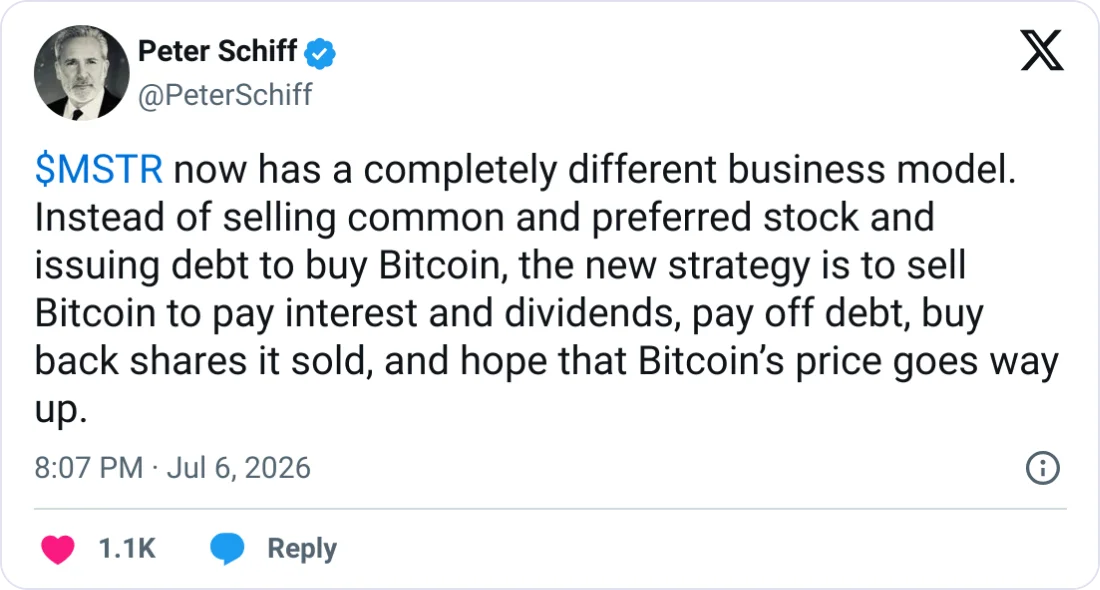
Strategy’s transaction placed its capital structure in focus because the sale was tied to recurring preferred-stock obligations rather than a stated reduction in long-term Bitcoin exposure. The company’s prior identity was centered on holding and expanding a Bitcoin treasury, while the July 5 sale showed that preferred equity obligations can require liquidity even for a company that remains a dominant corporate Bitcoin holder.
Lee Links Ethereum Thesis to Regulation and Use Cases
Tom Lee connected BitMine’s Ethereum accumulation thesis to expectations around the Clarity Act. “Over the past few days, investors have become more optimistic about the passage of the Clarity Act with prediction markets now seeing approximately 50% probability, the highest odds in two weeks,” Lee said. Prediction-market odds for passage this year were also reported around 48% on Monday morning, up 4% over the previous week and down from a February high of about 82%.
Lee said regulatory clarity could support smart contract platforms such as Ethereum. “We believe regulatory clarity is an important milestone, enabling crypto, particularly smart contract platforms like Ethereum, to benefit, as crypto becomes part of our everyday life,” Lee said. The Clarity Act was described as potentially recognizing ETH as a legal digital commodity under the CFTC umbrella and reducing lingering SEC-related uncertainty around Ethereum.
Lee also pointed to Ethereum’s role in payment infrastructure and layer-two networks. Ethereum already processes USDC stablecoin transactions for payment giants such as Visa and Shopify, according to the provided details. ETH also began gaining ground against Bitcoin as the ETH/BTC ratio moved sharply higher, a move Lee linked to investor expectations for clearer use cases.
“While there remains widespread skepticism around $ETH, the rise in the ratio of ETH/BTC signals investors are anticipating improving visibility of ‘use cases’ for crypto. This is a good thing,” Lee wrote. The comment positioned Ethereum’s relative strength against Bitcoin as part of BitMine’s broader argument for holding ETH as a productive treasury asset.
BitMine’s strategy still carries major mark-to-market pressure. The company reportedly bought ETH throughout the year at an average price above $3,300. Its unrealized paper loss was reported as breaking through the $9 billion to $10 billion range, even as the company remained locked into its position because it has no debt and uses staking cash flow for dividends and operating expenses.
The July 6 developments showed two different public crypto treasury models moving at the same time. BitMine is still accumulating Ethereum toward a defined supply target while building staking revenue. Strategy is still the largest corporate Bitcoin holder, but it sold Bitcoin to meet preferred-share dividend obligations, adding a liquidity-management dimension to its treasury model.
On-Chain Data Points to Fresh ETH Purchase
BitMine may have added another large Ethereum purchase after its latest weekly disclosure, though the company has not officially confirmed the transaction.
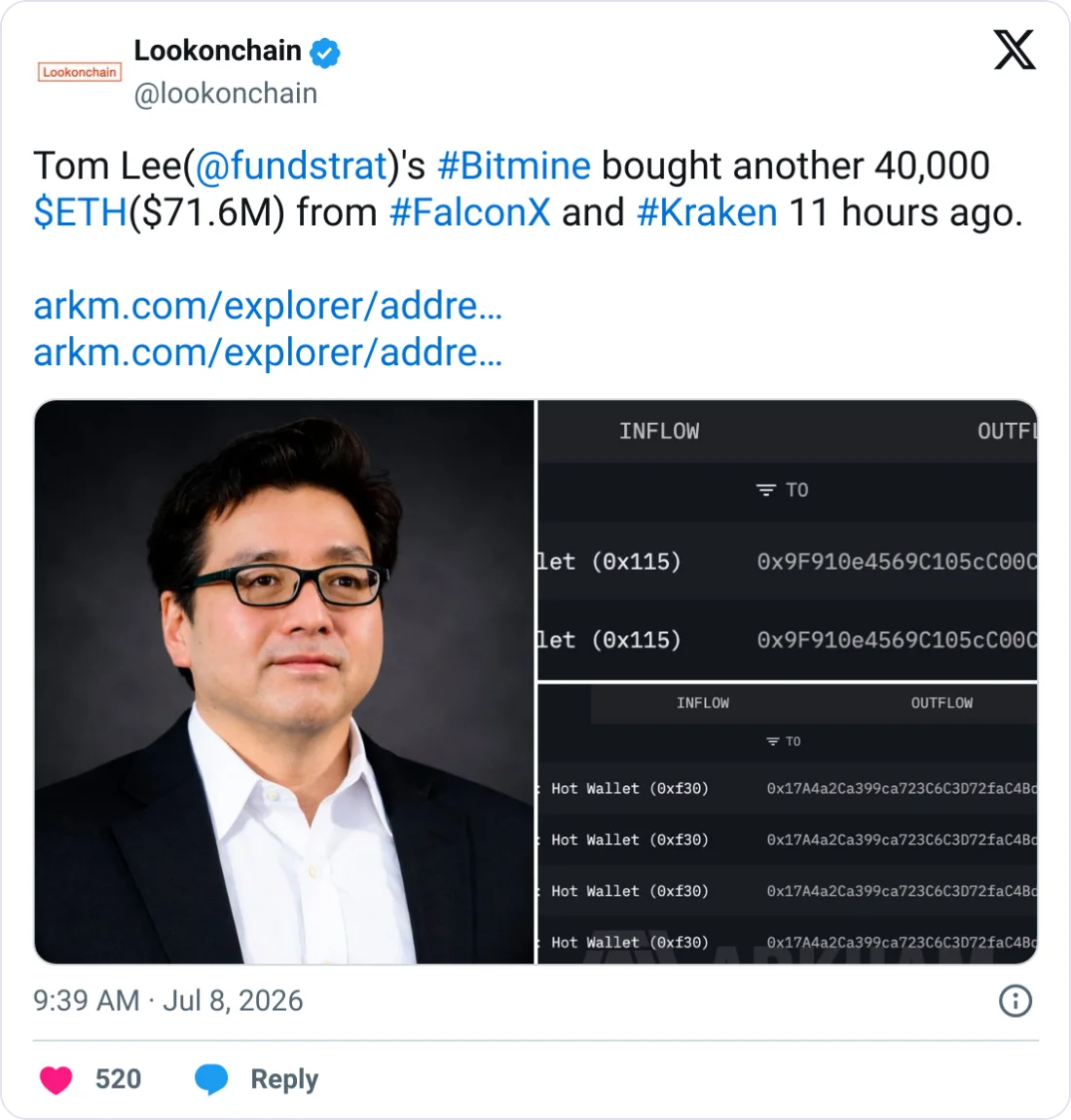
Blockchain analytics platform Lookonchain said BitMine acquired 40,000 ETH on Tuesday, worth about $70 million, across two wallet addresses. Arkham Intelligence data cited by Lookonchain showed the funds were transferred from hot wallets linked to FalconX and Kraken.
FAQ
Why did BitMine buy more Ethereum?
BitMine is pursuing its “Alchemy 5%” goal of owning 5% of Ethereum’s supply.
Why did Strategy sell Bitcoin?
Strategy sold Bitcoin to fund dividends tied to several preferred-share classes.
Who is leading BitMine’s Ethereum strategy?
Tom Lee, BitMine’s chairman, is the named executive tied to the strategy.
What is MAVAN?
MAVAN is BitMine’s Made in America Validator Network for staking Ethereum.
This article has been refined and enhanced by ChatGPT.


