




 USD
USDCircle Acquires IBM Blockchain Patents, Becomes Largest U.S. Holder


The USDC issuer adds enterprise, payments and infrastructure technology to its intellectual-property portfolio
TL;DR
- Circle acquired foundational assets from IBM’s blockchain patent portfolio on July 27, 2026.
- The transaction covers more than 680 patent families and nearly 1,000 issued patents worldwide.
- Circle said the portfolio will support USDC, Circle Payments Network, Arc and other onchain financial products.
Trade smarter on Jupiter, Solana’s leading DEX built for fast execution and deep liquidity.
Swap tokens at competitive rates, route across multiple liquidity sources automatically, and access perpetuals, DCA, and advanced trading tools — all in one place!
Circle acquired foundational assets from IBM’s blockchain patent portfolio on July 27, 2026, taking control of more than 680 patent families and nearly 1,000 issued patents worldwide and becoming the largest blockchain patent holder in the United States.
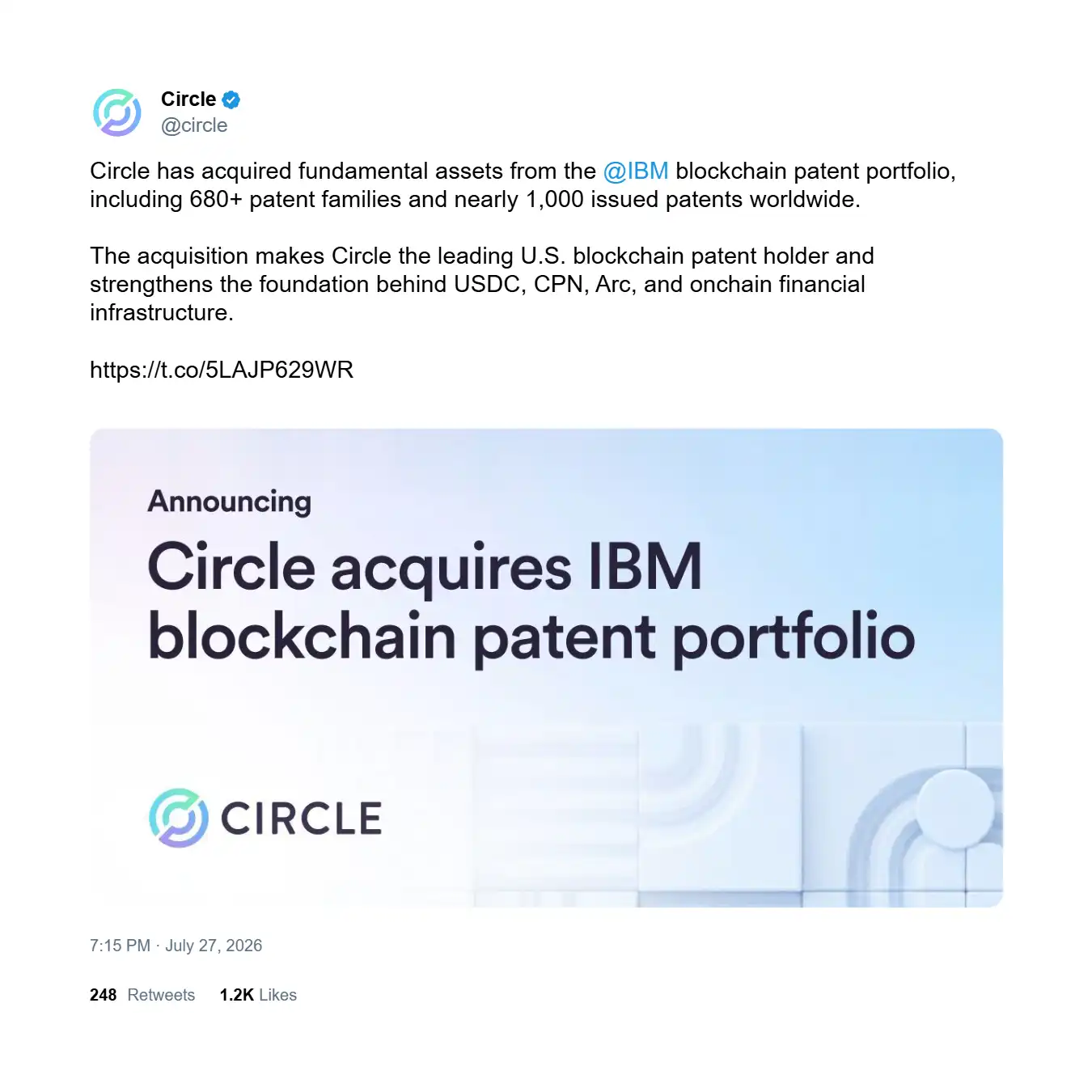
The acquired intellectual property spans foundational blockchain technology, banking, financial services, insurance, enterprise infrastructure, supply-chain verification and secure cloud operations. The portfolio also covers blockchain transaction processing and technologies that can be used in onchain payment, settlement and agentic financial systems.
Circle said the acquisition will support its effort to build an internet financial system around USDC, Circle Payments Network, Arc and a growing collection of onchain products and agentic financial tools. Agentic financial tools were identified as artificial intelligence-powered systems capable of independently initiating or completing certain financial actions without requiring a person to authorize every operational step.
“The portfolio comprises over 680 patent families and nearly 1,000 issued patents worldwide, spanning foundational blockchain technology, banking, financial services, insurance, enterprise infrastructure, supply chain verification, and secure cloud operations,” Circle said.
The portfolio was also characterized as containing over 1,000 patents. Circle’s own announcement used the narrower formulation of nearly 1,000 issued patents worldwide. Patent families group related applications covering the same or connected inventions in different jurisdictions, while the issued-patent figure counts individual patents.
Acquisition reshapes Circle’s patent position
The transaction moves Circle from a limited historical patent position to the top of the U.S. blockchain patent rankings. Circle received its first patent in December 2023 for a method involving parallel blockchain data processing, which allows multiple groups of blockchain data or transactions to be processed or verified simultaneously.
IBM previously held the leading domestic position. Patent analytics data showed that IBM controlled 790 U.S. blockchain patents as of December 2025, compared with approximately 200 held by Bank of America.
IBM ranked among the leading recipients of blockchain patents during 2019 after a multiyear push into distributed-ledger technology. The company publicly declared that blockchain was “open for business” in 2016, reflecting the enterprise focus behind the portfolio later acquired by Circle.
IBM’s blockchain patent filings declined in subsequent years as the company shifted toward patents regarded as higher quality and more commercially monetizable rather than maintaining the earlier filing volume.
Patents give their owners legal control over protected inventions, including the ability to determine whether another party may use the technology and under what licensing conditions. Circle joined the LOT Network before the IBM transaction, placing the company in a patent-protection coalition intended to shield members from litigation initiated by patent assertion entities, commonly known as patent trolls.
“Intellectual property is critical to advancing our mission and expanding adoption of onchain infrastructure,” said Sarah Wilson, General Counsel and Corporate Secretary at Circle.
“IBM has been a pioneer in technological innovation, and this acquisition expands Circle’s ability to advance the infrastructure that powers global, internet-native finance,” Wilson added.
Circle said the enlarged intellectual-property position will directly support its core infrastructure. USDC is the company’s dollar-backed stablecoin used for payments, savings, trading, settlement and international transfers. Circle Payments Network is intended to connect financial institutions, payment providers and other participants moving regulated digital money.
Arc is Circle’s payment-focused blockchain for institutional financial activity involving stablecoins and tokenized assets. Circle said the portfolio will also support future onchain products beyond the company’s existing stablecoin and payment operations.
“The expanded IP position directly supports Circle’s foundation for building the internet financial system, including USDC, Circle Payments Network, Arc, and a growing suite of onchain products and agentic financial tools,” Circle said.
Circle and IBM did not disclose the financial terms of the transaction. The companies said they plan to explore additional commercial opportunities after the patent transfer.
We’ve launched the all-new COIN360 Perp DEX, built for traders who move fast!
Trade 130+ assets with up to 100× leverage, enjoy instant order placement and low-slippage swaps, and earn USDC passive yield while climbing the leaderboard. Your trades deserve more than speed — they deserve mastery.
IBM retains ties to a competing stablecoin initiative
IBM remains a confirmed participant in Open Standard, the consortium behind Open USD, despite transferring the blockchain patent estate to Circle.
Open USD launched on June 30, 2026, with more than 140 participating backers. Named participants include Visa, Mastercard, Google, BlackRock, Stripe, Coinbase and IBM.
Open USD is structured to distribute reserve-generated income to participating distributors rather than retaining all reserve revenue at the issuer level. The structure is designed to give wallets, exchanges, payment companies and other distribution partners an economic incentive to support the stablecoin.
The model competes with the reserve-income structure used in Circle’s stablecoin business, where interest can be earned from the cash and short-term assets backing tokens in circulation. IBM’s participation in Open Standard and its sale of blockchain patents to Circle represent separate commercial arrangements.
Circle shares, which trade under the ticker CRCL, rose 2.57% on the day of the announcement. The acquisition gives the company control of a large collection of enterprise blockchain inventions developed during IBM’s mid-2010s expansion into distributed-ledger technology.
This article has been refined and enhanced by ChatGPT.


