




 USD
USDMovement Labs Files for Chapter 11 After MOVE Token Crisis


Bankruptcy filing follows market-making controversy, leadership upheaval and weak blockchain activity
TL;DR
- Movement Labs sought Chapter 11 protection after its assets fell far below its outstanding liabilities.
- The filing followed a disputed MOVE market-making arrangement, an exchange ban and the departure of co-founder Rushi Manche.
- Despite substantial fundraising, the Movement blockchain generated minimal fees, application revenue and sustained developer growth.
Trade smarter on Jupiter, Solana’s leading DEX built for fast execution and deep liquidity.
Swap tokens at competitive rates, route across multiple liquidity sources automatically, and access perpetuals, DCA, and advanced trading tools — all in one place!
Movement Labs, the developer behind the Movement blockchain, filed for Chapter 11 bankruptcy protection after months of token-market controversy, governance disruption and limited network adoption left the company with substantially more liabilities than remaining assets.
The company sought protection in the U.S. Bankruptcy Court for the District of Delaware on July 15, 2026. The filing listed fewer than 1,000 creditors and estimated Movement Labs’ assets at $100,000 to $500,000, compared with liabilities exceeding $1 million and potentially reaching the filing category of up to $10 million.
Named creditors included Movement Labs co-founder Rushi Manche, the Delaware Division of Revenue and Anchorage Digital. The available information did not disclose how much the company owed to each creditor.
Funding failed to produce a self-sustaining network
Movement Labs had raised an estimated $41.4 million, but the capital did not produce enough developer participation, decentralized application growth or user activity to establish a sustainable blockchain economy.
GitHub commits and contributor growth showed little sustained acceleration during the project’s development. Grants and incentives generated only modest adoption among users and decentralized applications, while development activity slowed rather than expanding at a pace that could support the network independently.
The available figures indicate that fundraising primarily extended Movement Labs’ operating runway instead of creating recurring on-chain demand. The project remained reliant on external capital while its applications and blockchain infrastructure produced limited revenue.
Daily application revenue remained below $800 from November onward. Chain fees later fell to $1 during a measured 24-hour period, indicating that users were interacting with the network too infrequently to produce meaningful transaction-based income.
MOVE’s fully diluted valuation declined by more than 99% to approximately $107 million as confidence in the ecosystem weakened. The valuation decline coincided with low blockchain usage, limited developer growth and continued concerns surrounding the token’s launch and market-making structure.
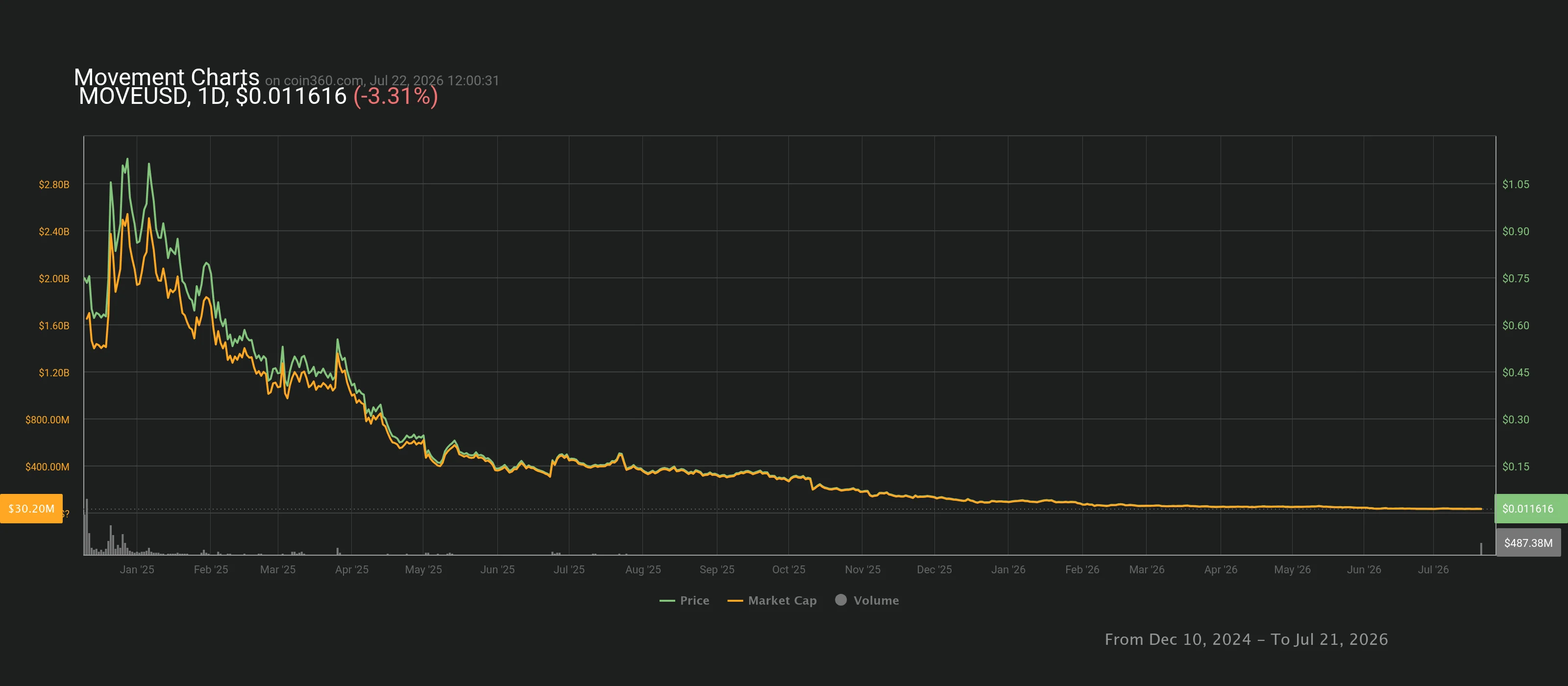
Movement was built as an Ethereum layer-2 network using the Move programming language, which was originally developed at Meta. The project aimed to bring Move-based smart contracts to Ethereum while providing faster and cheaper transactions through a separate scaling network.
The blockchain entered a crowded market for Ethereum scaling networks, but its technical design did not translate into enough recurring usage to support its development company.
We’ve launched the all-new COIN360 Perp DEX, built for traders who move fast!
Trade 130+ assets with up to 100× leverage, enjoy instant order placement and low-slippage swaps, and earn USDC passive yield while climbing the leaderboard. Your trades deserve more than speed — they deserve mastery.
MOVE launch controversy weakened confidence
The project’s most visible crisis followed the December launch of the MOVE token, when questions emerged about a market-making agreement that gave one counterparty broad influence over the token’s circulating supply.
An investigation published in April 2025 said Movement was examining whether it had been misled into entering the agreement. Internal documents showed that the arrangement allowed 66 million MOVE tokens to be sold only one day after the token debuted.
The token sales contributed to a sharp market decline and prompted scrutiny of Movement’s controls over token distribution, market-maker supervision and the protection of holders during the launch.
Rentech, a little-known intermediary, appeared in contracts connected to Chinese market maker Web3Port. Movement executives later questioned whether the foundation entered the arrangement believing Rentech was affiliated with Web3Port.
Rentech denied wrongdoing and denied misrepresenting itself. The available information therefore does not establish that Movement was definitively deceived, and the dispute remained unresolved.
Binance later banned the market-making account connected to the MOVE launch for misconduct. Movement responded by launching a token buyback program and hiring outside firm Groom Lake to review the events surrounding the market-making agreement and token debut.
Those measures did not prevent further disruption. Movement Labs and Rushi Manche separated in May 2025, creating additional uncertainty over leadership, accountability and the project’s future direction.
Manche’s later inclusion among the company’s named creditors showed that financial ties remained between the bankrupt entity and its former co-founder after their separation.
Separate entity pursued a payments strategy
Move Industries announced a strategic shift in June 2026 toward cross-border payments, remittances and stablecoin settlement rather than competing primarily as an Ethereum scaling network.
Move Industries is a separate legal entity from MVMT Labs, the entity that filed for bankruptcy. The distinction is central to the story because the payments strategy was not announced by the bankrupt company.
Move Industries said it had secured access to licensed payment infrastructure in the United States, Canada and the European Union. The company planned to target emerging markets through remittance, stablecoin transfer and cross-border settlement services.
The strategy represented an effort to pursue a more commercially focused use case, but it did not reverse the financial deterioration already accumulated by MVMT Labs.
Movement Labs’ bankruptcy followed several overlapping problems rather than one confirmed cause. The disputed token arrangement weakened market confidence, while low application revenue, minimal chain fees, limited developer growth and continued dependence on external capital left the company without a sustainable operating base.
FAQ
Did every Movement-related company file for bankruptcy?
No. MVMT Labs filed, while Move Industries was identified as a separate legal entity.
Was Rentech found responsible for wrongdoing?
No definitive finding was provided. Rentech denied wrongdoing and denied misrepresenting itself.
Did the fundraising create sustained network growth?
No. Developer activity, application adoption, revenue and fees remained limited.
What happens to the Movement blockchain?
The available information does not state how the bankruptcy will affect the network’s future operations.
This article has been refined and enhanced by ChatGPT.


