




 USD
USDRobinhood Chain Reaches Top Five in First Week


Bernstein says early activity supports Robinhood’s tokenized-asset expansion
TL;DR
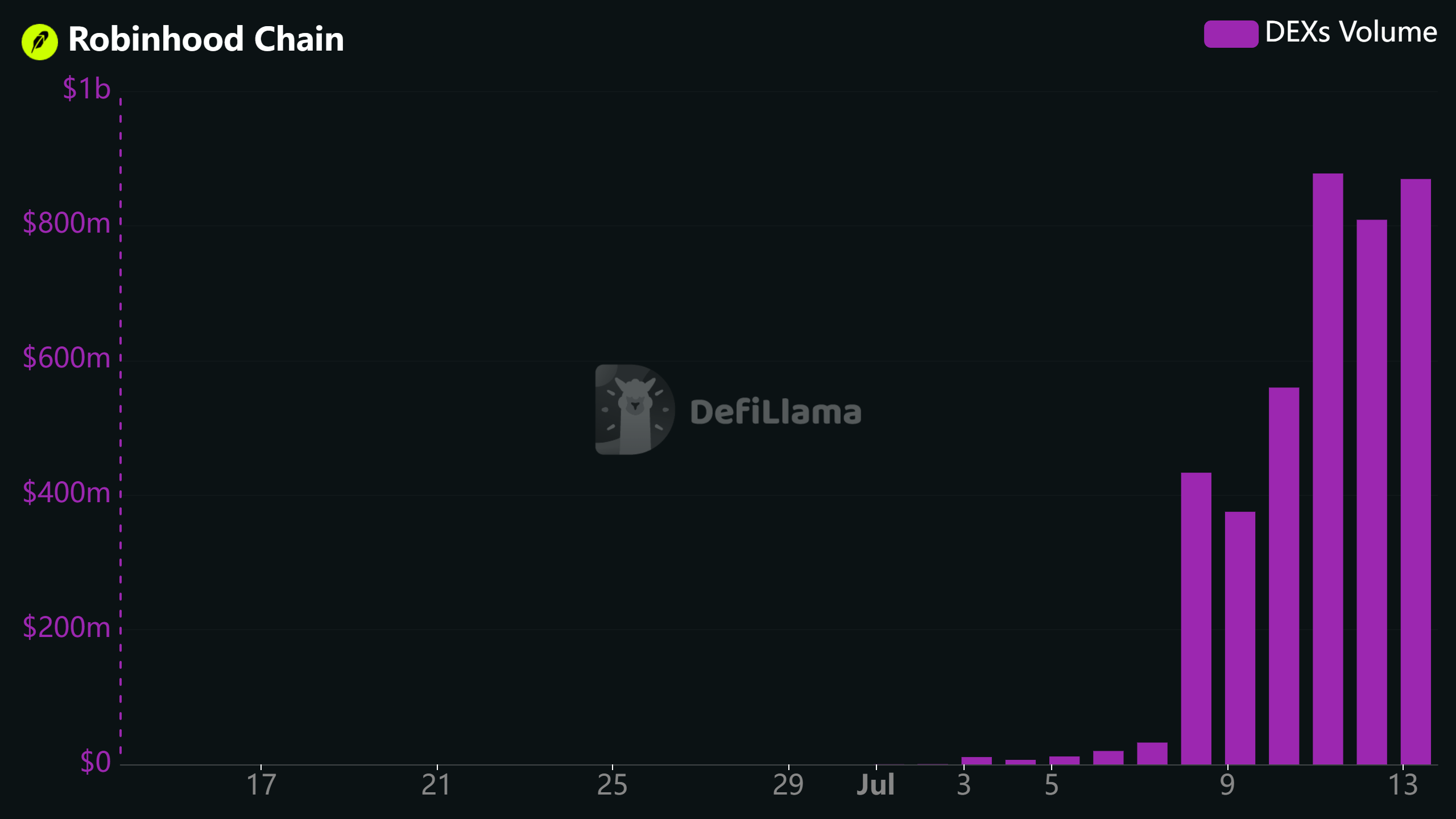
- Robinhood Chain generated about $3.1 billion in decentralized exchange volume during its first seven days.
- More than 65,000 users held assets on the network, including stablecoins and tokenized stocks.
- Bernstein said meme-coin trading drove the initial surge, while Robinhood is building toward equities, lending and perpetual futures.
Trade smarter on Jupiter, Solana’s leading DEX built for fast execution and deep liquidity.
Swap tokens at competitive rates, route across multiple liquidity sources automatically, and access perpetuals, DCA, and advanced trading tools — all in one place!
Robinhood Chain became one of the five largest blockchains by weekly decentralized exchange volume shortly after its public launch, generating approximately $3.1 billion during its first seven days of operation, according to Bernstein analysts led by Gautam Chhugani. The Ethereum Layer 2 network opened to the public on July 1, 2026, as Robinhood expanded from offering crypto trading through its brokerage platform into operating blockchain infrastructure for tokenized financial assets and decentralized finance.
Robinhood Chain was built using Arbitrum technology and is designed for financial services, tokenized real-world assets and decentralized finance applications. The network is permissionless for outside developers, allowing third parties to build products rather than limiting activity to services operated directly by Robinhood.
Bernstein said the launch supports Robinhood’s strategy of connecting tokenized equities and other real-world assets with decentralized exchanges, lending markets, liquidity providers and onchain collateral systems.
“Strong early adoption highlights the growing convergence of tokenized real world assets with the broader DeFi ecosystem, as industry participants continue to innovate across multiple business models for regulated asset tokenization,” Bernstein analysts led by Gautam Chhugani wrote.
Trading activity and network balances
More than 65,000 users held assets on Robinhood Chain after the launch. Their disclosed holdings included stablecoins and tokenized stocks, while additional balances tied to meme coins, derivatives collateral, lending deposits and other assets were not specified.
Bernstein said meme-coin speculation accounted for most of Robinhood Chain’s initial trading activity before broader liquidity arrived from crypto-native market participants. The composition means the network’s early volume was not driven primarily by tokenized equities or regulated real-world assets, despite those products forming the core of Robinhood’s longer-term blockchain strategy.
Tokenized stocks gain onchain functions
Robinhood plans to move the network progressively toward equities, commodities and perpetual futures, supported by tokenized assets and liquidity connected to Bitstamp. The product structure combines tokenized stocks, decentralized lending and derivatives within one onchain environment.
Robinhood’s stock tokens allow eligible users to trade outside conventional stock-market hours and hold the assets through compatible self-custody wallets. The tokens can also be used as collateral and deposited into lending pools that generate yield, extending their purpose beyond tracking the market value of an underlying security.
The stock tokens are offered in more than 120 countries but are not available in the United States. Before the blockchain’s public expansion, Robinhood primarily offered the products to users in the European Union, with more limited utility beyond price exposure.
If the disclosed tokenized-stock balance were distributed evenly across the represented assets, the average would be approximately $144,000 per stock, although the available information did not provide individual asset balances and did not indicate that the holdings were evenly allocated.
Robinhood’s structure uses a custodial or sponsor-backed model. A sponsor buys the underlying shares, holds them in a secured account and issues blockchain tokens backed by those holdings. The token provides economic exposure to the security but does not necessarily place the holder directly on the issuing company’s shareholder register.
Ondo Finance introduced a different tokenization structure during the same week. Ondo said its third-party tokenized securities complied with existing U.S. regulations and used a registered transfer agent to mint tokens and pass shareholder rights to holders. Ondo tokenized one exchange-traded fund and one individual stock to demonstrate the model.
We’ve launched the all-new COIN360 Perp DEX, built for traders who move fast!
Trade 130+ assets with up to 100× leverage, enjoy instant order placement and low-slippage swaps, and earn USDC passive yield while climbing the leaderboard. Your trades deserve more than speed — they deserve mastery.
Lending, derivatives and infrastructure partners
Robinhood partnered with Morpho to offer decentralized lending through its primary application. Eligible U.S. users can lend USDG, a U.S. dollar-backed stablecoin, and earn up to 7% annual percentage yield without using a separate DeFi interface.
The USDG lending product is available to eligible users in the United States even though Robinhood’s tokenized stocks are unavailable there, reflecting different geographic restrictions across the company’s blockchain-linked offerings.
Perpetual futures operate through Lighter, which committed $11 million worth of LIT tokens as incentives for Robinhood users trading the contracts. Those rewards could support early liquidity and trading volume, although the available information did not quantify how much activity was attributable to incentives.
Robinhood Chain has integrations with Uniswap, Morpho, Lighter, Chainlink and BitGo. Uniswap provides decentralized exchange infrastructure, Morpho supports lending markets, Lighter handles perpetual futures, Chainlink supplies data and oracle services, and BitGo contributes custody and institutional digital-asset infrastructure.
Bernstein identified those integrations as important to the network’s liquidity and the utility of tokenized assets. The infrastructure allows supported securities to trade on decentralized venues, interact with lending markets, rely on external pricing data and move through custody and collateral systems.
Tokenized real-world assets outpace the broader market
Tokenized real-world assets grew while the wider cryptocurrency market declined during 2026. Private credit and tokenized U.S. Treasurys accounted for most of the sector, while tokenized equities remained smaller but expanded more quickly.
Robinhood Chain therefore entered a growing market that remained heavily concentrated on established networks and in credit-related assets. Its early decentralized exchange ranking did not establish a comparable position in the value of tokenized assets issued or held onchain.
Robinhood’s brokerage distribution gives the company a direct channel for introducing blockchain products to existing retail users. Operating its own network also gives Robinhood more control over product design, settlement flows, custody connections and integrations than relying entirely on third-party chains.
The strategy combines consumer distribution, brokerage-linked assets and decentralized finance infrastructure. Potential activity spans trading, custody, lending, derivatives and blockchain-based settlement, although the available information did not disclose the revenue generated by the network or its applications.
Several operational questions remain unresolved. The information did not show whether tokenized equities can maintain liquidity outside conventional trading hours, how custodial reserves and redemptions would perform during market stress, or how dependent the products are on external pricing oracles and legal claims against underlying assets.
Bernstein maintains bullish Robinhood rating
Bernstein maintained an Outperform rating on Robinhood shares and set a $130 price target.
Robinhood Chain’s opening period showed that the company could attract substantial decentralized trading volume and stablecoin liquidity quickly. Bernstein’s data also showed that speculative tokens, rather than tokenized stocks, supplied most of the initial momentum, leaving the network’s longer-term adoption of equities, commodities, lending and regulated financial assets unresolved.
FAQ
Is Robinhood Chain an Ethereum Layer 2?
Yes. It was built using Arbitrum technology and settles within the Ethereum ecosystem.
Can U.S. users buy Robinhood’s tokenized stocks?
No. The stock tokens are available internationally but are not offered in the United States.
What drove Robinhood Chain’s early trading activity?
Bernstein said meme-coin speculation generated most of the network’s initial decentralized exchange volume.
Which applications are connected to Robinhood Chain?
The disclosed integrations include Uniswap, Morpho, Lighter, Chainlink and BitGo.
This article has been refined and enhanced by ChatGPT.


