




 USD
USDWhite House Pushback Deepens Senate CLARITY Act Ethics Standoff

Enforcement, consumer protections and an August deadline remain unresolved
TL;DR
- The Senate’s integrated CLARITY Act draft advanced, but Democrats said its ethics, consumer-protection and illicit-finance provisions remained inadequate.
- The White House rejected demands for state enforcement and restrictions addressing Trump’s past crypto activity.
- Industry executives warned that the ethics fight could derail broader rules for exchanges, intermediaries, decentralized finance and financial crime.
Trade smarter on Jupiter, Solana’s leading DEX built for fast execution and deep liquidity.
Swap tokens at competitive rates, route across multiple liquidity sources automatically, and access perpetuals, DCA, and advanced trading tools — all in one place!
The Senate’s latest Digital Asset Market Clarity Act draft moved the crypto market-structure bill closer to a potential floor vote, but lawmakers remained divided over government ethics, enforcement authority and other provisions after the integrated text was released on July 22, 2026.
The legislation combined work previously approved by the Senate Banking and Agriculture Committees with input from the Judiciary, Ethics and Intelligence Committees. The draft was expected to span hundreds of pages and included dozens of pages of additional language addressing consumer protection, investor safety, illicit finance, market integrity and conflicts of interest.
Senator Cynthia Lummis, a Wyoming Republican and one of the bill’s lead negotiators, said the publication did not end negotiations. Government ethics and parts of the illicit-finance framework were expected to remain under discussion after the text became public.
“It’s time to show everyone the fully integrated bill that we will be voting on, and get the feedback from the industry that’s about to be regulated, as well as others,” Lummis said. “So I’m pleased we’ve reached this point.”
Temporary ethics rules draw Democratic objections
The central dispute involved restrictions on crypto activity by the president, federal lawmakers, their spouses and senior federal judges. The proposed framework would cover judges serving on U.S. district courts, federal appeals courts, the U.S. Supreme Court and the U.S. Court of International Trade.
The restrictions were scheduled to expire in 2029 unless Congress renewed or replaced them. Regulators would receive one year after enactment to implement the rules, leaving unresolved when they would take effect and how they would apply to President Donald Trump’s crypto businesses.
Trump’s disclosed interests included an ownership stake in World Liberty Financial, involvement with a stablecoin issuer and ties to a company issuing a memecoin bearing his name. The draft did not establish precisely whether those businesses would have to be restructured, divested or otherwise restricted.
Trump’s latest financial disclosure showed that he earned more than $1.4 billion from crypto ventures in 2025. That disclosure intensified Democratic demands for enforceable restrictions on federal officials profiting from the digital-asset industry while participating in policy decisions affecting it.
Republican senators met with Trump during the week before the draft’s publication and reached an agreement on ethics language by Monday, July 20. A White House official said Trump had “agreed to the most comprehensive and wide-ranging ethics provision in history.”
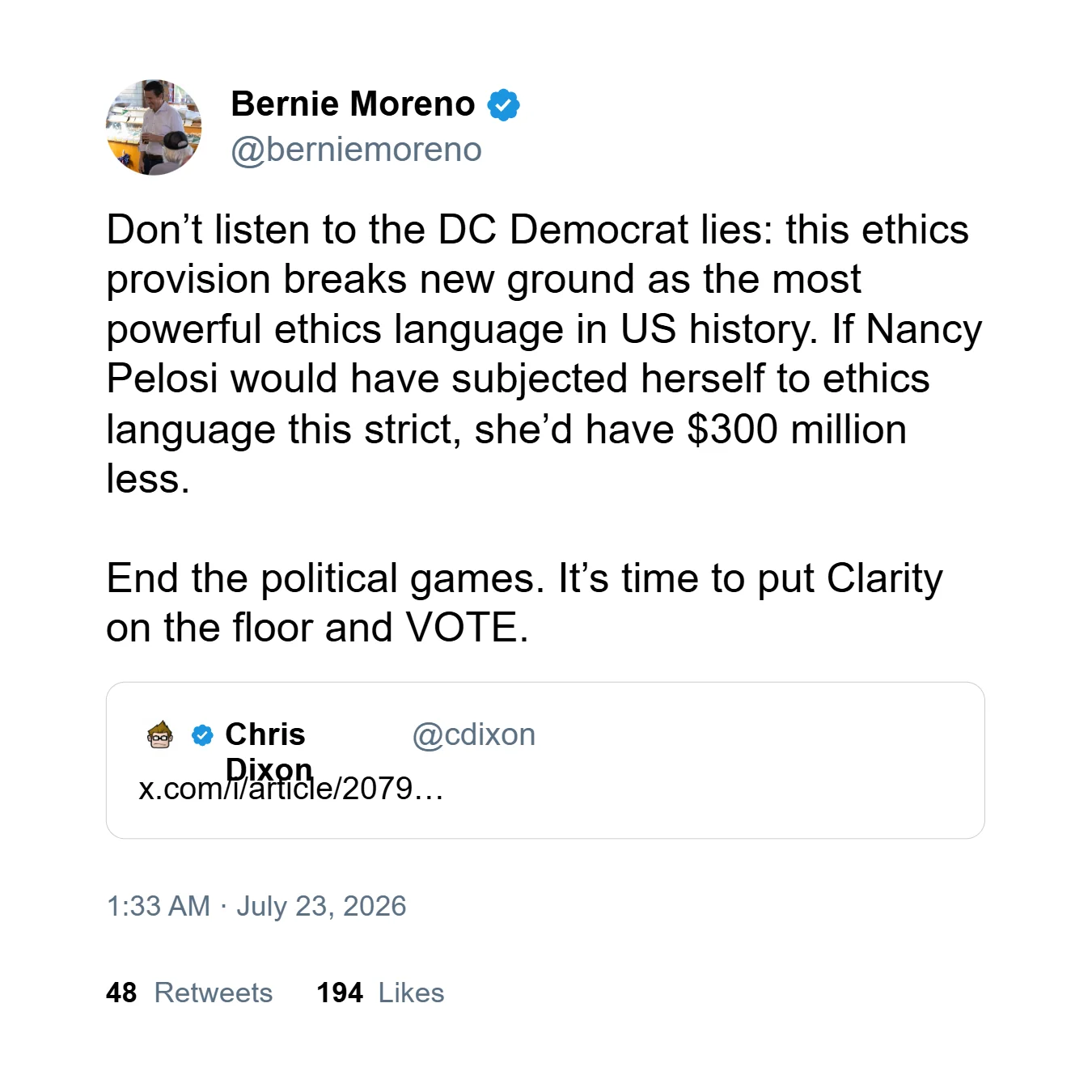
Senator Bernie Moreno, one of the lead Republican negotiators, called the proposal “the most powerful ethics language in U.S. history” in a post on X. He added, “Don’t listen to the DC Democrat lies.”
The proposed enforcement framework would place the U.S. Department of Justice in the primary role of policing violations. Democrats questioned whether an executive-branch department could credibly enforce restrictions involving a sitting president or administration officials.
Senator Angela Alsobrooks, one of only two Democrats who supported the legislation during committee consideration, rejected that structure before the text was released.
“This DOJ enforcing an ethics provision? That’s an unserious offer, and I wouldn’t support the bill if that’s the language,” Alsobrooks said. “But we’ll keep working from that floor to reach an agreement that holds us all accountable.”
Senator Elizabeth Warren, the top Democrat on the Senate Banking Committee, said the proposal would allow Trump to continue much of his crypto business activity, depend on a Justice Department loyal to him to ignore improper conduct and potentially shield that conduct from prosecution after he left office.
A separate fight centered on whether state attorneys general should be able to bring criminal proceedings or private civil cases directly against officials covered by the ethics rules. Lummis said Republican and Democratic negotiators had discussed that question “for weeks on end” without reaching an agreement.
“That was a bright red line for a lot of U.S. senators who did not want to subject themselves to being sued by a different state attorney general,” Lummis said.
Lummis said the same objection applied to the White House because the administration had faced multiple lawsuits and prosecutions initiated by state attorneys general. Republican senators and the administration opposed allowing state officials to bring cases directly against covered federal officials.
The draft instead would permit state authorities to sue crypto exchanges that listed assets whose issuance or trading violated the ethics restrictions. That structure would allow action against market intermediaries without exposing the president, lawmakers, judges or spouses to direct state litigation.
Democrats had not accepted the exchange-focused mechanism as an adequate substitute for direct enforcement. Negotiations over the ethics provision were expected to continue through the weekend following the draft’s release.
Seven Democrats say the proposal falls short
Seven Democratic senators considered important to the bill’s prospects issued a joint statement criticizing the Republican text. The group consisted of Angela Alsobrooks, Cory Booker, Catherine Cortez Masto, Ruben Gallego, John Hickenlooper, Mark Warner and Raphael Warnock.
“The Republican-proposed text of the CLARITY Act as it currently stands falls short,” the senators said.
The group said provisions covering “ethics for elected officials, consumer protection, illicit finance, conflicts of interest and market integrity must be strengthened.”
Their objections extended beyond Trump-related ethics and included safeguards for consumers, financial-crime controls and the integrity of digital-asset markets. The senators nevertheless said they would remain involved in bipartisan negotiations.
“We have been working in good faith with our Republican colleagues for the past year and will continue doing so to get this over the finish line,” they said.
Alsobrooks and Gallego were the only Democrats in the group who voted for the CLARITY Act during committee consideration. Several others had previously expressed support for advancing a broader crypto market-structure framework.
Lummis thanked Democrats for contributing to the integrated text and reiterated “my commitment to reaching a deal in the coming days that will allow this legislation to become law.”
Senate Democrats remained divided over the bill. Warren and other opponents had consistently resisted the legislation, while a separate group continued negotiating with Republicans and remained open to supporting a revised version.
Restrictions on federal officials’ crypto involvement had become a shared Democratic demand even as members disagreed over the broader legislation. Several Senate Democrats also held a press conference during the week before publication to warn about the crypto industry’s growing political influence in Washington.
The ethics dispute had surfaced earlier during Senate work in 2025 on the stablecoin-focused Guiding and Establishing National Innovation for U.S. Stablecoins Act, known as the GENIUS Act. Trump’s disclosed crypto income later increased pressure to include enforceable restrictions in the market-structure bill.
Illicit-finance language remains under negotiation
Financial-crime provisions were also expected to remain open through the weekend, although Lummis said Republicans believed the draft had reached “a good place” on the issue.
The legislation addressed the Bank Secrecy Act, anti-money-laundering safeguards, sanctions compliance for centralized exchanges and sanctions or illicit-finance risks involving decentralized finance.
Some provisions were added at the request of law-enforcement agencies. Those additions included language addressing fraud conducted through cryptocurrency automated teller machines.
The draft also included a safe harbor allowing crypto platforms to freeze funds when they suspected assets were connected to suspicious transactions, particularly when the platform was cooperating with law enforcement. The protection was intended to reduce legal exposure when a company temporarily restricted access to funds during an investigation.
Lummis said the broader purpose of the bill was to improve law-enforcement tools, establish consumer protections and prevent digital-asset activity from moving outside the United States.
“It’s time to land this plane,” Lummis said. “This is about helping law enforcement fight illicit finance, passing consumer protections and keeping these markets onshore in the U.S.”
We’ve launched the all-new COIN360 Perp DEX, built for traders who move fast!
Trade 130+ assets with up to 100× leverage, enjoy instant order placement and low-slippage swaps, and earn USDC passive yield while climbing the leaderboard. Your trades deserve more than speed — they deserve mastery.
Developer protections and registration rules remain intact
The bill preserved the Blockchain Regulatory Certainty Act, a key provision for decentralized-finance developers. Developers who did not control customer assets would not be treated as money transmitters solely because they created or maintained noncustodial blockchain software.
That protection would prevent noncustodial developers from automatically assuming the registration, licensing, monitoring and compliance obligations imposed on businesses that received, held or transmitted customer funds.
The draft also contained new language concerning federal preemption, provisional registration procedures and commodity pool operators. Legal and industry specialists were still assessing the consequences of those provisions after publication.
Federal preemption would determine how the federal framework interacted with state licensing and regulatory requirements. The draft’s complete statutory wording and final scope were not established in the available information.
Provisional registration procedures were intended to provide an interim pathway while federal agencies developed permanent rules. Full eligibility standards and deadlines for that provisional status remained unspecified.
Miller Whitehouse-Levine, CEO of the Solana Policy Institute, said the draft would provide “clear regulatory treatment for tokens and token fundraising” while creating a formal regulatory framework for crypto exchanges.
Whitehouse-Levine said the legislation would give financial institutions “the green light to use public blockchains” and direct federal agencies to develop a regulatory pathway for tokenized securities and futures markets operating onchain.
He said the establishment of “robust consumer and developer protections” was the bill’s most important contribution.
Digital Chamber CEO Cody Carbone called the publication “a meaningful step toward the Senate vote on the Clarity Act we’ve been calling for.”
“We’re encouraged, and we’re ready to keep working until the bill reaches the president’s desk,” Carbone said.
Banks challenge stablecoin yield provisions
Banking trade associations remained dissatisfied with the treatment of stablecoin yield products, a dispute separate from the fight over ethics and market structure.
The groups warned that the text “still puts at risk the local lending that drives economic activity in the U.S.”
Their concern was that stablecoin issuers, exchanges or affiliated platforms could offer yield-like rewards that drew deposits away from banks. The associations argued that lower deposits could reduce the funding banks used to support local lending, though no independent estimate of the potential impact was provided.
The banking groups also said they “appreciate [senators’] willingness to consider targeted changes,” indicating that they remained involved in the legislative process.
SEC and CFTC representation enters the debate
The draft included a “sense of Congress” provision stating that at least two commissioners at both the Securities and Exchange Commission and Commodity Futures Trading Commission should be nominated in consultation with the Senate minority party.
The language expressed Congress’ preferred approach but would not compel the president to nominate specific individuals.
Neither regulator had a Democratic commissioner at the time. The SEC was being run by three Republican commissioners, while the CFTC was operating with only one commissioner.
Lummis blamed the absence of Democratic nominees on Senate Minority Leader Chuck Schumer, saying he needed to submit names to the White House.
“The language in there is not to compel the president to do something,” Lummis said. “It’s basically to compel Senator Schumer to submit some names to the president.”
Senate calendar narrows the path to passage
The bill’s political prospects depended on winning substantial Democratic support. Most Senate legislation requires 60 votes to overcome procedural barriers, meaning Republicans could need backing from as many as 10 Democrats, depending on attendance and the final Republican vote count.
The seven Democrats who criticized the draft represented a potentially decisive group. Their willingness to continue negotiating kept a bipartisan agreement possible, but their statement showed the released text did not yet have sufficient support.
Senate Majority Leader John Thune’s office said he intended to move toward floor action in the coming days, although no vote date had been established.
Scheduling was complicated by expected absences the following week for Senator Lindsey Graham’s funeral, according to Lummis.
The Senate was scheduled to leave Washington after August 7 for its extended summer recess. From the publication date, lawmakers had 16 days, including weekends, to revise the text, secure commitments and find floor time.
Additional time could have been available in September, but lawmakers were expected to become increasingly focused on the November 2026 midterm elections. The Senate also had other legislative business competing for attention before the recess.
The integrated draft advanced the legislation by combining committee proposals, preserving noncustodial developer protections, adding law-enforcement provisions and publishing an ethics framework. Enforcement authority, the scope of restrictions on federal officials and the protections demanded by key Democrats remained unresolved.
White House rejects expanded ethics demands
The White House pushed back on July 22 as the ethics dispute narrowed around state enforcement and President Donald Trump’s previous crypto activity. Patrick Witt, a senior White House crypto adviser, argued that allowing state attorneys general to enforce the restrictions would depart from existing federal ethics laws.
“If you hold position (1), then you are basically saying that ALL current federal ethics laws are meaningless because none of them are enforceable by state AGs,” Witt said in a post on X.

The revised proposal would require covered officials to sell certain crypto holdings, place them in independently controlled blind trusts or combine both approaches. Sales exceeding $1,000 would require disclosure. Amanda Fischer, who works on financial policy at Better Markets, said the draft may leave income from trading fees and reserve assets tied to existing businesses untouched.
Crypto executives warned that the standoff could undermine the wider legislation. Miles Jennings, general counsel at Andreessen Horowitz’s crypto division, said failed negotiations could also eliminate proposed rules for exchanges, intermediaries and illicit finance. Coinbase Chief Policy Officer Faryar Shirzad urged compromise, while Ripple Chief Legal Officer Stuart Alderoty said, “Perfect can't be the enemy of good.”
This article has been refined and enhanced by ChatGPT.


