




 USD
USDStorj, BitMart and Poolin Join Broad Crypto Retrenchment

Bankruptcy filings and exchange closures spread across storage, trading and Bitcoin mining businesses
TL;DR
- Storj filed for Chapter 11 restructuring, while Poolin entered bankruptcy to sell its remaining mining assets.
- BitMart began an orderly shutdown, with trading scheduled to end before the platform closes permanently.
- Token prices fell sharply as customers, creditors and investors faced extended restructuring and withdrawal processes.
Storj Labs filed for Chapter 11 bankruptcy protection, BitMart began winding down its crypto exchange, and former Bitcoin mining pool giant Poolin moved to sell its remaining operating assets, extending a late-July contraction across several parts of the digital-asset industry. Storj plans to continue its decentralized-storage business during restructuring, BitMart intends to close its platform, and Poolin is pursuing asset sales to address obligations that include unpaid balances owed to thousands of wallet users.
The three developments involve different legal and operational outcomes. Storj and Poolin entered Chapter 11 proceedings, while BitMart announced a scheduled shutdown without a bankruptcy filing. Storj is seeking to reorganize around its core storage network, Poolin plans to liquidate its remaining mining infrastructure, and BitMart has shifted its platform into a withdrawal-focused wind-down.
Storj seeks to separate core network from legacy obligations
Storj Labs filed its voluntary petition in the U.S. Bankruptcy Court for the Northern District of West Virginia. Storj said the proceeding was intended to address legacy obligations tied to previous acquisitions and non-core operations rather than terminate its decentralized-storage business. The company expects its network, customer services and normal daily operations to continue during the restructuring, subject to bankruptcy-court approval.
Storj plans to use the proceeding to right-size its operations and reorganize its ownership structure. The proposed structure is intended to align the interests of management, the decentralized community, STORJ token holders, existing investors and potential new investors. Storj characterized the obligations behind the filing as remnants of an earlier period of the company rather than liabilities created by its current core storage operation.
Kaloyan Raev, Storj’s director of software engineering, said the bankruptcy represented a decisive step for the company. Raev said the underlying business was “strong and right-sized,” while obligations from an earlier chapter continued to restrain it. He said the process would allow Storj to resolve those obligations in an orderly manner and return the company to its decentralized roots.
Storj’s parent company, Inveniam, supported the restructuring and the company’s renewed focus on decentralized storage. Storj said Inveniam had backed that narrower direction since acquiring the business and viewed the reorganization as a path toward shared ownership involving management, community participants, token holders and prospective investors.
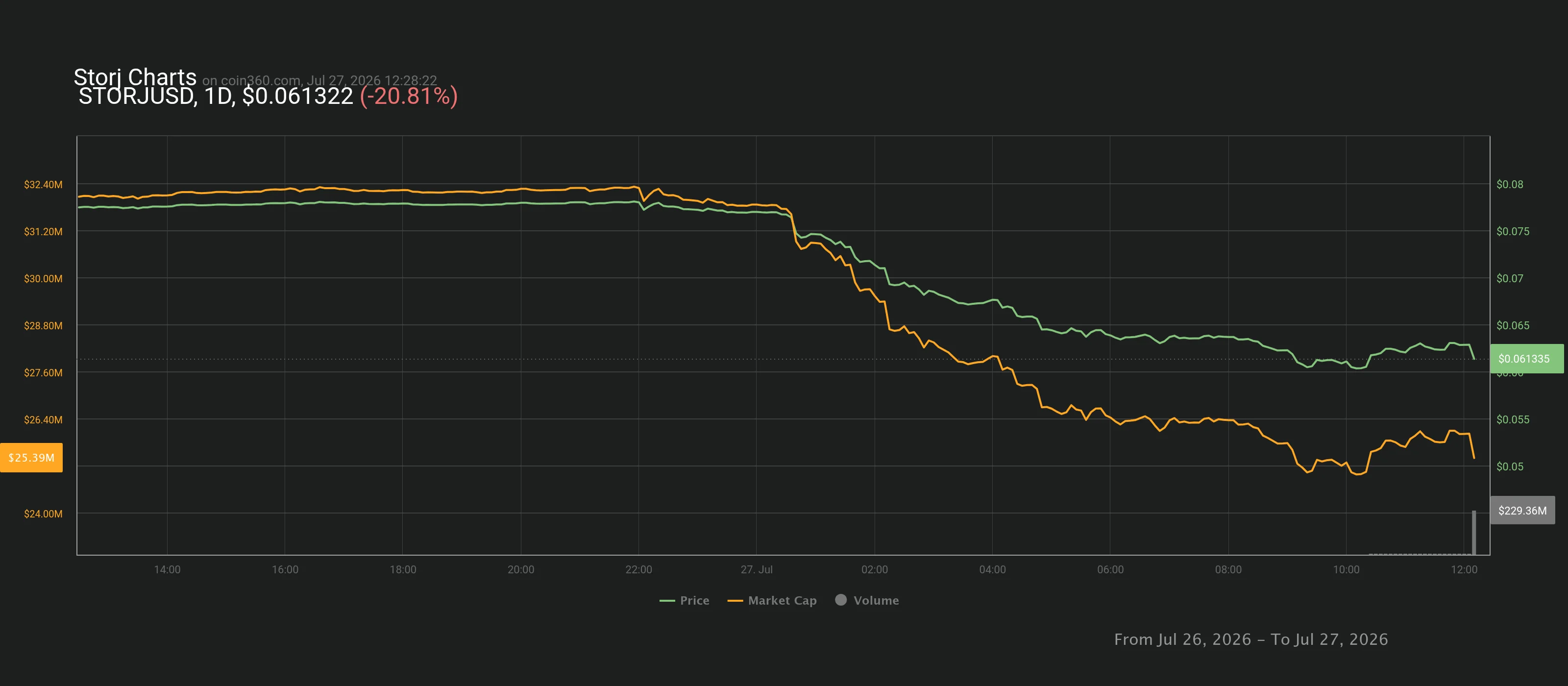
The STORJ price fell approximately 21% over 24 hours and traded at roughly $0.06 following the bankruptcy disclosure. The market move occurred despite Storj’s position that its core network and customer operations would continue during the court-supervised process.
BitMart begins six-month exchange shutdown
BitMart announced that it would wind down its trading platform after nine years of operation. The exchange said the decision followed “a careful evaluation of the Company’s operating conditions, market environment, and future strategic direction.”
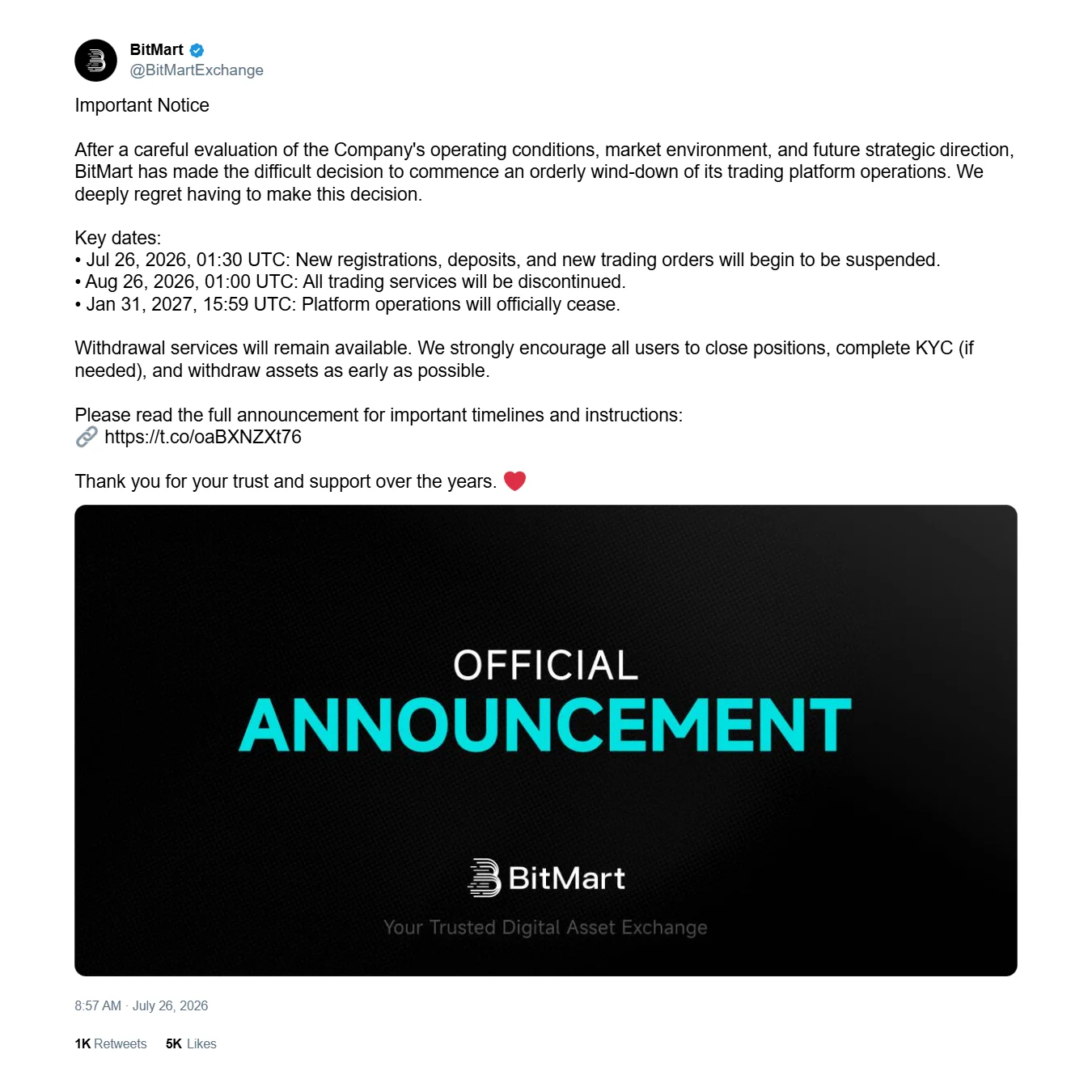
The company stopped accepting new registrations, deposits and trading orders at 01:30 UTC on the announcement date. Existing spot and derivatives trading is scheduled to end on August 26, 2026, while the platform is scheduled to close formally on January 31, 2027.
Withdrawals are expected to remain available during the wind-down. BitMart warned that identity verification, device checks, sanctions screening and source-of-funds reviews could delay processing as customers remove assets from the platform.
BitMart said it “remains committed to managing this wind-down process in a responsible, orderly, and transparent manner.” The company expressed regret over the decision and described the closure as difficult.
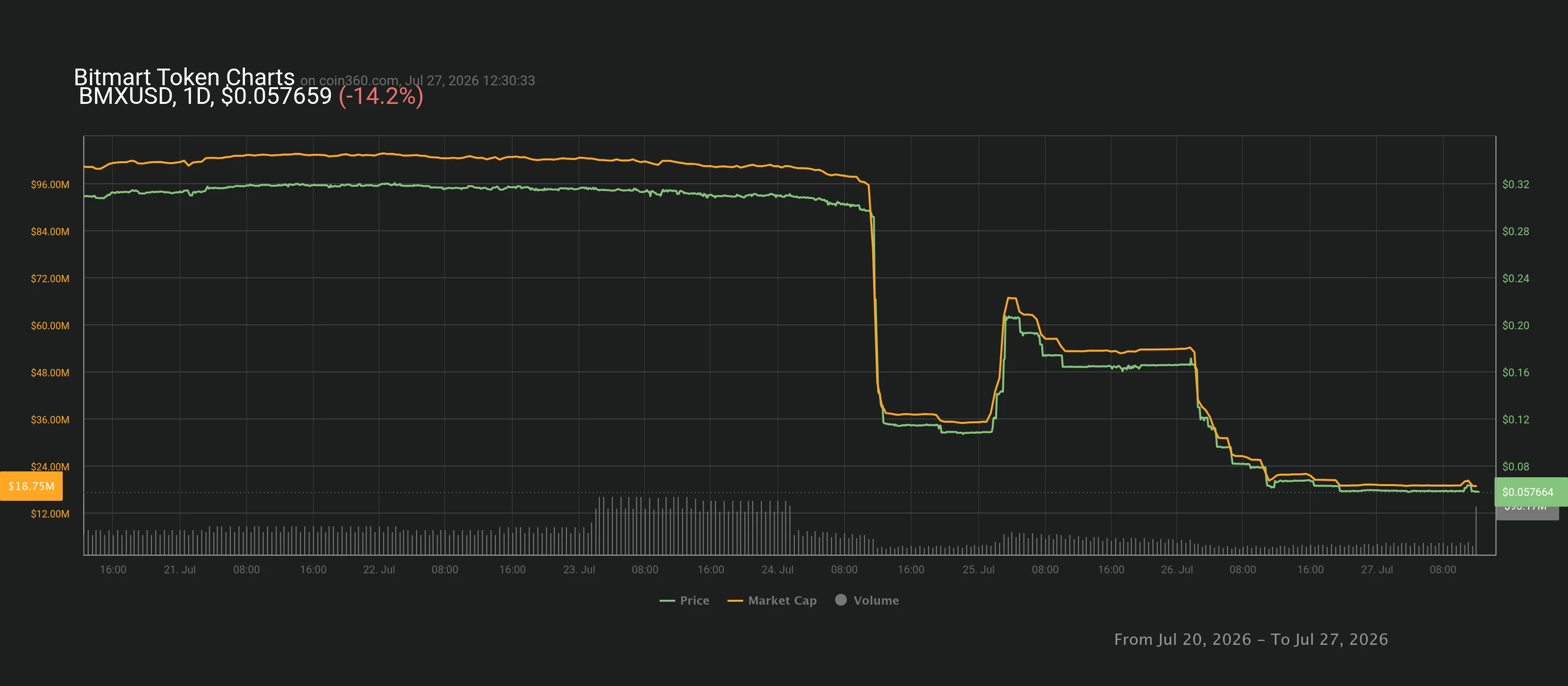
The BMX price dropped approximately 81% over the week surrounding the closure announcement and traded near $0.057. The token’s coin market cap was estimated at approximately $19.6 million.
BitMart’s closure follows a major hot-wallet security breach in December 2021 that resulted in approximately $196 million in losses. BitMart covered customer losses from the incident. The shutdown announcement did not establish the breach as the cause of the later wind-down.
BitMart global CEO Nenter Chow said he was terminated on July 24 and learned publicly about the platform wind-down decision. His account raised questions about how the decision was communicated within the company’s senior leadership.
The shutdown made BitMart the second major crypto exchange within one week to announce plans to close, following BitMEX. BitMEX said separately that it would permanently shut its platform on September 23, 2026, after a strategic review and an unsuccessful sale process.
BitMEX was co-founded by Arthur Hayes in 2014 and operated for approximately 11 years before announcing its closure.
Roshan Dharia, CEO of investment firm Echo Base, said the exchange shutdowns reflected a broader contraction. “We are entering a period of significant consolidation in digital assets,” Dharia said.
Dharia said the companies most likely to withstand the pressure would be those that “recognize the pressure early, act decisively, and secure the right capital and strategic support before their options narrow.”
Poolin moves to sell remaining Texas mining sites
Poolin Technology Pte. Ltd., a Singapore-based company that once operated one of the world’s largest Bitcoin mining pools, filed for Chapter 11 protection in the U.S. Bankruptcy Court for the District of New Jersey.
Poolin filed alongside U.S. affiliates Lonestar Dream Inc. and Lonestar Taproot LLC. The company plans to use bankruptcy proceedings to supervise asset sales and close its remaining operations rather than restart the mining business.
Initial court information described Poolin and its affiliates as holding more than $100 million in prepetition obligations and less than $10 million in assets. A separate summary placed Poolin’s total prepetition obligations at approximately $173 million.
The largest liability category is approximately $163.7 million owed to about 11,700 Poolin Wallet users. Chief Restructuring Officer Michael DuFrayne disclosed the customer liability and affected-user count in a court declaration.
The aggregate amounts imply an average claim of approximately $13,991 per affected wallet holder, although individual customer balances may differ.
Poolin’s customer obligations date to a withdrawal freeze imposed in September 2022 on Poolin Wallet and Pool Account users. Poolin said at the time that it was “facing some liquidity issues” following a surge in withdrawal requests during the broader crypto-market downturn.
Poolin issued IOU tokens representing Bitcoin and other assets that customers could no longer withdraw immediately. Those obligations remained unpaid for more than three years and became the largest liability category in the bankruptcy proceeding.
Poolin was founded in Beijing in 2017 by Zhibiao “Kevin” Pan, Fa Zhu and Tianzhao Li, all veterans of mining-hardware manufacturer Bitmain. The company expanded rapidly and at its peak controlled nearly one-fifth of Bitcoin’s global network hashrate.
Poolin later expanded beyond mining-pool coordination into crypto lending and interest-bearing accounts through Poolin Wallet. The withdrawal freeze converted customers’ liquid withdrawal claims into promises dependent on the company’s eventual financial recovery.
Lonestar Dream conducted Poolin’s Texas mining and hosting operations. Those facilities shut down completely on July 10, 2026, and Poolin does not intend to restart them.
Poolin is seeking to sell two West Texas mining sites through a court-supervised auction. Thor CALAP LLC submitted a $52 million stalking-horse bid, establishing an opening purchase price and sale terms against which other bidders may compete.
The offer covers the physical mining infrastructure and does not directly assume or repay the frozen Poolin Wallet balances.
The opening bid equals approximately 31.8% of the wallet-user liability before administrative expenses, secured claims, priority claims, other obligations and transaction costs. That comparison does not represent an expected customer recovery rate because sale proceeds would be distributed under the bankruptcy process.
The combined disclosed operating and equipment-sale losses exceed the opening bid by approximately $2.7 million. Poolin’s customer claims are roughly 3.1 times the bid, while the wallet liability is more than eight times BMX’s remaining estimated market value.
Closures spread across multiple crypto business models
Movement Labs, the original core developer behind a Move-based Ethereum layer-2 network, also filed for Chapter 11 in Delaware in a case posted on July 15, 2026.
Ousted Movement Labs co-founder Rushikesh Manche held the company’s largest unsecured claim, exceeding $1.6 million.
The late-July developments affected several distinct business models, including decentralized storage, centralized trading, Bitcoin mining and blockchain-development companies. Storj is attempting to preserve its operating network while restructuring legacy liabilities, BitMart is managing user withdrawals ahead of closure, and Poolin is converting its remaining mining assets into bankruptcy-estate proceeds.
Stakeholders face different processes under each case. Storj’s restructuring depends on court approval and continued operations, BitMart customers must complete withdrawals during the scheduled wind-down, and Poolin creditors depend on the final auction price and the court-approved distribution process.
FAQ
Did BitMart file for bankruptcy?
No. BitMart announced an orderly platform shutdown.
Will Storj continue operating?
Storj expects its storage network and customer services to continue during restructuring.
Why does Poolin owe users money?
Poolin froze withdrawals and issued IOU tokens representing customer assets.
What will Poolin sell?
Poolin plans to auction two West Texas mining sites.
This article has been refined and enhanced by ChatGPT.


