




 USD
USDTrump Crypto Ethics Deal Leaves CLARITY Act Vote Uncertain


Justice Department enforcement remains the main obstacle to a bipartisan Senate agreement
TL;DR
- President Donald Trump accepted proposed ethics restrictions covering federal officials’ cryptocurrency activities, but Senate Democrats have not agreed to the enforcement structure.
- The emerging provision would bar covered officials from issuing digital assets and give the Justice Department primary enforcement responsibility.
- Senate negotiators face a narrow legislative window before the chamber’s summer recess, followed by another required House vote.
Trade smarter on Jupiter, Solana’s leading DEX built for fast execution and deep liquidity.
Swap tokens at competitive rates, route across multiple liquidity sources automatically, and access perpetuals, DCA, and advanced trading tools — all in one place!
President Donald Trump has agreed to proposed cryptocurrency ethics restrictions covering senior federal officials, but the CLARITY Act remains stalled because Senate Democrats object to placing primary enforcement authority with the Justice Department. The agreement, reported on July 21, 2026, removed one major obstacle between the White House and Republican negotiators but did not secure the Democratic support required to advance the broader digital-asset market-structure bill.
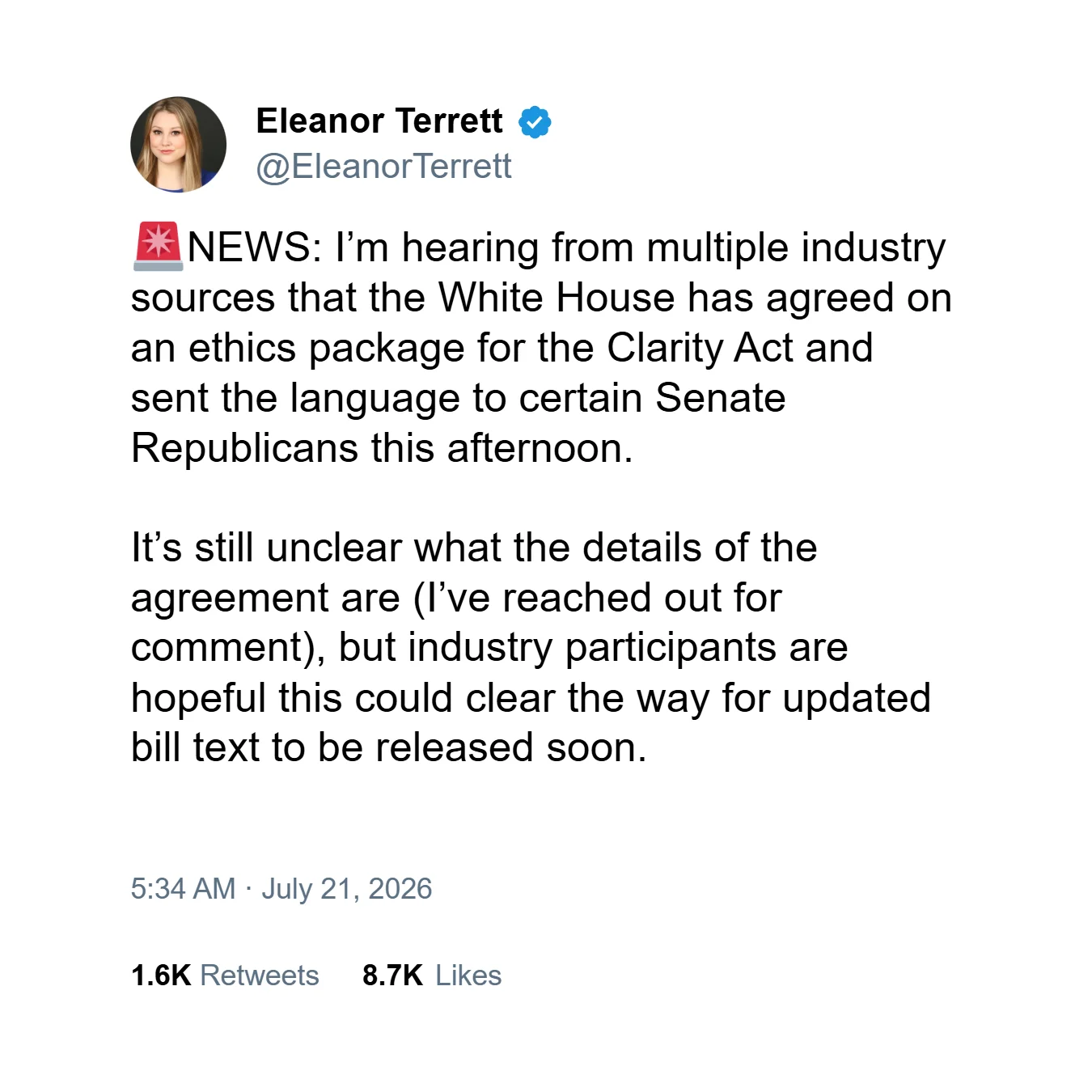
The emerging language would prohibit federal officials, including the president, vice president and members of Congress, from issuing cryptocurrencies or other digital assets, according to three people familiar with the provision. Related restrictions are also intended to prevent covered officials from holding substantial crypto interests or profiting from cryptocurrency businesses while serving in office. The complete legislative text had not been released, leaving the scope of the restrictions unresolved.
Key unanswered questions include whether the proposal would require divestment, establish blind trusts, cover family members, preserve existing ownership interests or exempt assets and businesses established before an official took office. The absence of public text also makes it impossible to determine whether the prohibition on issuing digital assets and the restrictions on holding or profiting from them would operate as separate rules.
DOJ enforcement draws Democratic opposition
The White House and Republican negotiators favor giving the U.S. Department of Justice, led by the attorney general, primary authority to enforce the ethics provision. Two people familiar with the discussions confirmed that state attorneys general would not receive the principal enforcement role sought by Democratic negotiators.
Senate Democrats have argued that state attorneys general should have enforcement authority, or at least a meaningful role, because the Justice Department could lack sufficient independence when a complaint involves a sitting president. Several state attorneys general have previously pursued legal disputes against the Trump administration, while the federal department would remain part of the executive branch led by the official who could become the subject of an investigation.
Sen. Angela Alsobrooks, D-Md., one of the leading Democratic negotiators on the CLARITY Act, rejected the reported federal enforcement structure while leaving the door open to further talks.
“This DOJ enforcing an ethics provision? That’s an unserious offer, and I wouldn’t support the bill if that’s the language. But we’ll keep working from that floor to reach an agreement that holds us all accountable,” Alsobrooks said.
Her response made clear that Trump’s acceptance of the proposal did not amount to a bipartisan agreement. Democratic negotiators had not committed to the language, and at least one central participant said the bill would not receive her support unless the enforcement mechanism changed.
Details of the proposal were discussed during a cryptocurrency industry call on Tuesday afternoon involving White House top crypto adviser Patrick Witt. Eleanor Terrett and Julia Shapero also reported elements of the proposed provision, although the available information contained conflicting descriptions of Terrett’s role and did not resolve her precise affiliation.
Trump’s crypto interests drive the ethics debate
The ethics negotiations are tied directly to Trump-branded memecoins and the Trump family’s involvement in World Liberty Financial. Financial disclosures released in June 2026 showed that Trump received millions of dollars connected to the business, strengthening Democratic demands for enforceable restrictions on officials’ commercial cryptocurrency interests.
Trump disclosed approximately $1.4 billion in crypto-related income for the previous year, including about $636 million from the memecoin business and approximately $594 million from World Liberty Financial.
The information also said World Liberty Financial sold a 49% stake to a UAE royal four days before Trump’s inauguration. The underlying transaction documentation was not included, leaving that claim unverified within the available material.
Trump has maintained that his administration’s cryptocurrency policymaking does not conflict with his family’s business activities. Democratic lawmakers have accused him of corruption and demanded rules governing the crypto holdings and business activities of sitting federal officials.
Trump’s acceptance of ethics language does not explain how his ownership interests, revenue rights or family-connected companies would be separated, suspended or otherwise structured to comply. The public text had not been released, and Democratic negotiators had not confirmed whether the proposal adequately addressed those concerns.
A White House official called the concession “the most comprehensive and wide-ranging ethics provision in history,” although the accepted language had reportedly not been provided to Democratic negotiators when that characterization was circulated.
The administration also said it had “bent over backward” to address Democratic objections and sought to assign responsibility for any subsequent legislative failure to the opposition party.
“If Senate Democrats block this historic legislation after the administration has bent over backward to accommodate their concerns, stakeholders should make no mistake: it is the Democrats who are blocking this legislation because they were never serious about a legislative outcome,” a White House official said.
The statement reflected the administration’s negotiating position but did not establish that Democratic demands had been included in the proposal.
One account said the agreement had been circulated among Senate Republicans but had not been delivered to the Democratic lawmakers whose votes would be needed to move the legislation. Democratic senators reportedly first learned about the development through a social-media post rather than through receipt of revised legislative text.
We’ve launched the all-new COIN360 Perp DEX, built for traders who move fast!
Trade 130+ assets with up to 100× leverage, enjoy instant order placement and low-slippage swaps, and earn USDC passive yield while climbing the leaderboard. Your trades deserve more than speed — they deserve mastery.
Senate vote count leaves Democrats with leverage
Republicans hold 53 Senate seats, while legislation facing a filibuster generally requires 60 votes to advance. Supporters would therefore need at least seven Democratic votes if every Republican senator backed the CLARITY Act.
That arithmetic gives Democratic negotiators substantial influence over the final ethics provision. They have linked support not only to conflict-of-interest rules but also to protections against illicit finance.
Sens. Ruben Gallego and Angela Alsobrooks have tied their support to the strength of the legislation’s illicit-finance safeguards. Sens. Chris Murphy, Jeff Merkley and Chris Van Hollen publicly opposed the version under discussion in early July and demanded restrictions on crypto businesses operated by federal officials.
A committee amendment introduced by Van Hollen failed by a 13-11 party-line vote in May 2026, demonstrating earlier Republican resistance to adding stronger ethics restrictions during committee consideration.
The White House had previously indicated that it could accept ethics rules applied equally across federal offices but would oppose language expressly targeting a particular president, officeholder or family. That disagreement contributed to the collapse of several earlier drafts and kept the legislation unresolved for months.
Other CLARITY Act provisions remain unfinished
The ethics language is the most consequential unresolved issue, but negotiators have not completed every other part of the bill.
One outstanding question concerns how software developers would be treated under illicit-finance safeguards, including the extent to which developers could receive legal protection for publishing or maintaining decentralized technology.
Democratic discussions have also included the possible addition of prediction-market policy. The proposal remains controversial and could create another regulatory dispute inside the broader package.
The CLARITY Act is intended to establish a comprehensive digital-asset market structure. The legislation would place most cryptocurrency oversight under the Commodity Futures Trading Commission while leaving tokens that function like securities under the Securities and Exchange Commission.
The bill would establish protections for customer assets during bankruptcy proceedings and create safe-harbor provisions for certain decentralized-finance developers. The final treatment of developers, however, remained under negotiation.
Supporters view the legislation as a way to resolve the longstanding jurisdictional division between the two federal regulators. Legal and compliance uncertainty has prevented institutional teams from approving larger cryptocurrency allocations for approximately three years, according to analysis included in the available information.
August recess narrows the legislative window
The Senate faces a compressed schedule, with August 7, 2026, identified as the final day before the chamber’s summer recess and the main deadline for completing Senate action during the current period.
Industry participants expected the bill could reach the Senate floor during the week beginning July 27, 2026, consistent with an earlier indication from Senate Majority Leader John Thune. Floor consideration could take several days because of procedural votes, debate and amendments.
The period between the initial report and the recess deadline amounted to approximately 17 days. Patrick Witt reportedly postponed or reversed a planned departure for months-long Georgia Army National Guard training so he could remain in Washington during the legislative push.
Trump met in the Oval Office on July 17, 2026, with Sens. Cynthia Lummis and Bernie Moreno and Todd Blanche. Reports that Trump had accepted the ethics language emerged four days later.
A Senate vote remains possible if negotiators release the revised text quickly and enough Democrats accept the ethics and illicit-finance provisions. Continued opposition to Justice Department enforcement, delays in circulating the text or the addition of prediction-market language could push consideration beyond the recess.
Failure to complete the Senate process before the break could delay the effort until November 2026, when the midterm-election environment could affect lawmakers’ political calculations. That timeline was presented as an assessment rather than a formal congressional schedule.
Senate approval would not complete the legislative process. The revised measure would still require another vote in the U.S. House of Representatives, which would probably reconsider the Senate version after returning in September 2026.
House passage is not guaranteed because divisions within the Republican majority have recently disrupted progress on unrelated legislative matters.
Bitcoin price rises before Democrats see the text
Bitcoin price moved sharply higher after news that Trump had accepted an ethics restriction, even though the legislative language was not public and Democratic support had not been secured.
The move reflected news of an agreement between Trump and Republican negotiators, not publication of a final bill or confirmation that Senate Democrats would support it.
A prediction market’s estimate that the CLARITY Act would pass during the year fell to 32% by Friday, July 17, after repeated delays. The estimate increased to 43% on Monday following reports of Trump’s concession, but still indicated that passage was considered less likely than not.
Glassnode UTXO data showed that 1.03% of Bitcoin’s supply had an acquisition cost between the stated market level and $70,685. The next major concentration of acquired supply was identified between approximately $83,000 and $85,600. Those figures describe acquisition-cost distribution and do not establish that Bitcoin will reach those levels or encounter resistance there.
The potential legislative catalyst was also compared with the GENIUS Act, a stablecoin law Trump signed in July 2025. Total cryptocurrency market capitalization exceeded $4 trillion for the first time during the week of the signing.
Regulators later missed the law’s one-year rulemaking deadline on the Saturday before the latest CLARITY Act reports, showing that enactment does not automatically produce immediate implementation.
Trump’s agreement has moved negotiations forward, but the CLARITY Act remains a White House-Republican proposal rather than a completed bipartisan deal. The next decisive steps are circulation of the full ethics language and a determination by Democratic senators on whether the enforcement provisions provide sufficient accountability.
FAQ
Has Trump approved the full CLARITY Act?
No. He accepted proposed ethics language, while the broader legislation remains under negotiation.
Why do Democrats oppose DOJ enforcement?
They question whether the department would act independently in cases involving a sitting president.
Would Senate passage complete the process?
No. The revised legislation would still require another House vote.
Is the ethics provision publicly available?
No. The complete legislative text had not been released.
This article has been refined and enhanced by ChatGPT.


