
What is GambleFi – Meaning, Definition, and Examples
DeFi powers unlocked 🚀With DeFi features, crypto casino platforms can offer more than just betting. In this article, we will be looking at the basics of GambleFi, how it works, and some of the top platforms that offer a better web3 casino experience.


Key Takeaways
- GambleFi combines DeFi protocols with gambling, creating transparent, blockchain-based casinos where players can earn cryptocurrency rewards
- Smart contracts ensure provably fair gaming, eliminating traditional trust issues through cryptographic verification
- Players maintain full asset ownership through blockchain technology, with the ability to trade winnings across different platforms
Decentralized Finance, or better known as DeFi, has already reimagined the way we think about finance. Now, imagine the same DeFi principles and technology being applied to online gambling, and we get ‘GambleFi’.
GambleFi represents more than just crypto casinos. It’s a fundamental shift toward transparent, decentralized gambling where players can earn real cryptocurrency rewards while enjoying their favorite games. This emerging ecosystem leverages blockchain technology to create provably fair gaming experiences that traditional online casinos simply cannot match.
Traditional online gambling has long suffered from trust issues, slow payouts, and centralized control that favors the house. GambleFi addresses these concerns head-on by utilizing smart contracts, decentralized protocols, and cryptocurrency payments to create a more equitable gaming environment.
With the global online gambling market continuing its explosive growth and cryptocurrency adoption reaching mainstream levels, GambleFi overlaps two massive trends. For crypto traders looking to diversify their digital asset activities, these platforms offer compelling opportunities to earn while enjoying entertainment that feels familiar yet technologically advanced.
What Exactly is GambleFi?
As we saw earlier, GambleFi, short for “Gambling Finance,” refers to the intersection of decentralized finance protocols with online gambling platforms. Unlike traditional online casinos that operate through centralized servers and payment processors, GambleFi platforms leverage blockchain technology to create transparent, trustless gambling experiences where smart contracts manage game logic, payouts, and asset ownership.
At its core, GambleFi refers to gambling platforms built on blockchain networks that use smart contracts to automate bets, payouts, and even revenue sharing with players. Instead of trusting a casino’s word that the game is fair, the math is all on-chain and anyone can check it. Players who hold native platform tokens aren’t just bettors anymore; they effectively “become the house,” earning a percentage of platform profits.

The core concept integrates DeFi mechanisms like liquidity pools, staking, yield farming, and tokenized assets directly into gambling platforms, creating an ecosystem where players don’t just wager but actively participate in the platform’s financial infrastructure.
Think of it this way – at a regular online casino, the house always wins and you have zero claim to those winnings. GambleFi flips that dynamic. Play, stake tokens, provide liquidity, and you can earn a cut of what would’ve been pure house profit.
Origins of GambleFi
Of course, GambleFi didn’t appear overnight. It’s the product of years of crypto evolution bumping into a gambling industry that was due for disruption.
Here’s a quick timeline of how GambleFi has evolved so far –
- Early 2010s: Bitcoin-based gambling sites launch, mostly simple dice games. Crypto is used purely as a payment method, nothing decentralized about the backend.
- 2015-2018: Ethereum arrives with smart contracts. Developers realize they can build games where the rules are locked in code and can’t be changed. Early provably fair casinos emerge.
- 2019-2020: Rollbit launches as a CS:GO skin-betting site. By early 2020, the founders recognized that blockchain could solve the trust issues of traditional gambling and re-launched it as a crypto-first casino with provably fair games, instant settlements, and transparent data.
- 2021: The DeFi boom. Concepts like liquidity pools, yield farming, and tokenomics enter mainstream crypto. Gambling projects start adopting these structures. Rollbit launches Rollbots, an NFT collection where holders earn a share of casino revenue.
- Mid-2023: The term “GambleFi” gets real traction. GambleFi emerges in the second half of 2023 as a narrative offering democratized access to casino games and prediction markets for billions of users. In July 2023, Rollbit Coin (RLB) debuted on Solana, distributed entirely to community members and NFT holders with no VC allocation or private sale.
- 2024: Prediction markets like Polymarket explode during the US presidential election cycle, pulling GambleFi concepts into the mainstream spotlight.
- 2025: The GambleFi sector’s combined token market cap exceeds $2 billion, supported by millions of active wallets. What began as hobbyist dice rolls now rivals mid-tier DeFi protocols in liquidity.
GameFi vs GambleFi – what’s the difference?
On the surface level, GameFi and GambleFi may seem similar. However, they are two very different concepts. For quick clarification, we have summed up the differences here in a table –
| GameFi | GambleFi |
|---|---|
| Play-to-earn gaming with NFT rewards and virtual economies | Gambling and betting with DeFi integration for enhanced returns |
| Players earn through gameplay achievements, asset trading, and staking rewards | Players earn through gambling wins, liquidity provision, and token staking |
| Lower risk, skill-based earnings through time investment and strategic play | Higher risk, chance-based outcomes with potential for quick gains or losses |
| Players own in-game NFTs, virtual land, and characters permanently | Players own tokens and crypto winnings that can be withdrawn or staked |
| Complex gameplay systems, character progression, and world-building | Traditional casino games enhanced with blockchain transparency |
| Guilds, tournaments, and collaborative gameplay environments | Social betting, shared liquidity pools, and governance participation |
| Significant time required for meaningful earnings and progression | Quick sessions with immediate results and instant payouts |
Best GambleFi Platforms to Check Out
In this section, we will be looking at some of the top platforms that benefit from DeFi protocols integration.
| Platform | Token | Utility & Features |
|---|---|---|
| BC.Game | $BC | Staking rewards, profit sharing, community governance, access to exclusive games, buy-back and burn on TON blockchain |
| TrustDice | TXT | Used for betting, earning daily staking dividends, receiving faucet rewards, unlocking VIP tiers, community governance |
| Shuffle | SHFL | Used for gaming, betting, Wager-to-Vest and airdrops, buyback & burn, exclusive bonuses, integrated ERC-20 utility |
| Rollbit | RLB | Used as lottery ticket, profit share (20% of platform profits shared), runs on Solana for casino gaming and trading |
| Decentraland | MANA | Buys digital land & NFTs, decentralizes governance/voting, entry to metaverse casinos, access to virtual games & events |
| Lucky Block | LBLOCK | Gaming, lottery, staking, cashback up to 15%, exclusive games, NFT integration, future real-world payments, futures trading |
| TG.Casino | TGC | Telegram-native casino, revenue-sharing with stakers, cashback, buyback and burn, instant KYC-free gameplay, Web3 features |
| Megadice | DICE | Casino utility on Ethereum, fast transaction Layer 2 (future), unlocks rewards, early user competitions, meme coin ecosystem |
| BetFury | BFG | Betting, staking for APY, trading, deflation (buyback & burn), earning ecosystem rewards, CertiK audited, operates on BNB Chain |
Note: While our team has done its due diligence while reviewing and recommending the platforms here, we still strongly advise our readers to conduct their own research before signing up for any of the platforms.
How Does GambleFi Work?
Here’s a straightforward example before getting into the mechanics.
Say you join a GambleFi platform like Rollbit. You connect your crypto wallet, buy some of their native token (RLB), and start playing blackjack. Every bet is settled by a smart contract, not by a human. The result is recorded on-chain. You win, the funds hit your wallet within seconds. No withdrawal forms, no waiting three business days, no customer support ticket.
But here’s where it gets interesting. You can also stake your RLB tokens. When you do, you earn a share of the platform’s revenue, the same revenue that would normally stay entirely with the house. That’s GambleFi in action.
Tokenomics and Liquidity
Every major GambleFi platform has a native token, and that token does a lot more than just act as casino chips. Tokens serve multiple purposes: players use them to place bets, access features, earn governance rights, and stake them to generate additional yield.
Rollbit’s RLB is one of the clearest examples of how this works. RLB’s tokenomics center on three pillars: deflation, utility, and alignment. The hourly Buy & Burn program uses platform revenue to purchase RLB on the open market; 90% of purchased tokens are burned, while 10% goes to Rollbot NFT stakers as passive yield. Fewer tokens in circulation means each one you hold becomes relatively more scarce over time.
On the liquidity side, many GambleFi platforms let users add funds to liquidity pools. Those pools act as the “bank” for the casino. When players lose, the pool earns. When players win, the pool pays out. Liquidity providers share in both outcomes, earning fees in exchange for providing that capital.
DeFi and Cross-Chain Bridges
Traditional online casinos are walled gardens. You deposit money in, play, and hopefully withdraw. GambleFi platforms, by contrast, are built to connect with the broader DeFi ecosystem.
Smart contracts automatically execute game outcomes and distribute winnings without human intervention, while blockchain technology records every transaction permanently, allowing players to verify game fairness through cryptographic proofs.
Cross-chain bridges take this further. BetDEX, for example, expanded cross-chain to Base in 2025 and processed over one million bets per month, with transaction fees averaging just 0.01 SOL. This means a player on one blockchain can interact with a platform running on another, without needing to manually move funds through exchanges first. It dramatically reduces friction and opens GambleFi platforms to a far wider pool of users.
TG.Casino, a Telegram-native betting app built on the TON blockchain, gamifies wagers through chatbots and AI odds engines, representing a shift toward frictionless, social betting ecosystems directly embedded into messaging platforms.
Tokenized Feedback Loop
This is where GambleFi gets genuinely clever. In a traditional casino, profits flow one direction: from players to the house. GambleFi creates a loop where player activity generates revenue, that revenue funds token buybacks and burns, and those burns make existing tokens more valuable for the community.
Rollbit generates $18 to $30 million in monthly revenue and has burned over 3 billion RLB tokens through its buy-and-burn mechanism. The result is that active players who also hold and stake tokens benefit from the platform’s success in two separate ways: through game winnings and through token appreciation. The more the platform grows, the more the burn program accelerates, which benefits long-term token holders.
Shuffle, co-founded by a former Alameda trader, reports over $100 million in annualized net gaming revenues and returns roughly 15% of weekly revenues to SHFL token stakers through a USDC lottery yielding approximately 48% APR.
What Type of Games Can You Play at GambleFi Sites?
One common assumption is that GambleFi platforms only offer basic crypto dice games. That was true in 2018. Today, the game libraries at top GambleFi sites rival or exceed what you’d find at mainstream online casinos. And because outcomes are verifiable on-chain, players who care about fairness have concrete proof, not just the casino’s promise.
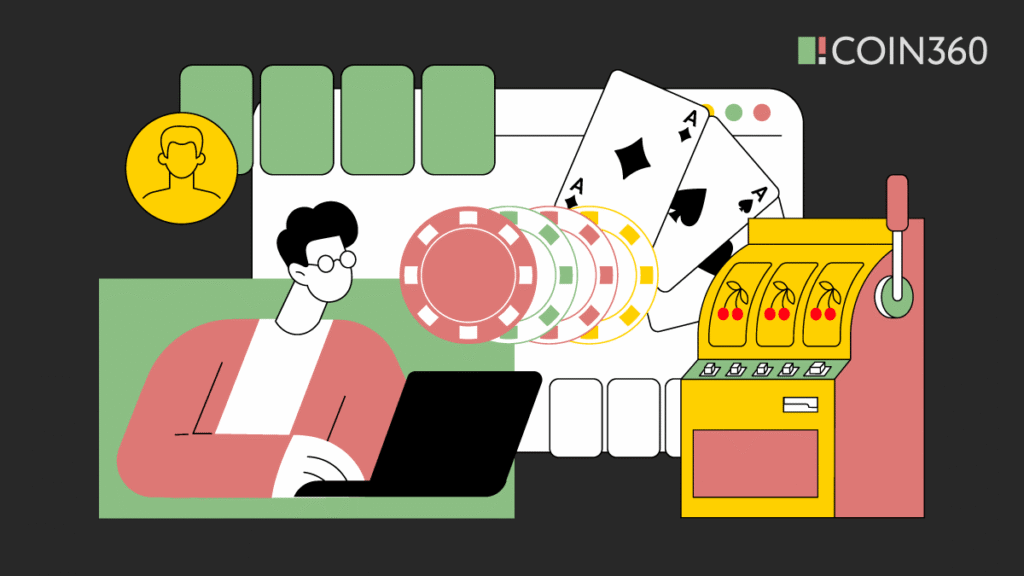
Here’s a breakdown of what’s typically available.
Slots
Slots are the most played game category online, and GambleFi sites have leaned into this hard. Dexsport, for example, supports over 10,000 games including slots across 20 networks. Rollbit also offers a wide library of slot titles alongside its other casino products.
The difference from a traditional online slot is that the random number generation on a GambleFi platform can be verified cryptographically. You’re not taking the site’s word for the RTP (return to player percentage). The math is right there on the blockchain.
Live Dealer Games
Live dealer games, where a real human dealer runs the table over a video stream, have become a huge part of online casino culture. GambleFi platforms have adopted this format too. Rollbit offers table games with or without live dealers, including blackjack, roulette, and baccarat.
The integration here is interesting: even though a human dealer is physically present, the bet settlement and payment side of things still runs through smart contracts. So you get the social feel of a live game with the trustless, instant-settlement mechanics of blockchain.
Instant Games
Instant games are fast-play formats that don’t fit neatly into traditional casino categories. Crash games are the most popular example. You watch a multiplier climb and cash out before it crashes. If you wait too long, you lose. The whole round takes about 30 seconds.
These games are tailor-made for GambleFi because their outcome can be provably fair in a very clean way: a cryptographic seed determines when the crash happens, and players can verify it before or after the round. Rollbit includes crypto futures gambling where players wager on crypto price movements, blurring the line between gambling and trading in a way that’s unique to the GambleFi space.
Future of GambleFi
The trajectory here is hard to ignore. The traditional betting industry is forecasted to grow to $133.59 billion by 2029, while on-chain betting remains a niche market. However, the growth drivers that fueled DeFi and meme coin adoption are poised to spark similar expansion in GambleFi.
A few developments worth watching:
- AI integration. By 2025, GambleFAI has combined the advantages of decentralized gambling and AI technology, with AI agents that outperform traditional gambling strategies through machine learning-based prediction accuracy. Platforms like Dexsport are already using machine learning to set esports and sports betting odds.
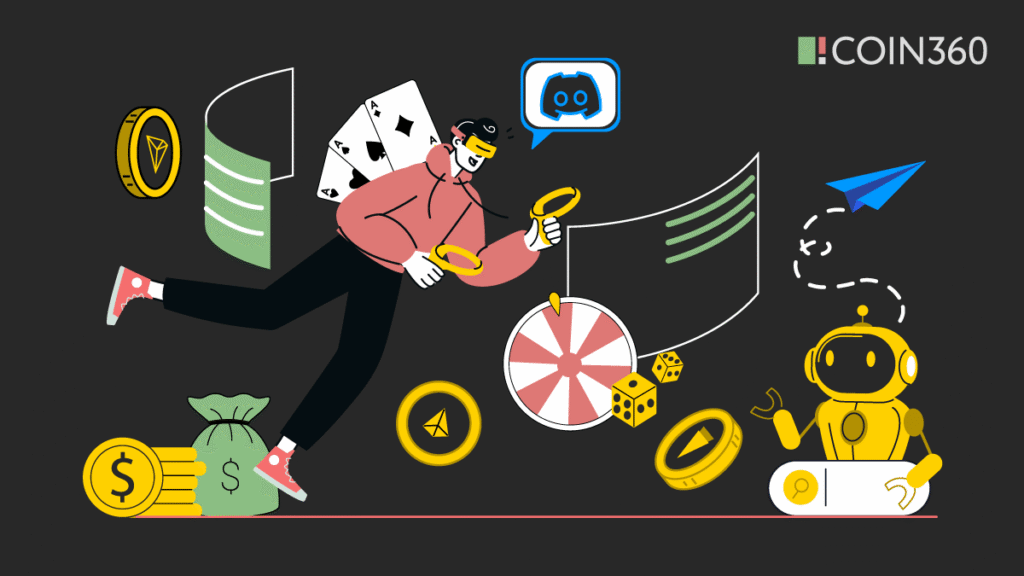
- Social and messaging-native gambling. TG.Casino’s integration with Telegram represents a shift toward social betting ecosystems directly embedded into messaging platforms. As more of everyday life moves through apps like Telegram and Discord, expect GambleFi to follow.
- Metaverse casinos. Decentral Games brings GambleFi to virtual reality, with users gathering in digital casinos inside Decentraland to play ICE Poker or wager MANA on slots while interacting through avatars, boasting over 500,000 monthly visitors and $50 million in total value locked.
- Regulatory clarity. This is the wildcard. Clearer regulations in the US and EU could either accelerate GambleFi’s growth by legitimizing it or constrain it significantly. Most analysts expect a middle-ground outcome: regulated GambleFi platforms that maintain on-chain transparency while adding basic compliance layers.
- New entrants. Bluff, which completed a $21 million funding round in February 2026 led by 1kx, attracted over 600,000 signups during its pre-release beta and processed over 125 million bets in three months, with a leadership team including former senior executives from Stake, Bet365, William Hill, and Bodog. Big-money investment is flowing in, which signals the sector is being taken seriously beyond the crypto-native crowd.
GambleFi – Advantages & Disadvantages
Like anything in crypto, GambleFi has genuine strengths and real risks. Here’s an honest look at both.
Advantages
- Provable fairness. This is GambleFi’s strongest selling point. Provably fair gaming protocols allow users to verify the fairness of game outcomes mathematically, which traditional online casinos simply cannot match. If you’ve ever wondered whether an online casino’s RNG is rigged, GambleFi removes that question entirely.
- Instant payouts. Smart contracts automate the settlement process, so when a bet is won, winnings transfer to the player’s wallet almost instantly, eliminating the lengthy withdrawal approval times common in traditional online casinos. No waiting days for your withdrawal to clear.
- Players earn from the house’s cut. Through staking, token holding, and liquidity provision, players can earn a share of platform revenue. This doesn’t exist in traditional gambling.
- Lower fees. Traditional casinos swallow margins of 5 to 10%, while GambleFi trims those fees to around 1% by removing intermediaries.
- No account required in many cases. Many GambleFi platforms operate without KYC verification. You connect a wallet and you’re in. Rollbit’s no-KYC requirement aligns it with privacy-first users.
Disadvantages
- Smart contract risk. Code can have bugs. In 2023, Stake.com lost $41 million in a hot-wallet exploit traced to the Lazarus Group, later reimbursing users. Audits in 2025 found nearly 20% of GambleFi projects susceptible to oracle manipulation.
- Token volatility. Your winnings are in crypto. A big win today can be worth significantly less tomorrow if the market moves against you. The token you’re staking can also drop in value regardless of the platform’s performance.
- Rug pull risk. Several RLB clones disappeared with investor funds exceeding $10 million. Newer, unproven GambleFi projects carry real exit scam risk. Stick to established platforms with verifiable on-chain activity.
- Regulatory gray area. Most jurisdictions have strict laws governing online gambling, and decentralized platforms often operate in a legal gray area. Regulators are still catching up, and a crackdown could render many platforms obsolete overnight.
- Learning curve. Connecting a wallet, understanding tokenomics, managing gas fees across different chains: none of this is as simple as signing up for a regular online casino with a credit card. For newcomers to crypto, GambleFi takes some getting used to.
Play Responsibly at GambleFi Sites
GambleFi makes gambling more accessible, more transparent, and in some ways more rewarding. That’s not an argument to gamble more. If anything, lower friction means you can lose money faster.
A few things to keep in mind before you start:
- Set a hard budget before you open your wallet. The crypto you put into a GambleFi platform should be money you’re genuinely okay losing. Don’t stake your emergency fund or money you need next month.
- Understand the token mechanics before you buy. Staking rewards and buy-and-burn programs sound great, but if the token’s value drops 60%, your staking yield doesn’t cover those losses. Do your own research on any token before holding a meaningful amount.
- The house still has an edge. GambleFi makes the edge smaller and transparent, but it still exists. You can verify the RTP on-chain; make sure you actually look at it before playing.
- Use only established platforms. Stick to projects with verifiable on-chain activity, public audits, and a track record. New GambleFi projects pop up constantly, and many don’t survive long enough to pay out.
- Know your local laws. GambleFi’s borderless design doesn’t mean it’s legal everywhere. Check the gambling laws in your country or state before putting real money in.
If you feel like your gambling is getting out of control, organizations like the National Council on Problem Gambling (ncpgambling.org) and GamCare (gamcare.org.uk) offer free support and resources.
Final Thoughts
Let’s quickly recap. GambleFi is more than just a tech upgrade for the gambling industry. By integrating decentralized finance protocols with gambling platforms, this emerging sector has created opportunities for players to generate multiple revenue streams while enjoying enhanced security, instant payouts, and provably fair gaming experiences that were impossible under centralized systems. Each platform offers unique advantages, whether through native token rewards, staking opportunities, or innovative gameplay mechanics that extend far beyond traditional gambling.
This article is not financial advice. Cryptocurrency investments involve risk, and prices may fluctuate significantly. Always conduct your own research. Gambling involves financial risk and may not be suitable for everyone. Please play responsibly and seek help if gambling becomes a problem.