




 USD
USDCardano Activates First Community-Approved Hard Fork


Van Rossem shifts protocol authority from Cardano’s founding developer to on-chain governance
TL;DR
- Cardano activated the Van Rossem hard fork on July 18, moving the mainnet to protocol version 11 without downtime.
- Delegated representatives, stake pool operators and the Constitutional Committee approved the first community-led major Cardano protocol upgrade.
- The upgrade improves Plutus execution, strengthens ledger rules and prepares Cardano for the planned Ouroboros Leios scaling system.
Trade smarter on Jupiter, Solana’s leading DEX built for fast execution and deep liquidity.
Swap tokens at competitive rates, route across multiple liquidity sources automatically, and access perpetuals, DCA, and advanced trading tools — all in one place!
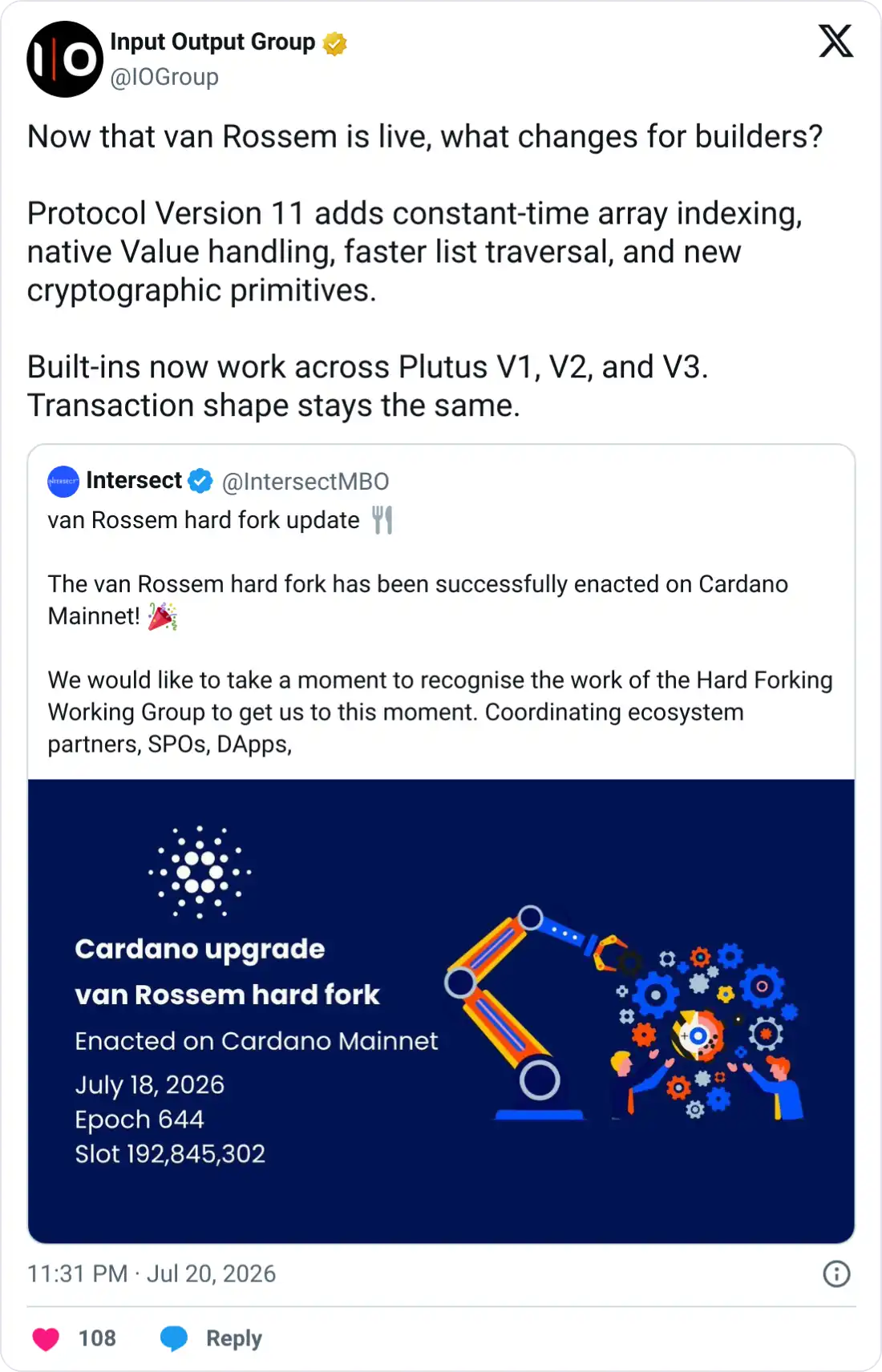
Cardano activated the Van Rossem hard fork on July 18, 2026, moving its mainnet from protocol version 10 to version 11 through the network’s on-chain governance process rather than a decision controlled by Input Output, the engineering company that originally built Cardano. The upgrade was completed without downtime and introduced five technical changes focused on smart-contract efficiency, cryptographic functionality and ledger security.
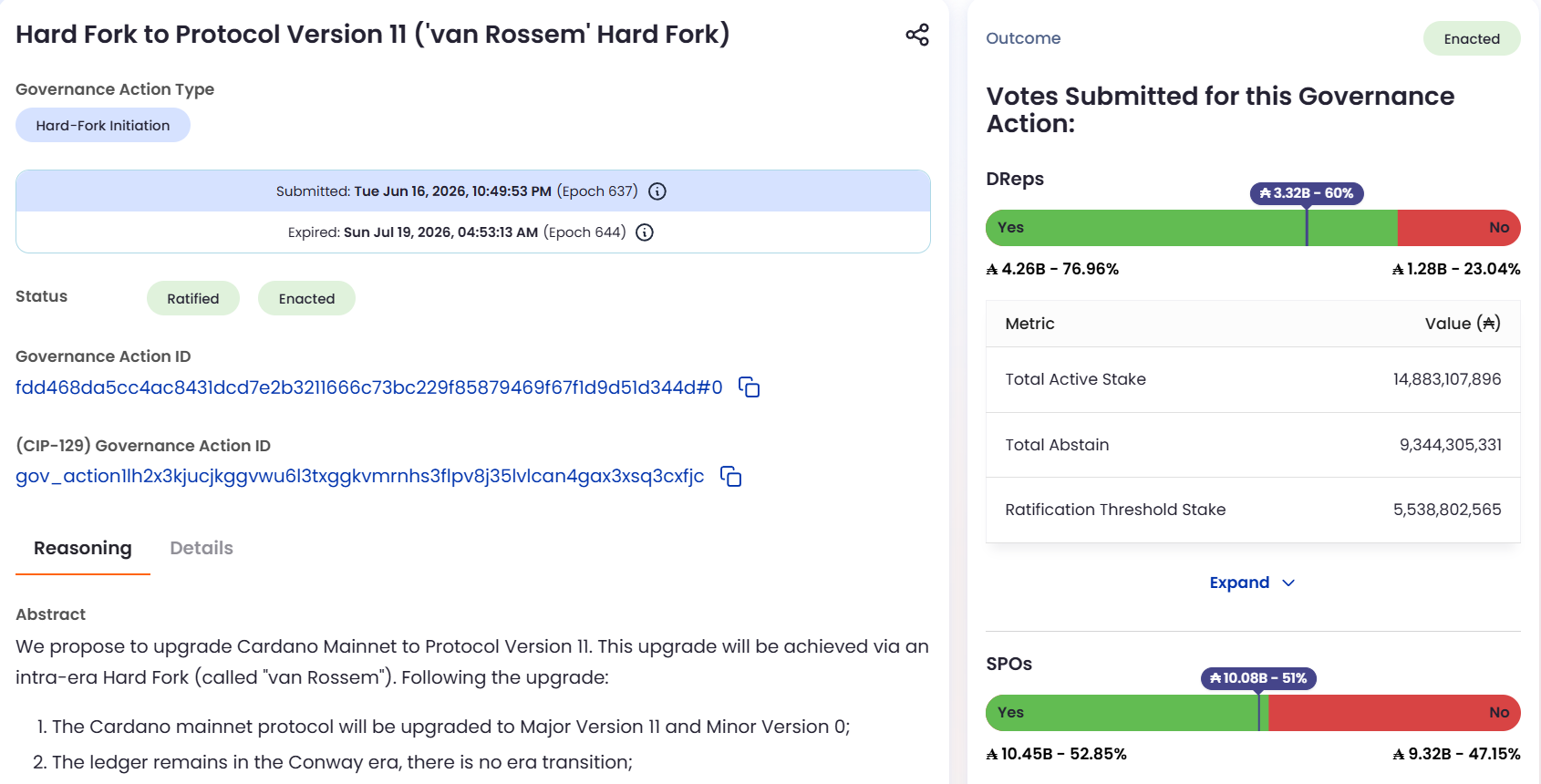
The network enacted the hard fork at 21:44 UTC as Cardano transitioned from epoch 643 to epoch 644, according to Cardanoscan on-chain data. The proposal had been ratified on July 13 after receiving the required support from Cardano’s three governance bodies and meeting the network’s software-readiness requirement.
The upgrade was detailed publicly on July 20, two days after activation. Its defining feature was not a visible change to ordinary ADA transactions but the method used to authorize it. Previous Cardano hard forks had been coordinated from the top down by the blockchain’s founding organizations, primarily Input Output. Van Rossem was instead proposed, debated, approved and activated through the governance framework introduced during Cardano’s Voltaire era.
A hard fork permanently changes a blockchain’s core protocol rules and requires the computers operating the network to adopt compatible software. Van Rossem therefore tested whether Cardano could coordinate a mandatory base-layer upgrade without allowing its founding developer to control the final activation decision.
Three governance groups approved the upgrade
Cardano’s governance process required independent approval from delegated representatives, stake pool operators and the Constitutional Committee. No single group had the authority to approve the hard fork alone.
Delegated representatives, known as DReps, are community members selected by ADA holders to vote on governance proposals on their behalf. Separate governance snapshots placed DRep approval at different levels while showing that support remained above the constitutional threshold.
The variation between the two DRep and stake pool operator figures reflected separate governance-data snapshots. Both sets showed that the proposal passed, although stake pool operator support cleared its required level by a relatively narrow margin.
Stake pool operators run the infrastructure that produces Cardano blocks and keeps the network operating. Their vote showed that support from Cardano’s founders or development organizations does not automatically guarantee approval once protocol authority is distributed among independent participants.
The Constitutional Committee is an elected body responsible for assessing whether proposed governance actions comply with the Cardano Constitution. Its role is focused on constitutional compliance rather than determining whether a technical proposal is strategically desirable.
Software adoption also had to reach a specified level before ratification. Block production running compatible software exceeded the requirement by roughly eight percentage points, reducing the risk that a substantial share of Cardano’s infrastructure would remain on an incompatible protocol version after activation.
Cardano had been building toward this governance structure through earlier upgrades. The Chang hard fork introduced on-chain voting mechanisms in 2024, while the Plomin hard fork transferred effective protocol decision-making authority to ADA holders and their representatives in early 2025.
Van Rossem became the first full operational use of that system for a major protocol change. Community participants did not vote on a peripheral funding or administrative matter; they authorized a mandatory change to Cardano’s base-layer rules.
Upgrade honors Cardano contributor Max van Rossem
The hard fork was named after Max van Rossem, a Dutch Cardano contributor who died in October 2025. Van Rossem had worked as a developer, node operator, elected representative and constitutional delegate.
Van Rossem contributed to the design of Cardano’s governance framework and helped shape the network’s constitution. The system he worked on was ultimately used to approve the protocol upgrade carrying his name.
Van Rossem is classified as an intra-era hard fork, meaning Cardano remains within its current governance-focused era rather than entering a completely new architectural phase. The upgrade does not change the fundamental structure of Cardano transactions, limiting the migration work required from wallets, exchanges and other ecosystem operators.
The activation also followed Input Output’s announcement that portions of Cardano development would begin moving to external specialist teams starting in August 2026. Van Rossem was the first hard fork executed during that broader movement away from development controlled primarily by the founding company.
Plutus changes target lower execution costs
Protocol version 11 contains five technical improvements centered on Cardano’s Plutus smart-contract platform. Plutus supports decentralized finance applications, NFT marketplaces, payment services and other programs that execute code on the blockchain.
The upgrade enhances the Plutus Cost Model, which determines how computational resources are measured when smart contracts run. The changes are intended to allow developers to execute more complex logic while using fewer network resources.
Lower execution costs could reduce the fees users pay when interacting with Cardano applications because application charges partly reflect the computing resources required by their smart contracts. Existing applications will not automatically receive those savings, however. Developers must update or rebuild their contracts to use the new functions and revised cost structure.
Version 11 also unifies built-in Plutus functions across Plutus V1, V2 and V3. That allows older applications to access capabilities added in newer versions of the platform without requiring Cardano to alter the structure of its transactions.
Input Output said on July 20 that the release added constant-time array indexing, native Value handling, faster list traversal and new cryptographic primitives while leaving transaction shape unchanged.
Constant-time array indexing allows a contract to retrieve an indexed item without processing an entire collection. Native Value handling gives Plutus scripts more direct tools for working with Cardano’s multi-asset value representation, potentially reducing the custom code required to manage tokens and bundled assets.
Faster list traversal improves how contracts process ordered collections of information. The additional cryptographic primitives provide native tools for tasks including digital-signature verification, reducing the computational burden for applications that depend on signature-based authentication or authorization.
Version 11 also tightens ledger-validation rules. One change prevents two stake pools from reusing the same cryptographic identity key, requiring every pool to maintain a unique identity within Cardano’s staking system and closing a known attack path.
We’ve launched the all-new COIN360 Perp DEX, built for traders who move fast!
Trade 130+ assets with up to 100× leverage, enjoy instant order placement and low-slippage swaps, and earn USDC passive yield while climbing the leaderboard. Your trades deserve more than speed — they deserve mastery.
Van Rossem prepares Cardano for Ouroboros Leios
Input Output said the upgrade establishes technical foundations for the planned Dijkstra era and its Ouroboros Leios scaling architecture.
“As well as Plutus improvements and Plutus Cost Model enhancements, this upgrade lays the foundation for the next upgrade, the Dijkstra era hard fork, which will introduce Ouroboros Leios to Cardano,” Input Output wrote in a development report published July 17.
Ouroboros Leios is a proposed redesign of Cardano’s proof-of-stake consensus and transaction-processing architecture. The system is intended to expand throughput without weakening Cardano’s existing security guarantees.
Leios is expected to increase network capacity by approximately 30 to 65 times and target more than 1,000 transactions per second. Cardano founder Charles Hoskinson expects the system to reach the mainnet before the end of 2026.
The public Leios testnet, Musashi Dojo, launched on June 23. It provides a testing environment where developers and infrastructure operators can evaluate the architecture before a mainnet deployment.
Van Rossem prepares for Leios through its ledger and Plutus changes while also demonstrating that Cardano’s governance system can authorize the protocol upgrades required to introduce larger architectural changes.
The more visible improvements for ordinary users are expected to come from Leios rather than Van Rossem. The scaling system is intended to provide faster confirmations and greater transaction-processing capacity during periods of heavy network activity.
ADA users face no immediate migration requirements
Ordinary users do not need to change how they hold, send or receive ADA following the hard fork. Wallet users are not required to install an update solely because of Van Rossem, and the base fee for transferring ADA remains unchanged.
The upgrade also does not alter Cardano’s user-facing interface or the basic structure of its transactions. Casual users may therefore see no immediate indication that the network moved to a new protocol version.
Developers are the direct initial beneficiaries because they can build or update applications using more efficient execution rules and a broader set of native functions. Users could later benefit through applications that charge lower interaction fees, execute more complex logic or support services that previously required excessive computational resources.
ADA holders also have a formal route to influence protocol governance. They can delegate voting authority to DReps or participate through Cardano’s broader governance framework, giving stakeholders constitutionally defined influence over future network changes.
The distributed process can be less predictable than upgrades coordinated by a single core development team. Van Rossem nevertheless showed that the multi-body system could approve and activate a major technical change while maintaining continuous network operation.
ADA price remains subdued after activation
Market reaction was limited after the hard fork. ADA traded largely flat for about three days, with the upgrade failing to produce an immediate repricing of the asset.
ADA’s 50-day exponential moving average remained below its 200-day exponential moving average, leaving the broader price structure bearish despite early signs of improving short-term momentum. The directional component of the Average Directional Index had shifted from bearish to bullish, although the overall reading did not confirm a strong trend.
Santiment data showed that wallets holding between 100,000 ADA and 100 million ADA had increased their combined balances to the highest level since 2023. Smaller holders reduced their exposure over the same period, creating a divergence between accumulation by larger wallets and selling or redistribution by smaller participants.
FAQ
Did Cardano stop operating during the hard fork?
No. The protocol transition was completed without downtime.
Do ADA holders need to update their wallets?
No wallet update is required solely because of Van Rossem.
Did the hard fork reduce the standard ADA transfer fee?
No. The base fee for sending ADA remained unchanged.
What upgrade is expected to deliver larger capacity gains?
The planned Dijkstra hard fork is expected to introduce Ouroboros Leios.
This article has been refined and enhanced by ChatGPT.


