




 USD
USDEthSystems Spins Out to Build Institutional Privacy on Ethereum


For-Profit Company Targets Banks as Ethereum Foundation Restructures
TL;DR
- EthSystems launched on July 14, 2026, to build confidential financial systems on public Ethereum.
- The for-profit spinout was founded by three former Ethereum Foundation privacy researchers and backed by major Ethereum investors.
- Its creation follows a wider restructuring that cut the foundation’s workforce and transferred specialized responsibilities to independent organizations.
Trade smarter on Jupiter, Solana’s leading DEX built for fast execution and deep liquidity.
Swap tokens at competitive rates, route across multiple liquidity sources automatically, and access perpetuals, DCA, and advanced trading tools — all in one place!
EthSystems launched on July 14, 2026, as a for-profit Ethereum Foundation spinout focused on building privacy infrastructure for banks, asset managers, central banks and other regulated institutions using public Ethereum. The company will combine bespoke consulting with technology development intended to protect transaction details, trading positions, counterparties and client identities while allowing authorized regulatory or audit access.
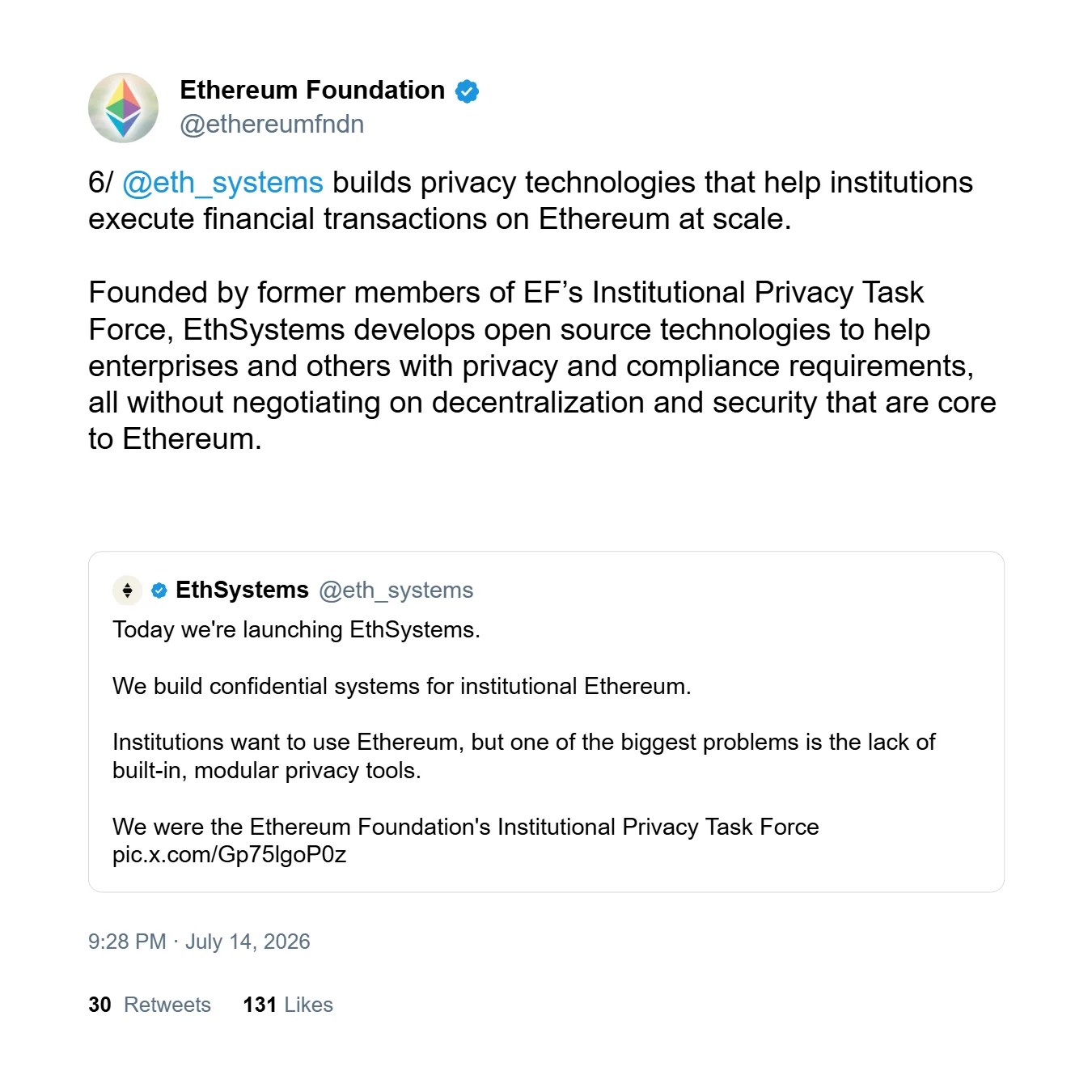
The company was founded by Mo Jalil, Oskar Thorén and Aaryamann Challani, former Ethereum Foundation employees who worked on or led its Institutional Privacy Task Force, known as IPTF. EthSystems is the third major independent organization linked to the foundation’s restructuring, following the establishment of EthLabs and Ethereum Institutional. Each organization operates under a different mandate, legal structure and funding model.
EthSystems said confidentiality remains a major obstacle preventing financial institutions from conducting large-scale activity on Ethereum. Public blockchains provide verifiable settlement and shared infrastructure, but their transparency can expose information that regulated firms may be commercially or legally unable to disclose, including transaction values, wallet relationships, counterparties, customer information and trading positions.
The company plans to build modular privacy systems that let institutions keep sensitive information confidential while selectively disclosing required data to regulators, auditors or authorized counterparties. The proposed systems are intended to preserve Ethereum’s public-network security and settlement features rather than move institutional transactions onto a separate blockchain.
Zero-knowledge proofs are among the technologies expected to support that work. Such systems can allow participants to demonstrate that a transaction meets specified conditions without revealing all underlying information. EthSystems has not disclosed a complete technical architecture, production network, testnet, smart-contract address or product-release schedule.
Commercializing Foundation Research
EthSystems will pair infrastructure development with customized consulting aimed at solving technical, regulatory and operational barriers faced by individual institutions. The founders said the commercial structure allows banks and other regulated firms to contract with a conventional legal counterparty rather than a nonprofit foundation or research team.
“The business model is simple: bespoke consulting, focused on solving the hardest blockers for institutional adoption. In practice, this means continuing a lot of the work we have been doing, only charging money for it,” the EthSystems team said.
The team also said, “Commercial engagements often require a commercial counterparty,” explaining why the work was moved into a for-profit company. EthSystems separately summarized the decision by saying, “Commercial engagements need a commercial counterparty. The model is simple: we continue the work we’ve been doing, only now we charge for it.”
EthSystems is not beginning its privacy work from scratch. Its founders intend to commercialize research and prototypes developed while they were working inside the Ethereum Foundation, converting experimental and open-source work into systems that can be implemented for paying institutional clients.
The founders said their foundation work involved hundreds of conversations with central banks, regulators and financial institutions. Those discussions included engagement with global banks and asset managers and helped shape the team’s understanding of the privacy, compliance and infrastructure requirements blocking institutional use of Ethereum. No participating institution was identified.
Previous projects included private bond systems using zero-knowledge proofs, confidential stablecoin transfers and private cross-chain settlement. The team also developed the Ethereum Privacy Map, an open-source initiative cataloging privacy-related technologies and infrastructure across Ethereum.
EthSystems said it will continue making open-source contributions and publishing detailed protocol specifications while operating commercially. Its stated mission is: “Help institutions build confidential systems on public Ethereum without giving up what makes Ethereum worth using.”
The company also linked its independence to the Ethereum Foundation’s narrower public-interest mandate. “As EF continues doubling down on cypherpunk fundamentals, especially with a focus on individuals, there’s room for an independent for-profit entity that can make different choices in the trade-off space,” EthSystems said.
That separation allows EthSystems to make commercial decisions involving confidentiality, compliance, selective disclosure and implementation requirements that may not fit the Ethereum Foundation’s neutral, open-source and individual-focused role.
EthSystems is backed by BitMine, SharpLink, Ethereum co-founder and Consensys CEO Joe Lubin, SNZ and other Ethereum-focused investors. BitMine and SharpLink were identified as the two largest Ethereum treasury firms. No funding amount, valuation, ownership stake or financing-round structure was disclosed.
Lubin previously said he expected at least three organizations to spin out of the Ethereum Foundation. EthLabs, Ethereum Institutional and EthSystems now fill separate roles covering protocol development, institutional coordination and commercial privacy systems.
We’ve launched the all-new COIN360 Perp DEX, built for traders who move fast!
Trade 130+ assets with up to 100× leverage, enjoy instant order placement and low-slippage swaps, and earn USDC passive yield while climbing the leaderboard. Your trades deserve more than speed — they deserve mastery.
Ethereum Responsibilities Move Outside Foundation
EthLabs was established as a nonprofit focused on Ethereum protocol research, scaling, ecosystem coordination and product development. It is expected to assume substantial research and development responsibilities previously housed within the Ethereum Foundation and has been characterized 'as a sister organization to the foundation.
Ethereum Institutional was created as a separate nonprofit focused on institutional adoption, education, research and standards development. It is intended to serve enterprises, asset managers and nonprofits considering or executing Ethereum-based initiatives and was presented as an “honest, neutral counterpart” for those organizations.
The resulting division places protocol and product development with EthLabs, neutral institutional coordination with Ethereum Institutional and commercial confidentiality work with EthSystems. The Ethereum Foundation retains a narrower role centered on long-term stewardship, core infrastructure and Ethereum’s underlying principles.
The broader restructuring followed criticism from developers, investors and prominent community members over the foundation’s execution speed, governance and technical priorities. Critics argued that Ethereum’s roadmap had become too focused on layer-2 scaling while improvements to the base layer progressed too slowly. Questions were also raised about whether the foundation adequately supported Ethereum’s growing institutional user base.
February 2026 brought the first major leadership development in the restructuring timeline, when Ethereum Foundation co-executive director Tomasz Stanczak announced that he would step down after helping lead the organization through its initial changes.
Several weeks later, the foundation published a narrower mandate defining itself as a long-term steward of Ethereum’s core principles and infrastructure rather than the ecosystem’s primary builder, coordinator or umbrella organization.
The mandate was organized around the CROPS framework, although two formulations were provided. One expanded CROPS as censorship resistance, resilience, openness, privacy and security. Another presented the priorities as Censorship Resistance, Open Source, Privacy and Security. The differing formulations were not reconciled.
Nine senior foundation leaders, researchers and executives left over the following months, marking one of the largest periods of senior turnover in the organization’s 12-year history. The departures included both co-executive directors and the three former leads of the Protocol Research and Development team.
Hsiao-Wei Wang resigned as co-executive director in June 2026. Days later, the foundation announced its largest restructuring to date, eliminating 54 positions, or approximately 20% of its workforce, and reducing its annual operating budget by approximately 40%.
The eliminated positions imply a pre-restructuring workforce of about 270 people, based on the stated headcount and percentage, although the foundation did not directly provide that total. Absolute budget figures before and after the reduction were also not disclosed.
Remaining employees were reorganized into five core operating groups, also called clusters, covering responsibilities the foundation considered uniquely suited to support. The overhaul narrowed the organization’s operational scope while transferring other work to independent entities.
EthLabs emerged around the restructuring period to handle protocol research and ecosystem development. Ethereum Institutional was unveiled in July 2026 to focus on enterprise adoption and coordination. EthSystems then added a commercial organization dedicated to confidentiality infrastructure.
By July 15, 2026, the restructured ecosystem included a smaller Ethereum Foundation focused on stewardship and core principles, EthLabs handling protocol and product development, Ethereum Institutional coordinating institutional adoption and EthSystems building commercial privacy systems.
Products and Clients Remain Undisclosed
EthSystems has identified several intended use cases, including confidential stablecoin transfers, private bond issuance, confidential trade execution, private cross-chain settlement, selective regulatory disclosure and protection of customer identities and financial positions.
The company has not named any paying clients, signed banks, confirmed pilot programs or active production deployments. It has also not disclosed expected revenue, transaction volume, bond value, stablecoin transfer value, audit results or implementation timelines.
No token or governance asset was announced, and EthSystems has not said it plans to launch a separate blockchain or layer-2 network. Its stated focus remains confidential financial infrastructure operating on public Ethereum.
FAQ
What is EthSystems?
A for-profit company building confidential institutional systems on public Ethereum.
Who founded EthSystems?
Mo Jalil, Oskar Thorén and Aaryamann Challani.
Has EthSystems named customers?
No paying clients, banks or confirmed pilot institutions were disclosed.
Will EthSystems launch another blockchain?
No separate blockchain or layer-2 network was announced.
This article has been refined and enhanced by ChatGPT.


