




 USD
USD
Ethereum Foundation Cuts Staff After Budget Reset


Restructuring follows Ethlabs launch and renewed core development funding concerns
TL;DR
- The Ethereum Foundation is cutting staff and reducing spending after adopting a leaner operating structure.
- Vitalik Buterin said the organization is shifting toward a lower long-term spending model.
- Ethlabs launched as an independent nonprofit research group while funding concerns around Ethereum core development intensified.
Trade smarter on Jupiter, Solana’s leading DEX built for fast execution and deep liquidity.
Swap tokens at competitive rates, route across multiple liquidity sources automatically, and access perpetuals, DCA, and advanced trading tools — all in one place!
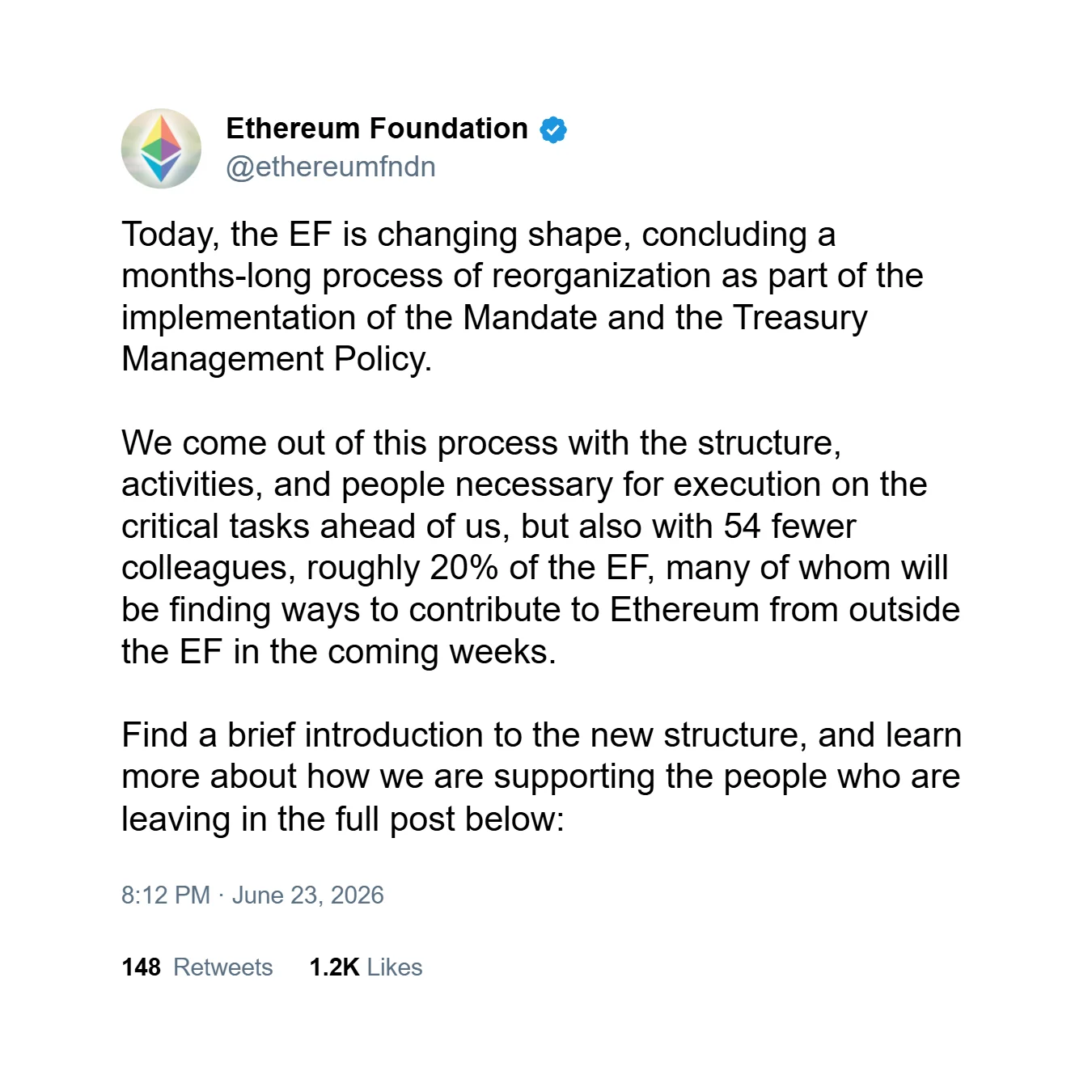
The Ethereum Foundation is cutting 54 jobs, or about 20% of its workforce, as it reduces its annual budget by roughly 40% and reorganizes around a leaner operating model announced on June 23, 2026.
The restructuring marks one of the Ethereum Foundation’s sharpest internal resets in years. Vitalik Buterin said the Foundation is moving away from its pre-2026 pattern of spending about 15% of remaining funds each year and toward a post-2030 target of about 5% per year. The change is tied to a long-term endowment-style model meant to make the organization more financially disciplined.
The Ethereum Foundation linked the changes to its Mandate and Treasury Management Policy. The Mandate was described as a 38-page document that functions as “part constitution, part manifesto.” The Foundation said the reorganization concluded a months-long process connected to implementing those policies and said on X that it is “changing shape” with the “structure, activities, and people necessary” for critical execution ahead.
The restructuring followed an internal process that began in June 2025, when the Ethereum Foundation adopted new objectives and a stricter treasury policy. The stated goal is to sharpen priorities and concentrate resources on the most important Ethereum development work instead of spreading Foundation capital across too many initiatives.
Ethereum Foundation reorganizes work into focused clusters
The new structure separates Ethereum Foundation work into five main clusters: protocol layer, access layer, user layer, community layer and institutional layer. Two additional clusters will handle operations and management, creating a clearer division between technical execution, ecosystem coordination and leadership responsibilities.
The protocol layer will focus on core Ethereum development, including scalability, censorship resistance, privacy, security, open-source guarantees, safe hard fork delivery and future protocol changes. Its scope also includes reducing complexity, lowering trusted dependencies, advancing MEV-related defenses, supporting zkEVM development, researching Layer 1 privacy and preparing for post-quantum security risks.
The access layer will focus on how users and agents interact with Ethereum without relying on intermediaries. Its work includes reading chain data, transacting, proving, delegating and exiting through interfaces that preserve self-custody and reduce dependence on centralized middlemen.
The user layer will study user needs, education, real-world use cases and impact measurement. The community layer will manage how the Ethereum Foundation communicates inside and outside crypto. The institutional layer will work with financial firms, companies, governments, universities and nonprofit organizations on Ethereum-related deployments.
Buterin introduced the CROPS framework as a guiding anchor for the new direction. CROPS stands for censorship resistance, capture resistance, openness, privacy and security, giving the restructuring a sharper focus on neutrality, resilience and decentralization.
Buterin acknowledged that the staff cuts carry real losses for the organization. He said many departing employees are experienced engineers and contributors who helped develop Ethereum’s protocol over several years, adding that he would not pretend “that nothing of great value was lost,” as some work previously handled inside the Ethereum Foundation shifts into the broader ecosystem.
Affected employees will receive severance and transition support. The severance package will be the higher of one month’s pay per year worked at the Foundation or the amount required by the employee’s local jurisdiction. Transition support will include help finding new roles across the Ethereum ecosystem and a small grant for costs such as career coaching.
Buterin said Ethereum’s ecosystem is adapting both inside and outside the Foundation and said he believes Ethereum remains positioned to “succeed and thrive.” The Foundation plans to share more details about each cluster’s work next month.
The Ethereum Foundation is also adopting a budget strategy referred to as “Subtraction.” The strategy aims to reduce annual spending toward a lower baseline by 2030 while allowing more work to move outside the Foundation’s direct budget.
Buterin said the Ethereum Strawmap remains a major technical undertaking that aims to replace or improve several parts of the protocol, including consensus, proofs, privacy, the account model and state. He described the Strawmap as a third phase of Ethereum development after the Merge, but said it would ship piece by piece rather than through a single upgrade.
Under the leaner structure, Buterin said Ethereum’s multi-client model may shift from pure redundancy toward more specialization. He also said more parts of Ethereum could rely on AI-assisted formal verification, potentially reducing the resources needed to ship large numbers of Ethereum Improvement Proposals.
Privacy and Scaling Explorations is winding down as a unit, with more zero-knowledge work moving from experimental exploration into direct implementation across the protocol and access layers. Devcon may also become smaller and lower cost over time as the Ethereum Foundation reduces spending and moves away from funding expensive, broad ecosystem programming.
Buterin said he favors a “soft lean-and-done” approach after the Strawmap is completed, with Ethereum then focusing mainly on security fixes and small high-value changes. Fewer beyond-Ethereum megaprojects are expected to receive Foundation funding under the new budget model.
We’ve launched the all-new COIN360 Perp DEX, built for traders who move fast!
Trade 130+ assets with up to 100× leverage, enjoy instant order placement and low-slippage swaps, and earn USDC passive yield while climbing the leaderboard. Your trades deserve more than speed — they deserve mastery.
Leadership exits and funding questions deepen pressure
The restructuring followed a wave of leadership and senior contributor departures. Hsiao-Wei Wang resigned as co-executive director on June 22, 2026, after eight years with the research team. Tomasz Stanczak left his co-director role in February 2026, and Bastian Aue became the sole executive leader in charge of daily operations after previously being appointed interim co-executive director.
Senior researchers and engineers who departed since January include Josh Stark, Trent Van Epps, Tim Beiko, Barnabe Monnot, Carl Beek and Julian Ma. Leading researcher Dankrad Feist left last year to work on Tempo, Stripe’s stablecoin blockchain. Feist attributed the wave of exits to management problems rather than strategic disagreement.
Coinbase head of engineering Yuga Cohler called the situation “dysfunction.” The criticism landed as Ethereum’s funding model was already under scrutiny, with questions growing over whether the ecosystem can support core protocol work as the Foundation reduces spending.
Trent Van Epps, described as a core development coordinator from 2021 until April 2026, warned that Ethereum developer funding could hit a crisis point within three to nine months. Van Epps estimated that maintaining Ethereum’s network of more than ten client teams requires roughly $30 million annually.
The Ethereum Foundation’s four-year Client Incentives Program, which funded teams building and maintaining Ethereum’s core software, expired in April 2026. Protocol Guild, an independent collective that pools donations for Ethereum contributors, has distributed roughly $38 million since 2022, but its reliance on voluntary donations leaves long-term predictability unresolved.
Ethlabs launched one day before the Foundation announced its cuts, adding another layer to the funding debate. The independent nonprofit research and development lab was founded by Ansgar Dietrichs, Barnabe Monnot, Caspar Schwarz-Schilling, Josh Rudolf and Julian Ma.
Ethlabs is backed by Ethereum co-founder Joe Lubin, BitMine Immersion Technologies, SharpLink, Anchorage and more than 50 community partners. Ethlabs described itself as “a non-profit R&D lab for Ethereum and ETH” and said its mission is to make Ethereum “the settlement layer of the global economy.”
Ethlabs framed Ethereum as shared infrastructure, saying the internet became global because shared protocols created a common language between networks, while private systems remained useful but not universally coordinating. The group will initially focus on improving the connection between institutions and Ethereum, along with settlement speed, cross-chain infrastructure and mainnet capacity.
Supporters view Ethlabs as a way to diversify funding and reduce pressure on the Ethereum Foundation. Critics worry the model could create parallel power centers inside Ethereum or shift influence toward private interests because corporate supporters are involved in funding core research work.
Ethlabs itself is not accused of misconduct. The unresolved issue is whether Ethereum can fund essential public goods without creating conflicts of interest or tilting influence toward a few well-funded entities.
A separate staking-linked funding proposal recently drew criticism from developers, with some warning it could favor large players. The broader question around Ethereum is now who pays for core protocol work, who gains influence when they fund it and how public-good development remains neutral.
Buterin views the rise of independent, community-funded organizations like Ethlabs as part of the necessary evolution for Ethereum core development to stay strong and decentralized while the Ethereum Foundation reduces spending.
ETH weakens as restructuring lands during market pressure
COIN360 data showed ETH trading under pressure as the restructuring became public. ETH was reported down 3.97% to $1,661.90 after the announcement, falling below the $1,700 level as the market digested the staffing cuts, governance changes and broader weakness across crypto assets.
Market observer Ali Charts said ETH was trading below the 200-hour SMA and argued that as long as that level stayed lost, $1,580 remained the next key target. ETH weakness was also linked to ETF outflows and broader market choppiness.

FAQ
Why is the Ethereum Foundation cutting staff?
It is reducing spending and reorganizing around a leaner operating model.
How many jobs are being cut?
The Ethereum Foundation is cutting 54 positions.
What is Ethlabs?
Ethlabs is an independent nonprofit research and development lab for Ethereum and ETH.
What remains unresolved?
Long-term funding for core Ethereum development and the influence of outside funders remain unresolved.
This article has been refined and enhanced by ChatGPT.


