




 USD
USDUniswap Moves Toward v4 Fee Switch as Robinhood Chain Volume Surges

UNI Burn Proposal Advances While Memecoin Trading Tests New Chain Demand
TL;DR
- Uniswap Labs is asking UNI holders to expand the UNIfication fee-burning model to Uniswap v4 pools.
- Robinhood Chain saw a sharp Uniswap volume surge after CASHCAT trading accelerated.
- The proposal links protocol fees, auctions and UNI burns, but liquidity provider concerns remain unresolved.
Trade smarter on Jupiter, Solana’s leading DEX built for fast execution and deep liquidity.
Swap tokens at competitive rates, route across multiple liquidity sources automatically, and access perpetuals, DCA, and advanced trading tools — all in one place!
Uniswap Labs is seeking UNI holder approval to extend the UNIfication fee-burning system to Uniswap v4 pools, while Uniswap activity on Robinhood Chain jumped sharply during the same week and added momentum to the protocol’s tokenomics debate.
The governance vote began on July 7, 2026, and is scheduled to run through July 12, 2026. Binding on-chain votes are expected to follow during the week of July 13, 2026. The proposal would expand UNIfication to v4 pools after the burn model had already been deployed across 11 chains: Ethereum, Arbitrum, Base, Celo, OP Mainnet, Soneium, X Layer, Worldchain, Zora, BNB Chain and Polygon.
The vote focuses on whether Uniswap should activate protocol fees on a selected portion of v4 pools. The targeted pools include pools without hooks, pools created through auctions and pools using aggregator hooks that bring in outside liquidity. The proposal would not treat all pools the same. Aggregator hooks face a fee that is 25 times higher, allowing the protocol to charge more than the normal 10-basis-point limit. On Base, the fee is 3 basis points, while on other networks it is 10 basis points.
UNIfication Links Protocol Fees to UNI Burns
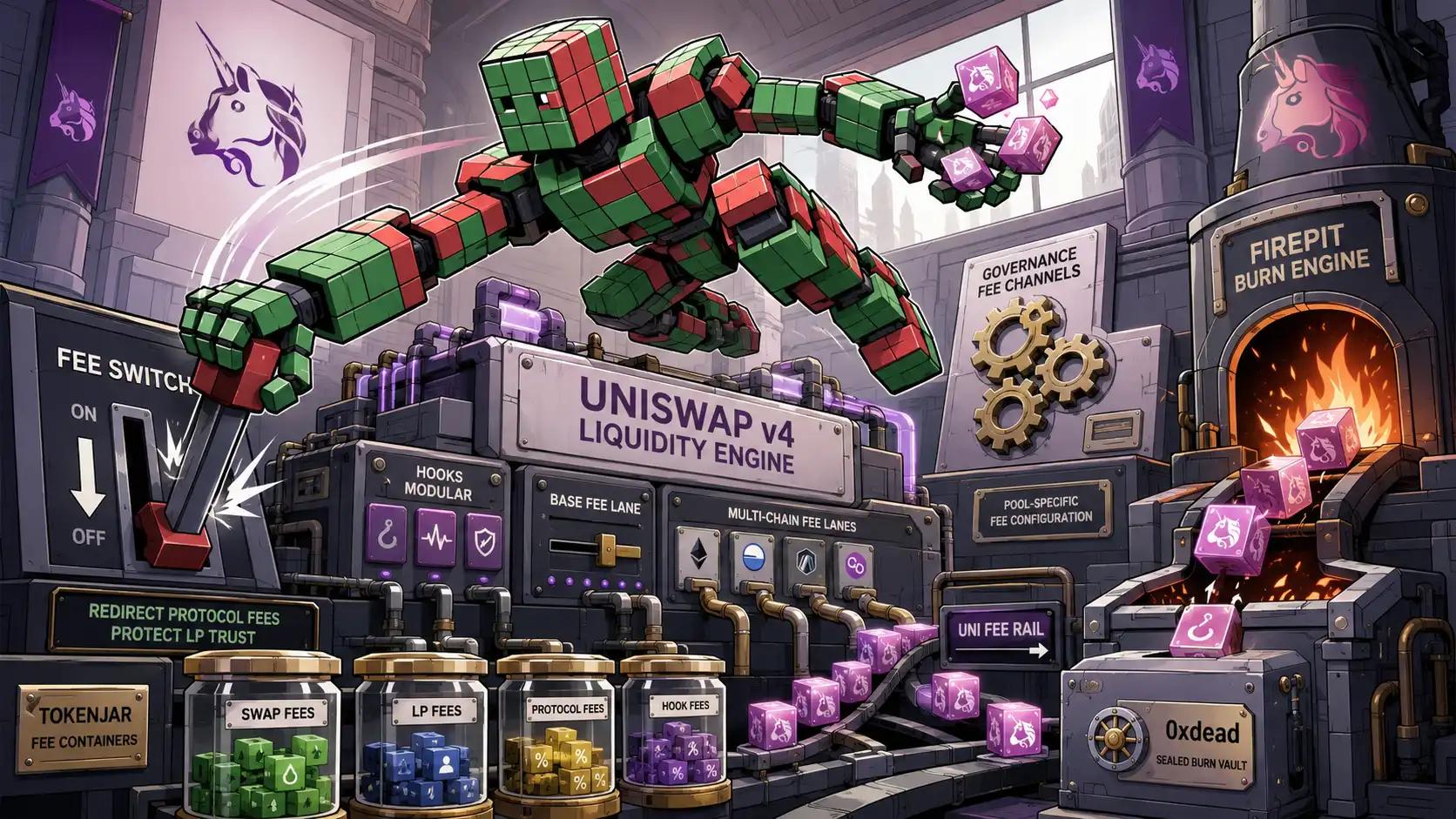
The UNIfication model is designed to connect Uniswap activity to UNI supply reduction. Traders pay fees on Uniswap, part of the fee flow can move to the protocol, and anyone claiming those protocol fees must burn an equal value of UNI. Burned UNI is bridged back to Ethereum and sent to the 0xdead address, permanently removing the tokens from circulation.
Two contracts sit at the center of that system. TokenJar collects trading fees, while Firepit burns UNI. The proposal also introduces a V4 Fee Controller to manage the extra complexity of v4 pools. V4FeePolicy determines the applicable fee according to governance rules, while V4FeeAdapter enforces those rules, adjusts fees for specific pools when needed and sends collected fees to TokenJar.
The additional architecture reflects the different design of Uniswap v4. Unlike v2 and v3, v4 uses hooks that let developers customize pool behavior, add extra features, enable multiple fee tiers and allow fees to change from one block to the next. The proposal is structured so governance can later replace the policy contract without rebuilding the entire fee system.
Liquidity provider pushback remains a central issue because activating fees on v4 would redirect part of the fee flow into protocol economics. Guillaume Lambert, founder of Panoptic, warned that taxing v4 could push liquidity providers away from Uniswap. Lambert said the v4 fee switch “risks killing the protocol” by favoring token holders over the liquidity providers who keep pools functional.
Uniswap’s earlier UNIfication vote passed in December 2025 with 125.34 million UNI votes in favor and 742 votes against. Before that proposal, UNI was described as a governance token with no direct link to Uniswap’s business performance, even though the protocol was generating around $600 million in annual fees. The July proposal would extend that fee-to-burn model further across the protocol.
We’ve launched the all-new COIN360 Perp DEX, built for traders who move fast!
Trade 130+ assets with up to 100× leverage, enjoy instant order placement and low-slippage swaps, and earn USDC passive yield while climbing the leaderboard. Your trades deserve more than speed — they deserve mastery.
Robinhood Chain Volume Rises After CASHCAT Trading Surge
Robinhood Chain became the other major source of Uniswap activity after Uniswap deployed on the new layer-2 network around July 1, 2026. Uniswap launched v2, v3, v4 and UniswapX on Robinhood Chain from day one. The chain was positioned for real-world assets and tokenized stock trading, but its first major breakout came from memecoin activity.
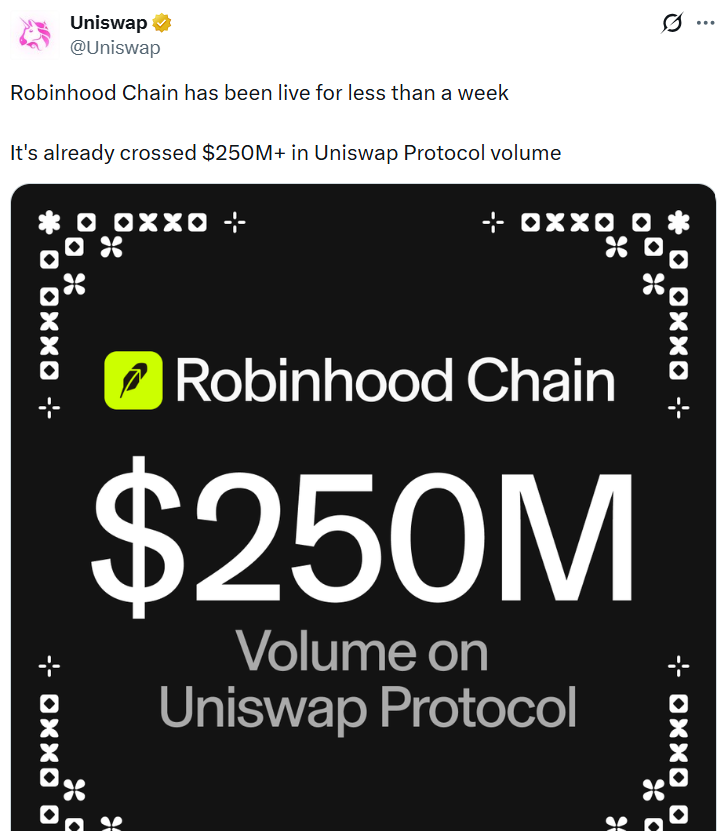
Uniswap’s official X account said on July 7, 2026, that trading volume on Robinhood Chain had surpassed $250 million within the first week of launch. Users can trade Robinhood’s tokenized equities, including AAPL, NVDA and GOOG, through the Uniswap Web App, Wallet and API. The deployment made Uniswap the chain’s default liquidity provider across multiple versions of the protocol.
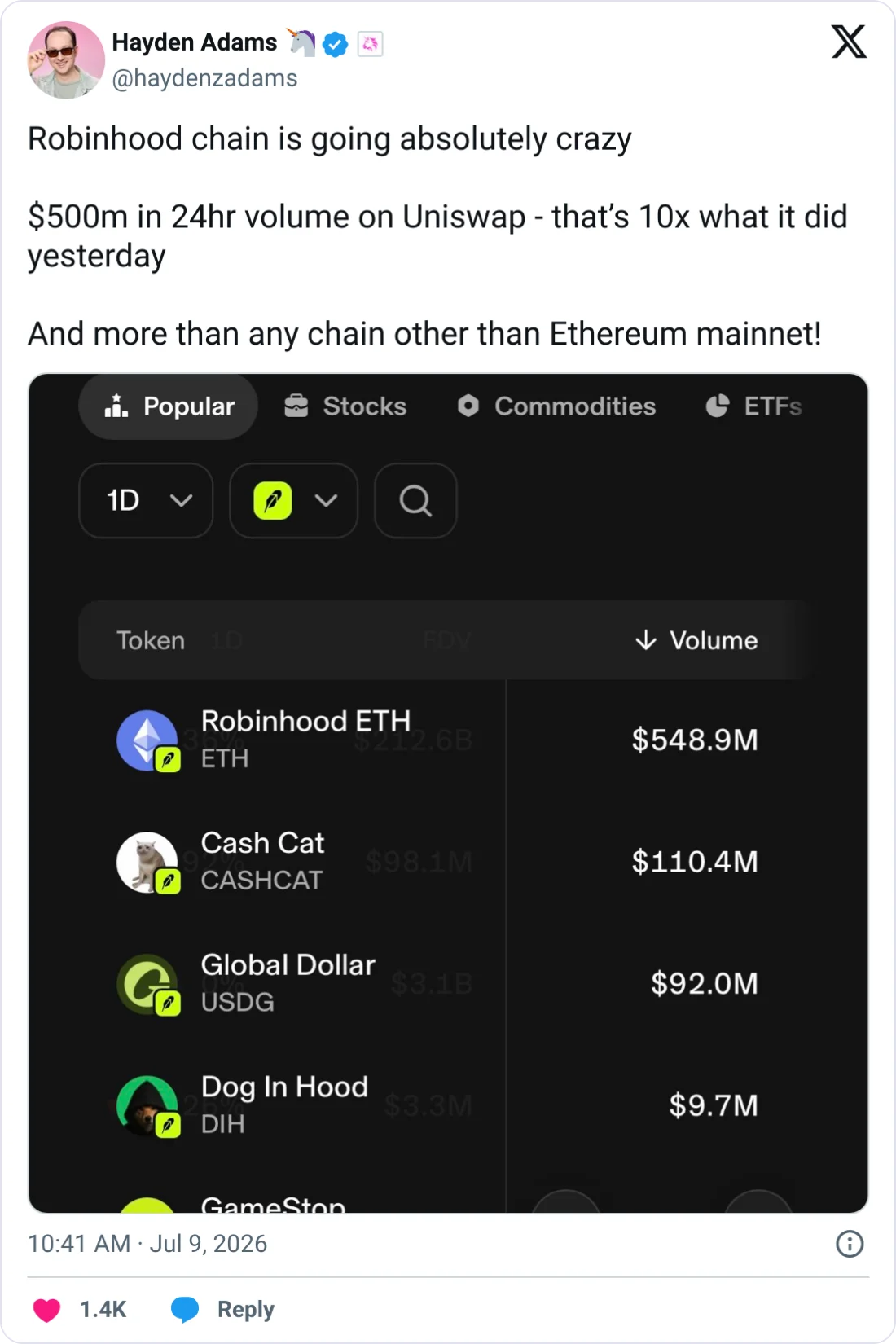
Robinhood Chain’s Uniswap volume reached $563.9 million on July 8, 2026, marking the network’s largest volume day since its July 1 mainnet launch. That daily figure was roughly 10 times the previous day’s $58.9 million. Uniswap founder Hayden Adams wrote on X: “Robinhood chain is going absolutely crazy.”
Adams added: “$500m in 24hr volume on Uniswap – that’s 10x what it did yesterday.” He also said the volume was “more than any chain other than Ethereum mainnet.” The spike put Robinhood Chain near the top of Uniswap’s network activity leaderboard during the period, with Ethereum mainnet remaining ahead.
CASHCAT was the main catalyst behind the July 8 activity. The memecoin is tied to Robinhood’s old “Cashcat” mascot and rose more than 10x within 24 hours, pushing its market capitalization above $100 million. CASHCAT’s market cap became roughly 8 times larger than Robinhood Chain’s entire tokenized asset market, which stood at $12.62 million.
CASHCAT activity pushed the chain’s Uniswap v3 WETH pair from the low tens of millions to $212.3 million in one day. Robinhood CEO Vlad Tenev responded to the meme activity by saying the RWA-focused chain “works great for memes too.” His comment underscored the gap between the chain’s real-world asset positioning and the type of trading that first drove its largest activity burst.
Pump.fun added Robinhood Chain support on July 8, 2026, lowering friction for retail token launches and trading. Pump.fun said Robinhood tokens were available on its app with “No bridging,” seamless SOL trading and access to trending Robinhood tokens. Pump.fun also said: “Never miss out again, no matter the meta. Only on the Pumpfun app.”
Geoff Kendrick, Head of Digital Asset Research at Standard Chartered, said the market was not properly recognizing the importance of the Uniswap-Robinhood partnership. Kendrick described it as a genuine strategic partnership and projected UNI could reach $6.50 by the end of 2026 and $100 by 2030. The projection was presented as Kendrick’s view, not a broader market consensus.
Token Auctions Add Another Burn Mechanism
The Protocol Fee Discount Auction mechanism added a third element to Uniswap’s busy week. The first PFDA auctions were for BWS and FOLD tokens. PFDA was introduced as part of UNIfication and is designed to capture value that automated market makers often leak to arbitrageurs or validators.
PFDA allows users to bid for trading rights without a fee. Winning bids are used to buy and burn UNI, linking auctions to the same token-supply reduction model as the protocol fee system. Together, the v4 fee switch proposal, Robinhood Chain deployment and PFDA auctions put Uniswap’s tokenomics discussion back at the center of its governance agenda.
The unresolved issue is whether the burn model can expand without weakening liquidity provider participation. If liquidity providers earn less under the fee switch, they may move liquidity to competing decentralized exchanges or Uniswap forks. That concern is especially sensitive for v4 because adoption remains early and the version’s hook-based design is still being integrated into the proposed fee framework.
FAQ
What is Uniswap voting on?
UNI holders are voting on extending the UNIfication fee-burning model to selected Uniswap v4 pools.
Why did Robinhood Chain volume jump?
CASHCAT trading drove the largest activity burst after Uniswap launched on Robinhood Chain.
What does UNIfication do?
UNIfication links protocol fee claims to UNI burns through TokenJar and Firepit.
What remains unresolved?
Liquidity provider reaction remains uncertain because protocol fees could reduce LP returns.
This article has been refined and enhanced by ChatGPT.


