




 USD
USD
Perp DEX: Why On-Chain Perpetuals Are Becoming Crypto’s Core Market Structure for 2026


Crypto narratives usually start with price. This one started with volume. If you want to understand where leverage, liquidity, and real risk are moving in crypto, you need to understand perp DEXs.
We’ve just launched the all-new COIN360 Perp DEX, built for traders who move fast!
Trade 130+ assets with up to 100× leverage, enjoy instant order placement and low-slippage swaps, and earn USDC passive yield while climbing the leaderboard. Your trades deserve more than speed — they deserve mastery.
Why Perp DEX Volume Signals Real Market Activity Has Moved On-Chain
The most important signal didn’t come from a product launch or a whitepaper. It came from the tape.
In early 2024, decentralized perpetual exchanges were processing only a few billion dollars per day. By late 2025, daily perp DEX volume was regularly exceeding $100 billion, with monthly volume crossing $1 trillion multiple times. In November alone, on-chain perpetuals accounted for roughly $1.3 trillion in trading, far surpassing on-chain spot volume during the same period.
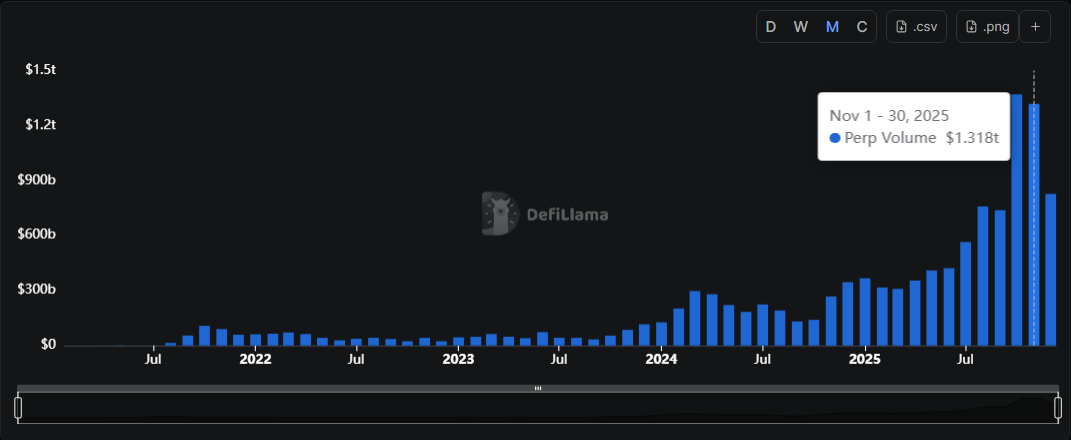
That shift matters. Volume reflects intent, not passive capital. When traders migrate leverage, they migrate price discovery. By late 2025, perp DEXs were already handling roughly 18–22% of global crypto perpetual volume, and that share was still climbing.
According to a year-end report from The Block, the DEX-to-CEX perpetual futures volume ratio surged from 6.3% to 18.7%, indicating a significant shift toward decentralized exchanges. Improvements in execution speed and user experience enabled more sophisticated trading. October witnessed the highest onchain derivatives volume to date, driven by a notable market drawdown on October 10.
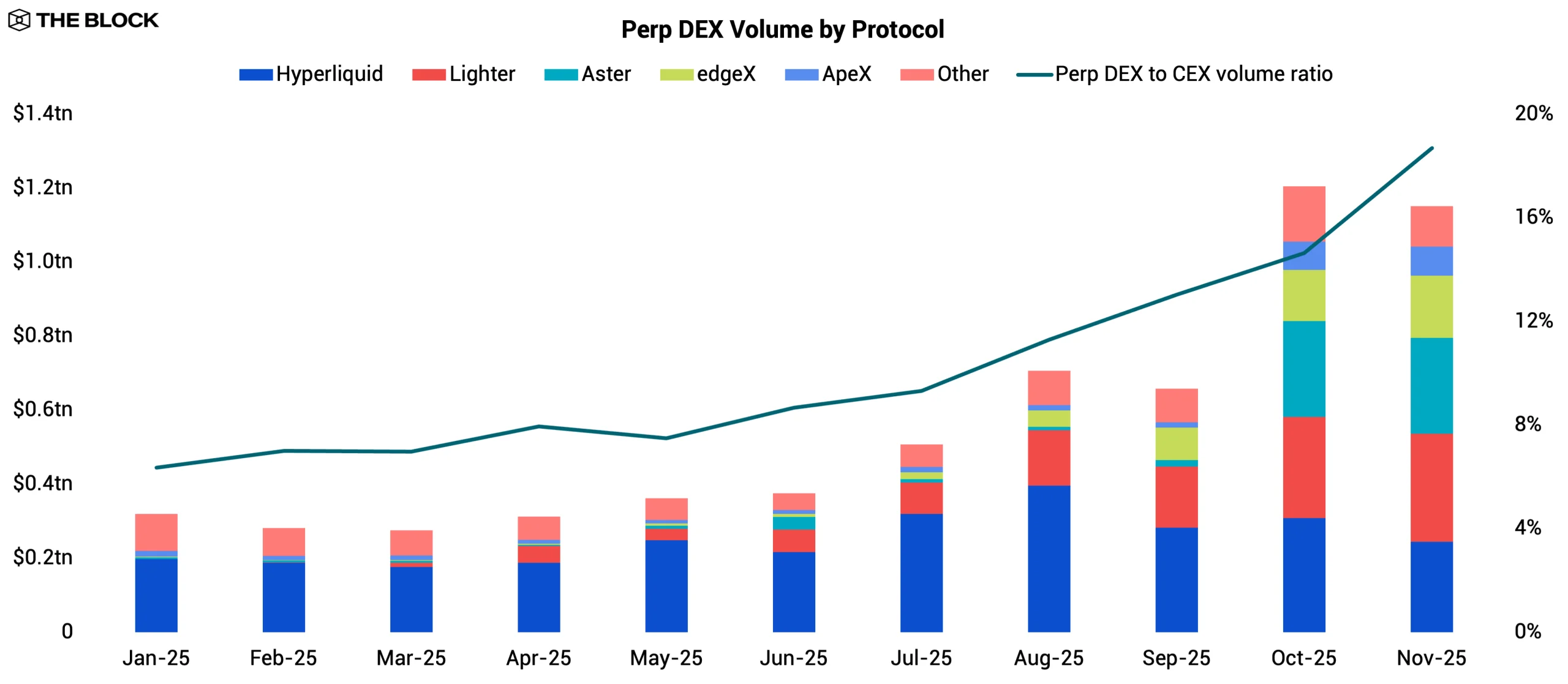
Bitwise’s Max Shannon noted that if DEXs continue to gain market share, trading volumes could hit $20–30 trillion in five years, driven by leverage, trading churn, institutional adoption, and clearer regulations.
This isn’t retail dabbling. Sustained trillion-dollar months only happen when professional traders, arbitrage desks, and market makers are active. The market didn’t just test perp DEXs. It stayed.
Why Perpetual DEX Models Are Becoming the Default for Crypto Derivatives
The structural appeal of a perp DEX isn’t ideological. It’s practical.
Centralized exchanges concentrate three risks in one place: custody, execution, and governance. When any of those fail, users lose access to capital. After FTX, many traders stopped treating that risk as theoretical.
Perp DEXs separate those layers. Traders keep custody. Execution is rule-based. Liquidation is enforced by code. That alone explains much of the migration.
There’s also an institutional signal worth noting. Coinbase Ventures has explicitly identified perp DEXs as a key crypto narrative for 2026, with a particular focus on perpetual derivatives tied to real-world assets. Their framing isn’t about DeFi ideology. It’s about capital efficiency, synthetic exposure, and global access without custody.
In other words, perp DEXs aren’t winning because they’re decentralized. They’re winning because they’re structurally better aligned with how modern trading actually works.
How Decentralized Perpetual Exchanges Change Counterparty Risk Compared to Centralized Exchanges
On a centralized exchange, every trade depends on the exchange remaining solvent, honest, and operational. That’s counterparty risk, even if it’s hidden behind a slick UI.
Perp DEXs remove that dependency. Margin sits in smart contracts, not corporate wallets. Positions are fully collateralized on-chain. If losses exceed maintenance margin, liquidation is automatic.
This doesn’t eliminate risk. It transforms it.
Instead of trusting a balance sheet, traders trust code and oracles. Smart-contract risk replaces credit risk. The difference is that smart-contract risk is visible, auditable, and bounded. There’s no overnight withdrawal freeze because someone misused customer funds.
From a trader’s perspective, that trade-off is rational. You can model oracle latency and liquidation thresholds. You can’t model human discretion during a crisis.
How a Perp DEX Works Without a Central Counterparty
The mechanics are simpler than they sound.
Every perp DEX does three things: enforces margin, tracks price, and balances longs and shorts via funding rates. The differences are in execution design.
Broadly, there are two dominant models:
- Pool-based models, where traders take positions against a shared liquidity pool supplied by LPs. Profits and losses flow between traders and the pool, with liquidations protecting solvency.
- Order-book models, where traders face each other directly, but margin, settlement, and liquidation are handled on-chain or via app-chain infrastructure.
In both cases, positions never expire. Funding rates periodically transfer value between longs and shorts to keep prices aligned with the underlying index.
The critical invariant is that leverage is always collateralized. There is no clearinghouse socializing losses. If margin fails, the position is closed. That’s how perp DEXs replicate futures markets without centralized risk managers.
Why Decentralized Perpetual Exchanges Can Finally Scale Today (and Couldn’t Before)
Earlier DeFi cycles tried and failed to make this work. The reasons were technical, not conceptual.
Ethereum L1 was too slow. Liquidity was too thin. Oracles lagged. UX was painful. Those constraints are mostly gone.
By 2025, perp DEXs were running on high-throughput L2s, custom app-chains, and even purpose-built L1s. Latency dropped to sub-second levels. Fees became negligible. Entire risk engines moved on-chain.
Liquidity matured too. Hundreds of millions in active liquidity and the return of professional market makers fundamentally changed execution quality. Cross-margining and multi-collateral systems improved capital efficiency, attracting larger traders.
This is why many crypto reports framed perp DEXs as a 2026 narrative rather than a DeFi experiment. The infrastructure finally caught up to the market’s demands.
Can Perp DEX and Perpetual DEX Platforms Replace Centralized Derivatives Exchanges?
Not entirely. Not yet.
Centralized exchanges still dominate absolute volume. They aggregate liquidity efficiently, offer fiat rails, and satisfy regulatory requirements for institutions that can’t self-custody.
But the direction of travel is clear. Core trading logic is moving on-chain. Execution venues are becoming modular. Centralized platforms increasingly look like access layers rather than market cores.
From that lens, perp DEXs don’t need to “kill” CEXs. They just need to keep absorbing marginal leverage. If that continues, the center of gravity shifts regardless.
The Real Trade-Offs for Perp DEX and Decentralized Perpetual Exchanges
Perp DEXs aren’t flawless.
Liquidity is fragmented across chains and protocols. Incentive programs can inflate volume without deep order books. Some platforms show extreme volume-to-TVL ratios that signal mercenary trading rather than organic demand.
UX remains a hurdle. Wallet management, bridging, and self-custody still intimidate new users. Mistakes are irreversible. There’s no customer support desk.
That said, experienced traders already tolerate these frictions in exchange for transparency and control. And UX improvements — account abstraction, social logins, better interfaces — are closing the gap quickly.
What Defines the Best DEX for Perpetual Trading in 2026
By 2026, the best dex for perpetual trading won’t be defined by marketing or raw volume. It will be defined by resilience.
Key benchmarks matter:
- Sustained organic volume and fee generation
- Deep liquidity during volatility, not just calm markets
- Sub-second execution and reliable uptime
- Robust oracle design and liquidation mechanics
- Capital efficiency through cross-margin and multi-collateral support
Coinbase’s 2026 thesis adds another dimension: synthetic exposure beyond crypto. Perp DEXs that support real-world asset derivatives, macro indices, or non-crypto benchmarks without custody will expand the addressable market dramatically.
The best perp DEX will feel less like an exchange and more like a global risk engine running in public.
For investors trying to compare platforms objectively, context matters. Liquidity depth, execution quality, supported markets, and real trading activity vary meaningfully across platforms, and these differences directly affect risk and performance. Rather than relying on anecdotal claims or token narratives, it’s more effective to benchmark the market directly.
At COIN360, we’ve curated a dedicated overview of the top perp DEXs to help investors cut through noise and compare platforms based on what actually matters. If you’re evaluating perp DEX exposure seriously, this list is designed as a practical reference point before committing capital or deeper research time.
Conclusion
Perp DEXs didn’t become relevant because of narratives. Narratives followed behavior.
When traders move leverage on-chain, infrastructure adapts. When institutions acknowledge it, the shift hardens. By 2026, perp DEXs won’t be an alternative. They’ll be part of the default mental model for how crypto markets actually function.


