




 USD
USD
Aave DAO Governance Turmoil Deepens as Brand Rights Vote and $10M Token Purchase Spark Power-Concentration Fears


Snapshot Vote Escalation and Founder Token Accumulation Put Aave’s Governance Model Under the Microscope
TL;DR
- Aave Labs pushed a disputed brand-rights proposal to a Snapshot vote amid active debate, triggering backlash from delegates and contributors.
- Founder Stani Kulechov faced scrutiny after a $10 million AAVE purchase that critics say boosted voting power ahead of the vote.
- Snapshot data shows voting power is highly concentrated, with the top three voters controlling over 58% of total weight.
We’ve just launched the all-new COIN360 Perp DEX, built for traders who move fast!
Trade 130+ assets with up to 100× leverage, enjoy instant order placement and low-slippage swaps, and earn USDC passive yield while climbing the leaderboard. Your trades deserve more than speed — they deserve mastery.
Aave’s decentralized governance model is facing renewed scrutiny after a rapid escalation of a contentious proposal and a closely timed token purchase by its founder intensified concerns over voting power concentration. Governance tensions resurfaced after Aave Labs moved a proposal on brand-asset ownership directly to a Snapshot vote, a step critics described as premature and procedurally aggressive while discussions were still ongoing. The vote was scheduled to open on Dec. 23, 2025, compressing what many delegates believed should have been a longer deliberation period for a decision that could permanently reshape control over the protocol’s identity and intellectual property.
The proposal, formally titled “ARFC $AAVE token alignment. Phase 1 – Ownership,” seeks to grant AAVE token holders explicit control over key brand assets tied to the protocol. These include domains, social media accounts, naming rights, GitHub organizations, NPM namespaces and other channels historically stewarded by Aave Labs, BGD Labs and affiliated contributors. Supporters frame the move as a logical step toward decentralization, pairing brand ownership with token governance and proposing DAO-controlled legal structures alongside anti-capture protections. Opponents, however, argue that the process by which the proposal advanced mattered as much as its substance, warning that bypassing established governance norms risks eroding trust regardless of the outcome.
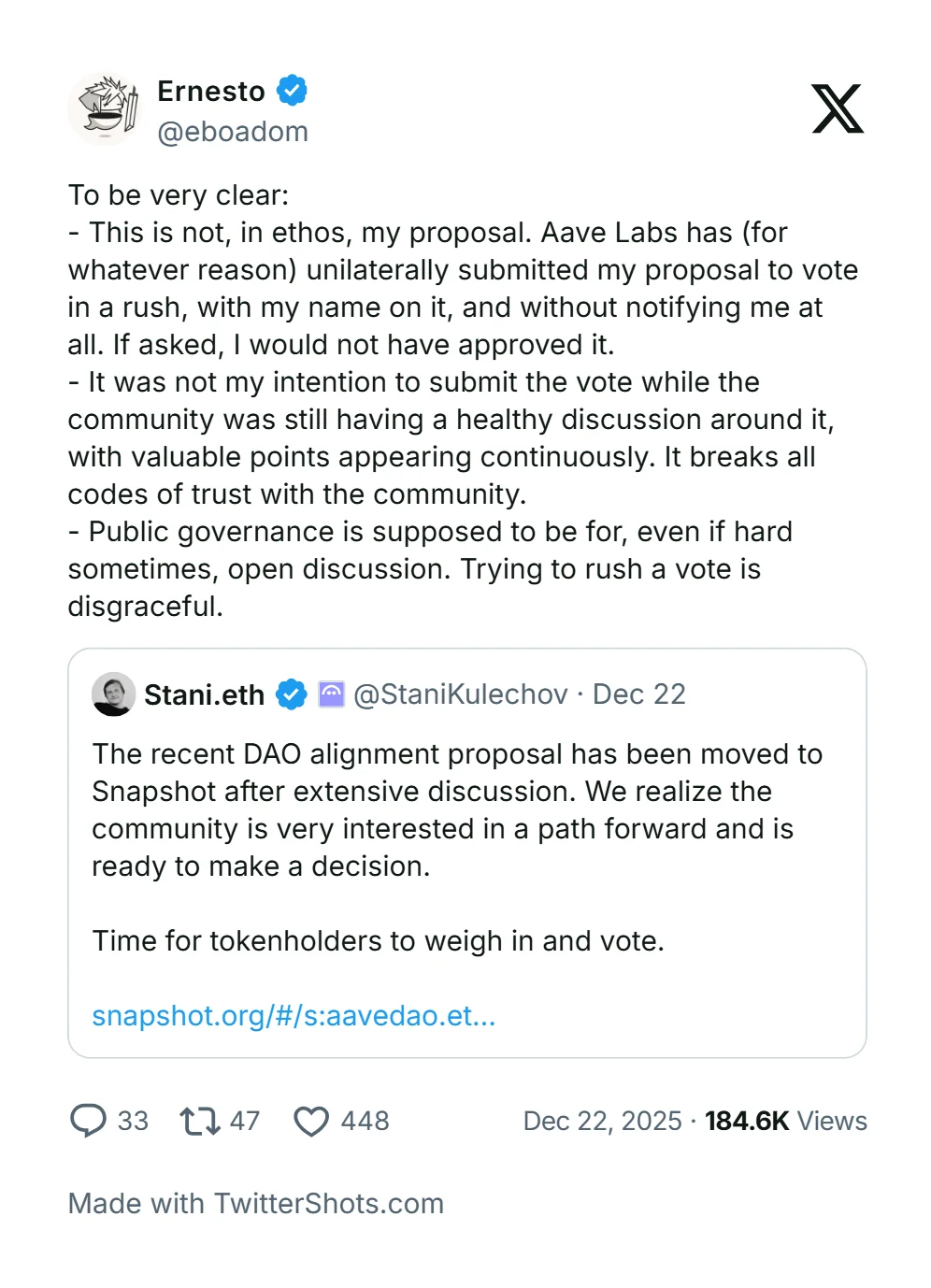
Community reaction sharpened after Ernesto Boado, former Aave Labs CTO and the listed author of the proposal, said the Snapshot escalation occurred without his consent. Boado publicly stated that the move broke established expectations around governance process, reinforcing claims that the decision was accelerated unilaterally rather than emerging from broad consensus.
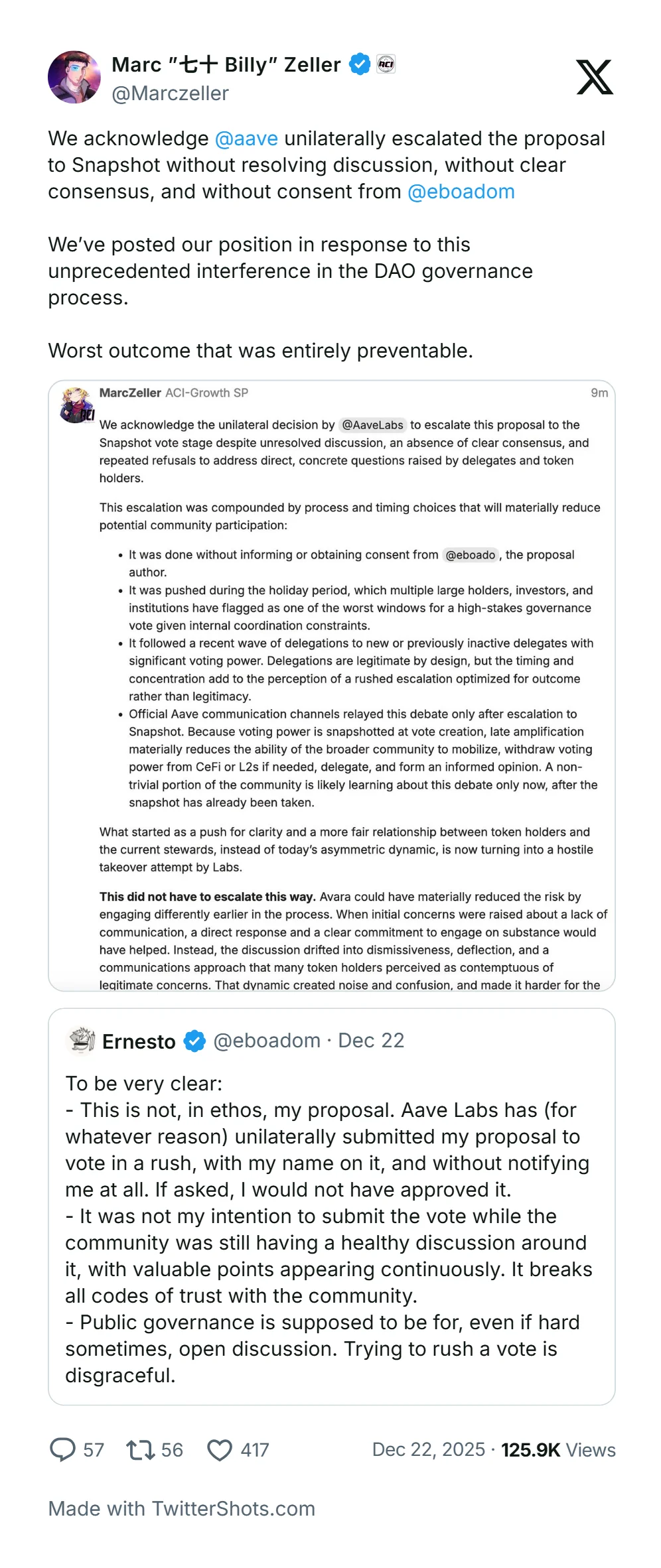
Critics went further, characterizing the maneuver as a “hostile takeover attempt” because brand assets represent strategic leverage that extends beyond on-chain code into legal, reputational and operational control.
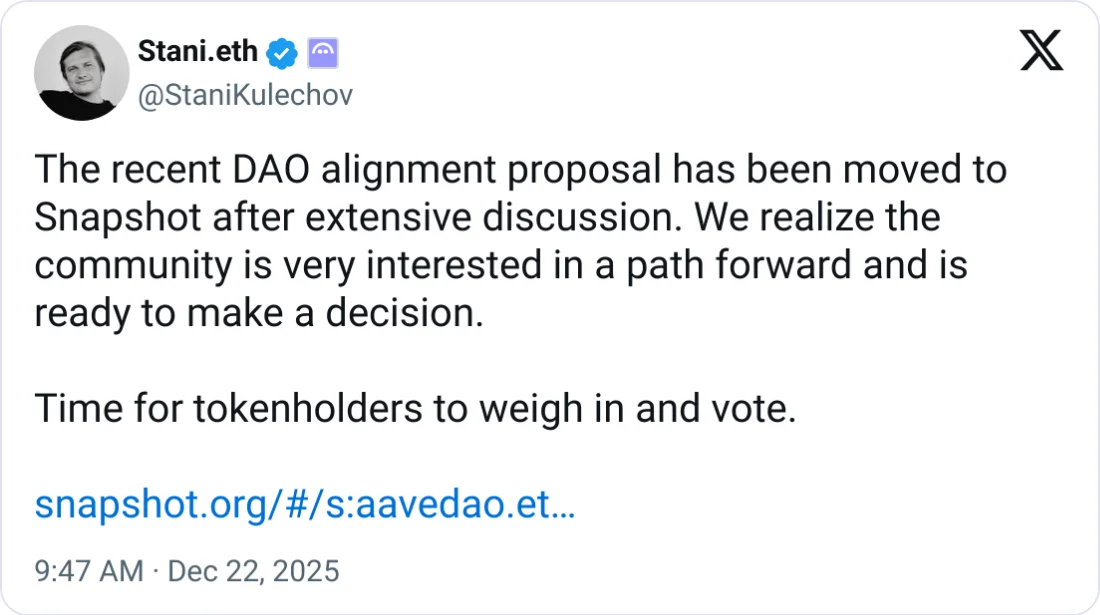
Aave founder Stani Kulechov defended the escalation, saying the proposal followed extensive discussion and that the DAO was ready to make a decision. That defense gained little traction after a separate controversy surfaced around a $10 million AAVE token purchase attributed to Kulechov shortly before the governance vote. Market participants and governance commentators argued that the timing of the purchase effectively increased his voting influence at a critical moment, reigniting long-running debates about whether token-based governance sufficiently guards against power consolidation by founders or early insiders.

Public criticism focused not only on the size of the purchase but also on historical context. Several commentators questioned the economic rationale of reaccumulating such a large position, pointing to claims that millions of dollars’ worth of AAVE tokens may have been sold by the founder between 2021 and 2025. From this perspective, the episode underscored how voting power can be rapidly rebuilt when governance stakes rise, regardless of prior positioning. A DeFi strategist described the move as a clear example of token systems struggling to disincentivize governance attacks, particularly when high-value proposals are on the table.
Underlying data from Snapshot added weight to those concerns. Voting records show that governance influence within the Aave DAO is heavily concentrated, with the top three voters accounting for more than 58% of total voting weight. The largest single wallet controls roughly 27% on its own, a distribution critics say leaves outcomes vulnerable to coordination among a small number of large holders. Observers noted that such concentration can overshadow broader community sentiment, even when participation appears robust on the surface.
The governance dispute unfolded against a backdrop of heightened attention to Aave across trading desks and analytics platforms, where shifts in governance can influence protocol risk assessments reflected in crypto price movements and the crypto price index used by traders. While the controversy did not immediately translate into dramatic swings in crypto price or coin market cap metrics, analysts noted that governance credibility increasingly factors into how markets value large DeFi protocols.
This article has been refined and enhanced by ChatGPT.


