




 USD
USD
Balancer Proposes Shutdown as CoinEx Announces Closure After Nine Years

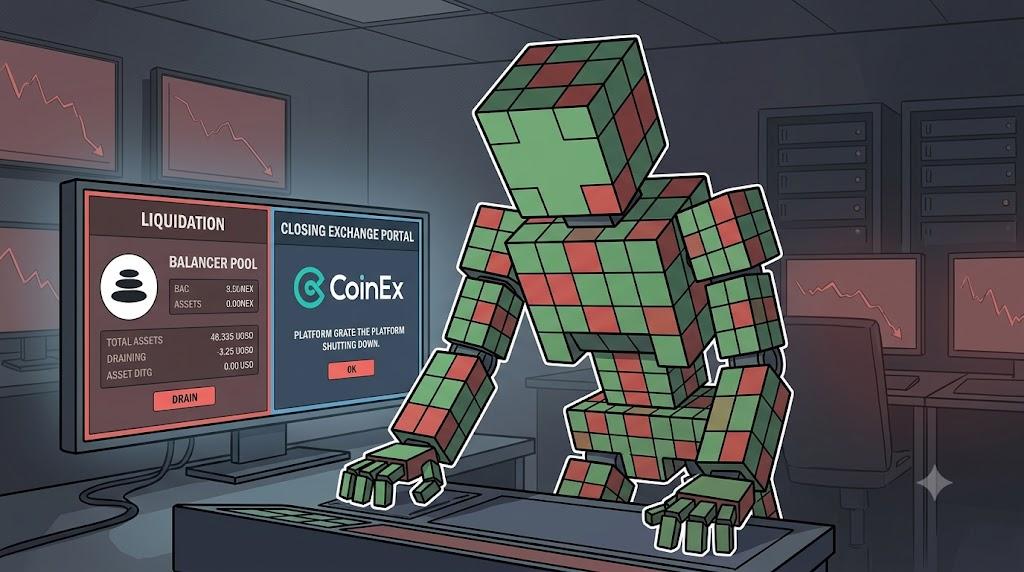
Two crypto businesses outline separate wind-down plans amid financial, security and compliance pressures
TL;DR
- Balancer is asking BAL holders to approve an orderly protocol shutdown and distribute at least $9 million in treasury assets through token redemptions.
- CoinEx announced it will close after nine years, citing weaker market conditions, declining liquidity and increasing security and compliance risks.
- Both plans use extended withdrawal or redemption periods rather than immediate closures, with some final claims extending into 2028.
Trade smarter on Jupiter, Solana’s leading DEX built for fast execution and deep liquidity.
Swap tokens at competitive rates, route across multiple liquidity sources automatically, and access perpetuals, DCA, and advanced trading tools — all in one place!
Balancer has proposed winding down its decentralized finance protocol and returning its remaining treasury to BAL holders, while crypto exchange CoinEx separately announced that it will shut down after nine years of operation. Balancer’s plan remains subject to governance approval, with a Snapshot vote expected from September 25 through September 29, 2026, while CoinEx began its closure process on September 15, 2026.
Balancer Seeks Approval for an Orderly Protocol Wind-Down
Balancer’s proposal was posted by Marcus Hardt, a treasury council member and former Balancer Labs CEO, and would end new business development, move the protocol through a phased shutdown and close the DAO as fully as possible from a legal and practical standpoint. The plan would cancel a previously approved BAL token buyback program and replace it with a direct redemption process that allows eligible holders to burn BAL and receive a proportional share of treasury assets.
Balancer’s treasury currently contains at least $9 million worth of tokens. Assets would be distributed in kind rather than being converted into a single asset before distribution. Additional assets held in other DAO wallets and positions would first be identified and brought into the treasury inventory. BAL already held by the treasury generally would not participate in the redemption, although the proposal includes an exception involving tetuBAL, a liquid staking wrapper token.
Hardt framed the proposal as the end result of an earlier attempt to put Balancer on a sustainable footing. “Balancer tried.” He said BAL holders had approved a restructuring plan in April 2026 designed to bring the protocol to profitability through a leaner operating model.
Hardt summarized that earlier plan directly: “In April, token holders approved a plan to take the protocol to profitability on a restructured base: costs cut, emissions ended, the token model simplified, protocol revenue routed to the DAO, growth expected from v3.”
Some parts of that restructuring effort gained traction, according to Hardt, but they did not produce sustained revenue growth. The proposed wind-down would therefore replace efforts to continue operating the protocol with a staged process focused on withdrawals and treasury distribution.
If BAL holders approve the proposal, Balancer pools would move into withdrawals-only mode on October 30, 2026, while contributor notice would continue through October 31, 2026. Balancer has said nothing changes before the governance vote.
The first treasury-redemption window would begin at the end of May 2027 and remain open for six months. Eligible BAL holders participating in that window would burn their tokens and receive their proportional share of the treasury.
After that first window closes, participating addresses would receive a second-round airdrop within two months. That distribution would include unused wind-down funds, assets or revenues received after the initial distribution and shares corresponding to BAL that was not redeemed during the first window.
A final sweep would occur six months later, distributing additional assets or inflows remaining after the earlier stages of the wind-down.
The proposal follows a series of setbacks for Balancer. Balancer Labs, the protocol’s corporate entity, ceased operations roughly six months before the September proposal after citing fallout from an exploit.
That exploit occurred on November 3, 2025, draining approximately $128 million from Balancer v2 pools across multiple blockchain networks. Balancer later moved through the restructuring approved the following spring before governance began considering a full protocol sunset.
CoinEx Sets Withdrawal Deadlines as Exchange Prepares to Close
CoinEx separately announced on September 15, 2026 that it would close after nine years of operation, citing a prolonged crypto market downturn, shrinking industry trading volume, deteriorating liquidity, higher regulatory requirements and increasing compliance costs.
The Seychelles-based exchange stopped accepting new user registrations on the day of the announcement. Most exchange services are scheduled to end on September 29, 2026, while withdrawals will remain available until December 22, 2026.
Assets left on CoinEx after regular exchange services end may be sold into USDT. After the withdrawal deadline, remaining USDT will be transferred into independent custody.
That custody arrangement will charge 5% of the original balance every month, creating an ongoing cost for users whose funds remain there. Customers whose assets enter independent custody will have until August 22, 2028 to submit custody claims.
CoinEx Founder and CEO Haipo Yang said the closure followed a broader reassessment of the risks involved in continuing to operate the exchange. “After much reflection, I have come to accept a hard truth.”
Yang identified security and compliance pressures as central to the decision. “The security and compliance risks of running a crypto exchange have become increasingly difficult to contain.”
Yang said he had seriously considered selling CoinEx rather than closing it, but ultimately chose what he called a “clean ending.”
Reflecting on the exchange’s history, Yang said: “Nine years, millions of users. I did not turn CoinEx into the ‘great’ exchange I once hoped it would become.”
He said the shutdown would instead focus on returning customer assets and managing the departure of employees. “But I can give it a decent ending: making sure users can withdraw their assets in full, giving my employees a dignified farewell.”
CoinEx said it had served users across more than 200 countries and regions during its operating history. The exchange had already exited the U.S. market in 2023 after a legal dispute with the New York attorney general, which accused CoinEx of operating without proper registration. CoinEx settled the lawsuit and left the U.S. market.
Earlier in 2026, TRM Labs alleged that CoinEx had processed more than $3.8 billion in flows linked to Iranian entities since 2019. TRM Labs said the activity included flows linked to Nobitex and other sanctioned counterparties. The figure was an allegation by TRM Labs and not an admission by CoinEx.
CoinEx characterized its shutdown as the cumulative result of weakening market conditions, falling volumes and liquidity, security exposure, greater regulatory requirements and rising compliance costs rather than as the result of a single hack or insolvency.
This article has been refined and enhanced by ChatGPT.


