




 USD
USD
Bermuda Unveils Plan to Build a Fully Onchain National Economy With Coinbase and Circle at Davos

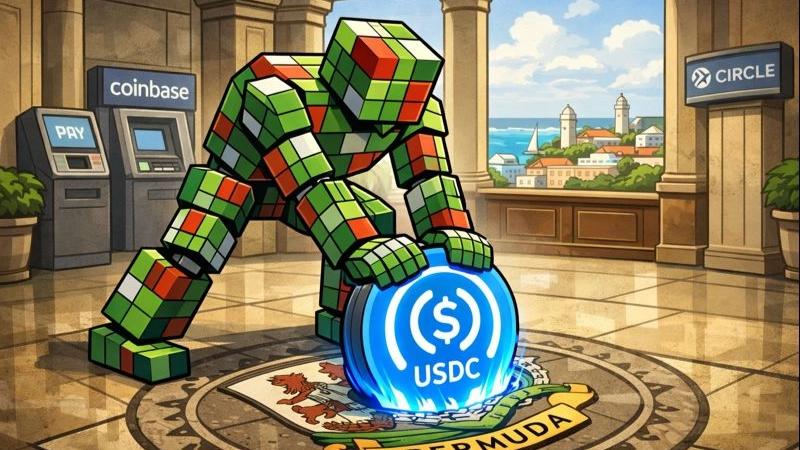
Government Targets Stablecoin Payments, USDC Adoption, and Public-Sector Pilots Across the Island
TL;DR
- Bermuda announced plans on January 19, 2026, to become the world’s first fully onchain national economy with support from Coinbase and Circle.
- The initiative centers on USDC-based payments, government pilots, and nationwide digital finance education.
- The plan builds on Bermuda’s 2018 Digital Asset Business Act and follows a 100 USDC airdrop at the Bermuda Digital Finance Forum 2025.
We’ve launched the all-new COIN360 Perp DEX, built for traders who move fast!
Trade 130+ assets with up to 100× leverage, enjoy instant order placement and low-slippage swaps, and earn USDC passive yield while climbing the leaderboard. Your trades deserve more than speed — they deserve mastery.
Bermuda announced on January 19, 2026, that it plans to transform the island into what it describes as a “fully onchain” national economy, partnering with Coinbase and Circle to deploy digital asset infrastructure across government agencies, financial institutions, businesses, and consumers. The announcement was made during the World Economic Forum Annual Meeting in Davos, Switzerland, positioning the initiative within a global policy and financial setting rather than a domestic regulatory update.

The government said Coinbase and Circle will provide enterprise-grade digital asset infrastructure and tools to public agencies, local banks, insurers, small and medium-sized businesses, and residents. Both companies will also support nationwide digital finance education and technical onboarding programs as part of the rollout. Officials described an onchain economy as one that uses digital assets as everyday financial infrastructure, rather than limiting blockchain applications to isolated pilots or experimental use cases.
Bermuda framed the initiative as a response to structural payment challenges faced by small island economies. Government statements said traditional payment rails are expensive and restrictive for a highly entrepreneurial economy with thousands of local businesses. Being grouped with Caribbean and other island jurisdictions can raise transaction fees and limit access to onshore payment processors and fiat banking services, creating pressure on already thin merchant margins.
Stablecoins were identified as the operational core of the plan, with USDC positioned as the primary payment instrument. According to the announcement, USDC allows merchants to accept fast, low-cost, dollar-denominated payments while meeting compliance requirements. Officials said there are already several live examples of USDC payments operating in the Bermudian market, enabling local transactions through digital wallets in commercial settings.
Government agencies are expected to begin piloting stablecoin-based payments as part of the initiative, while financial institutions will integrate tokenization tools into their operations. Residents are also slated to participate in nationwide digital literacy programs designed to support adoption of onchain payments and services. The government said these efforts are intended to lay the foundation for broad-based participation across the economy.
The plan builds on Bermuda’s regulatory framework established in 2018, when the country introduced the Digital Asset Business Act, described by officials as one of the first comprehensive digital asset regulatory regimes. Coinbase and Circle were among the first global firms licensed under that framework, and Coinbase currently operates derivatives offerings outside the U.S. through a Bermuda-based platform.
Momentum for the initiative increased at the Bermuda Digital Finance Forum 2025, held in May 2025, where the government, Coinbase, and Circle executed an onchain airdrop of 100 USDC to every attendee. The funds were intended for use with newly onboarded local merchants. Following the event, additional Bermudian businesses began accepting digital payments, and local financial institutions expanded their use of stablecoins and tokenized finance.
Further expansion is planned at the Bermuda Digital Finance Forum 2026, scheduled for May 11–14, 2026. Organizers said the event will include broader business participation, a larger consumer stimulus than prior efforts, and deeper engagement across the financial services sector, building on the initial USDC distribution and merchant onboarding.
Premier E. David Burt said the initiative is aimed at reducing costs and expanding access to modern financial infrastructure. “This initiative is about creating opportunity, lowering costs, and ensuring Bermudians benefit from the future of finance,” Burt said in a statement. He also described Bermuda’s approach as a collaborative model between government, regulators, and industry designed to enable responsible innovation at a national scale.
Circle Co-Founder and CEO Jeremy Allaire said Bermuda’s regulatory approach has positioned it as a global reference point for blockchain adoption. “Bermuda has been a global pioneer in digital asset regulation and continues to demonstrate what responsible blockchain innovation looks like at a national scale,” Allaire said. “We are proud to deepen our engagement as Bermuda empowers people and businesses with USDC and onchain infrastructure.”
Coinbase CEO Brian Armstrong linked the initiative to the role of clear regulatory frameworks in enabling adoption. “Coinbase has long believed that open financial systems can drive economic freedom,” Armstrong said. “Bermuda’s leadership shows what’s possible when clear rules are paired with strong public-private collaboration. We are excited to support Bermuda’s transition toward an onchain economy that empowers local businesses, consumers, and institutions.”
The government said the transition to an onchain economy is expected to lower transaction costs, increase access to global finance through digital wallets, and keep economic value circulating locally. Officials also noted that the initiative operates independently of fluctuations in crypto price, crypto price index movements, or coin market cap dynamics, focusing instead on payment infrastructure and financial services integration at the national level.
This article has been refined and enhanced by ChatGPT.


