




 USD
USD
Treasury Secretary Bessent presses Senate on CLARITY Act as CFTC fights states


Treasury and derivatives regulator intensify separate crypto policy battles
TL;DR
- Treasury Secretary Scott Bessent urged Congress on April 9, 2026, to move the CLARITY Act after it passed the House and stalled in the Senate.
- The main unresolved issue is whether stablecoin issuers should be allowed to pay yield, with banks, some crypto firms, and Senate Democrats still objecting for different reasons.
- The CFTC separately moved to block Arizona from enforcing state gambling laws against prediction markets, expanding a wider federal-state jurisdiction fight.
We’ve launched the all-new COIN360 Perp DEX, built for traders who move fast!
Trade 130+ assets with up to 100× leverage, enjoy instant order placement and low-slippage swaps, and earn USDC passive yield while climbing the leaderboard. Your trades deserve more than speed — they deserve mastery.
Treasury Secretary Scott Bessent is pressing Congress to advance the Digital Asset Market Clarity Act while the Commodity Futures Trading Commission is mounting a separate court fight over prediction markets, leaving two major U.S. crypto policy battles moving at the same time. The CLARITY Act has already passed the House but remains stuck in the Senate, while the CFTC is trying to stop Arizona and other states from applying gambling laws to event contracts it says fall under federal law.
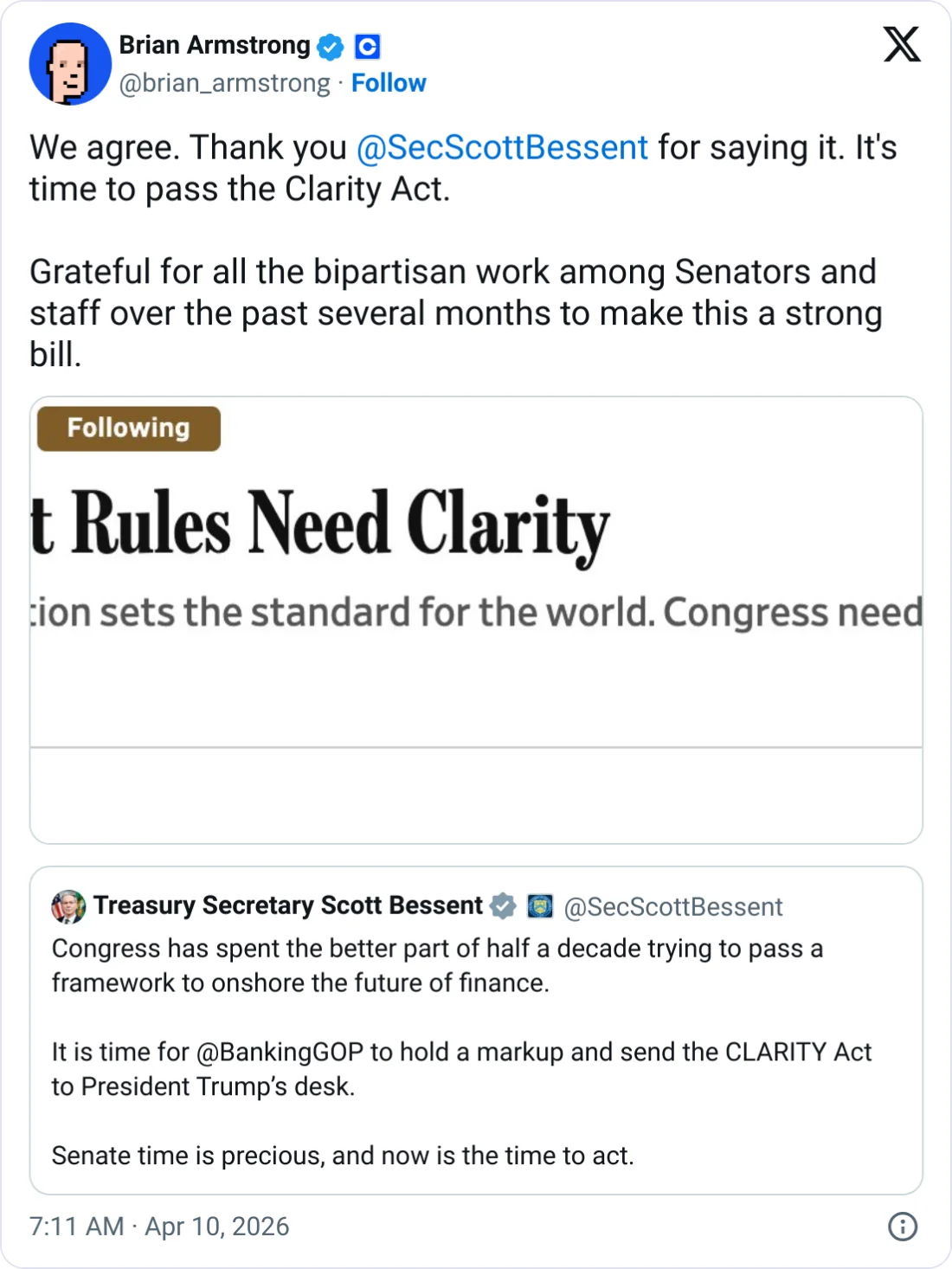
Bessent escalated that push on April 9, 2026, urging Senate Banking Republicans to mark up the bill and send it to President Donald Trump. He argued that after “the better part of half a decade” of work, “Senate time is precious, and now is the time to act.” He also framed the legislation as a competitiveness issue, saying crypto development has moved to jurisdictions with clearer rules, including Abu Dhabi and Singapore, and that only “durable law” can give developers and entrepreneurs the confidence to bring activity back to the United States.
The bill’s current status is clear. The CLARITY Act passed the House in July 2025 by a 294–134 vote, but it has remained stalled in the Senate for more than 260 days. The main unresolved issue is whether stablecoin issuers should be allowed to pay yield or interest to holders. The legislation is described as the broader follow-on to the GENIUS Act, which passed in July 2025 and set a federal framework for payment stablecoins, including a 1:1 reserve requirement backed by high-quality liquid assets such as U.S. Treasuries.
The CLARITY Act is intended to address the wider market-structure questions left unresolved by that earlier law. Under the proposed framework, the CFTC would become the primary regulator for digital commodity spot markets, while assets deemed investment contracts would remain under Securities and Exchange Commission oversight. That split is meant to resolve the long-running jurisdiction fight that has left exchanges, token issuers, and institutional investors operating without a settled federal perimeter.
CFTC leadership quickly aligned itself with Bessent’s push. Mike Selig publicly agreed that Congress should move the bill, reinforcing the message that the executive branch is converging around a unified digital-asset framework even as the measure remains blocked by disputes over stablecoin design and political objections unrelated to market structure.
Coinbase CEO Brian Armstrong openly supported the push to pass the bill after Treasury Secretary Scott Bessent called for Congress to act swiftly on regulating digital assets.
Stablecoin yield remains the central obstacle
The strongest policy argument against yield-bearing stablecoins was weakened on April 8, when the White House Council of Economic Advisers released an analysis finding that stablecoin yields pose only a quantitatively small risk to traditional bank deposits. The analysis said restricting those yields would do little to improve bank stability while reducing consumer options.
That did not end the fight. The banking lobby is still pushing to tighten or preserve a yield prohibition, warning that allowing customers to earn returns on dollar-pegged tokens outside the capital, insurance, and supervisory framework applied to banks could accelerate deposit outflows, particularly from smaller community banks. Industry opposition has also not disappeared. Coinbase withdrew its support for the CLARITY Act in January over language that could restrict stablecoin-yield programs.
A bipartisan Senate group and the White House floated a compromise last month, but that draft reportedly upset Coinbase. A newer revision is now drawing resistance from the banking industry instead. Bessent sharpened his criticism of internal opposition by calling some holdouts “industry nihilists,” and one account of the debate said he signaled that those resisting any workable framework should consider relocating to places such as El Salvador rather than blocking a U.S. market-structure law.
Political timing is adding more pressure. Congressional leaders are concerned the bill must move this spring because the 2026 midterm cycle could make meaningful legislating harder over the summer. Senate Republicans still want to hold a delayed vote later this month even though major stakeholder disputes remain unresolved. Another obstacle is the politics around President Trump’s personal crypto businesses, which several pro-crypto Senate Democrats have said must be outlawed or otherwise addressed before they will support the measure, a demand the White House has rejected.
TD Cowen's analysis of the recent White House report on stablecoins indicates that it is unlikely to alleviate the political challenges facing crypto legislation, particularly the Clarity Act. The report, released by the White House Council of Economic Advisers, suggests that prohibiting yield on stablecoins will not significantly affect bank lending, estimating only a modest increase of $2.1 billion—representing 0.02% of total loans. While this perspective aligns more closely with the crypto industry's stance, banks continue to view stablecoins as a threat to their deposits, which could lead them to oppose the legislation unless it includes a ban on stablecoin yields.
Supporters are also trying to make the economic case for moving the bill now. They argue that roughly one in six Americans hold digital assets and that the global crypto market cap stands at about $3 trillion. They also say a clearer U.S. framework could improve anti-money-laundering oversight rather than continue pushing activity offshore.
Market pricing reflects some optimism but not certainty, with Polymarket traders putting the odds of the CLARITY Act becoming law in 2026 at roughly 63% to 72%. Meanwhile, Jaret Seiberg from TD Cowen highlighted the political obstacles, projecting only a one-in-three chance of the bill passing this year, with potential delays pushing implementation to 2029 if hurdles remain.
FAQ
What is blocking the CLARITY Act?
The main unresolved issue is whether stablecoin issuers can pay yield or interest.
How long has the bill been stalled?
It has remained stalled for more than 260 days.
What is the estimated chance of passage in 2026?
Polymarket traders estimate roughly 63% to 72%.
This article has been refined and enhanced by ChatGPT.


