




 USD
USD
Binance Faces EU License Risk as DeFi Leverage Hits 38%

Greek MiCA Decision Could Force Binance Service Changes Across Europe
TL;DR
- Binance may lose access to European Union customers if its Greek MiCA application is rejected before the end-of-June regulatory cutoff.
- Binance said it believes its application met MiCA requirements and that Europe remains central to its long-term plans.
- Binance Research said DeFi’s on-chain leverage ratio reached about 38%, while April hacks and exploits drove $13 billion from protocols.
Trade smarter on Jupiter, Solana’s leading DEX built for fast execution and deep liquidity.
Swap tokens at competitive rates, route across multiple liquidity sources automatically, and access perpetuals, DCA, and advanced trading tools — all in one place!
Binance may be forced to halt services for European Union clients if Greece’s Hellenic Capital Market Commission rejects its application for a Markets in Crypto-Assets license before the bloc’s transition period expires around the end of June, according to Reuters, which cited two sources familiar with the matter.
Reuters reported on June 16, 2026, that Binance’s application through Greece’s Hellenic Capital Market Commission was expected to be rejected. The decision, if finalized, could prevent Binance from using the EU’s MiCA framework to serve customers across the bloc through regulatory passporting.
Binance had established a holding company in Greece in December 2025 and formally applied for a MiCA license in January 2026 through the Hellenic Capital Market Commission. A successful authorization through Greece could have allowed Binance to extend services into other EU markets, including France, Spain and Germany.
The timeline places Binance close to a regulatory cliff. One account of the situation framed the key cutoff as a June 30 license deadline, while another emphasized that the MiCA transition phase expires on July 1, 2026. The practical risk is that Binance could lose its ability to serve EU residents at the end of June or the start of July if the application is denied.
Binance is described as the world’s largest crypto exchange by volume and the world’s top crypto exchange by daily trading volume. That makes the reported licensing setback a significant operational issue for the exchange, not merely a procedural delay.
Binance Says It Believes Its Application Was Compliant
Binance pushed back against the reported rejection, saying it believes it is operating in compliance with applicable EU laws. A Binance spokesperson said the exchange had pursued a MiCA license and worked constructively with regulators over the past 18 months, including through a comprehensive application process with the Hellenic Capital Market Commission in Greece.
The Binance spokesperson said Binance understood that the Hellenic Capital Market Commission had completed its review and considered the application compliant with MiCA requirements. Binance also said it had received no indication that its application would be rejected.
Binance posted on X that its priority was to “minimize disruption” and keep users informed. Binance said it would provide further details directly as more information became available, including next steps and available options.
Binance also said in a blog post that Europe remains “central to [its] long-term plans” and that it remains willing and ready to operate under a “truly harmonized MiCA regime.”
Binance CEO Richard Teng said in a June 16, 2026 post that Binance was committed to securing a MiCA license and operating under a “clear, fair and harmonised” regulatory framework.
The licensing issue follows Binance’s broader effort to rebuild regulatory relationships after anti-money-laundering compliance failures. Binance reached a $4.3 billion settlement with the U.S. in 2023 tied to compliance failures. Former Binance CEO Changpeng Zhao received a four-month prison sentence connected to that U.S. case and was later pardoned by President Donald Trump.
We’ve launched the all-new COIN360 Perp DEX, built for traders who move fast!
Trade 130+ assets with up to 100× leverage, enjoy instant order placement and low-slippage swaps, and earn USDC passive yield while climbing the leaderboard. Your trades deserve more than speed — they deserve mastery.
MiCA Passporting Remains a Key Issue
The dispute centers partly on whether Binance can secure authorization in one EU country and use that approval to serve customers across the wider bloc. That passporting mechanism is a central practical question for large crypto exchanges trying to operate under MiCA.
French regulators had previously indicated in January 2026 that around 90 crypto firms were operating in the region without MiCA compliance. Of those firms, about 30% had applied for a MiCA license at that time.
French regulators had also threatened last year to disallow MiCA “passporting,” while pushing for more oversight power to move upward to the European Securities and Markets Authority. A Binance spokesperson said Binance understood that its MiCA application had also been reviewed at the ESMA level.
ESMA warned in April 2026 that crypto firms serving EU customers without the proper license after July would be in breach of EU law and should prepare to wind down operations or migrate customers.
Binance Research Flags Elevated DeFi Leverage
Separate from Binance’s EU licensing issue, Binance Research said DeFi’s on-chain leverage ratio had reached approximately 38%, a level last observed during the highly speculative market conditions of 2021. The DeFi report did not provide a clear release date, describing the publication only as a recent report from Binance.
Binance Research said the 38% ratio shows that leverage inside DeFi is high relative to the size of the remaining DeFi ecosystem. The report did not present the increase as proof that users are aggressively adding fresh debt. Instead, Binance Research said the ratio increased partly because the denominator shrank as total value locked compressed.
The decline in total value locked was attributed to falling asset prices and capital withdrawals. Major DeFi exploits and hacks in April made the contraction worse, leading investors to withdraw $13 billion from protocols.
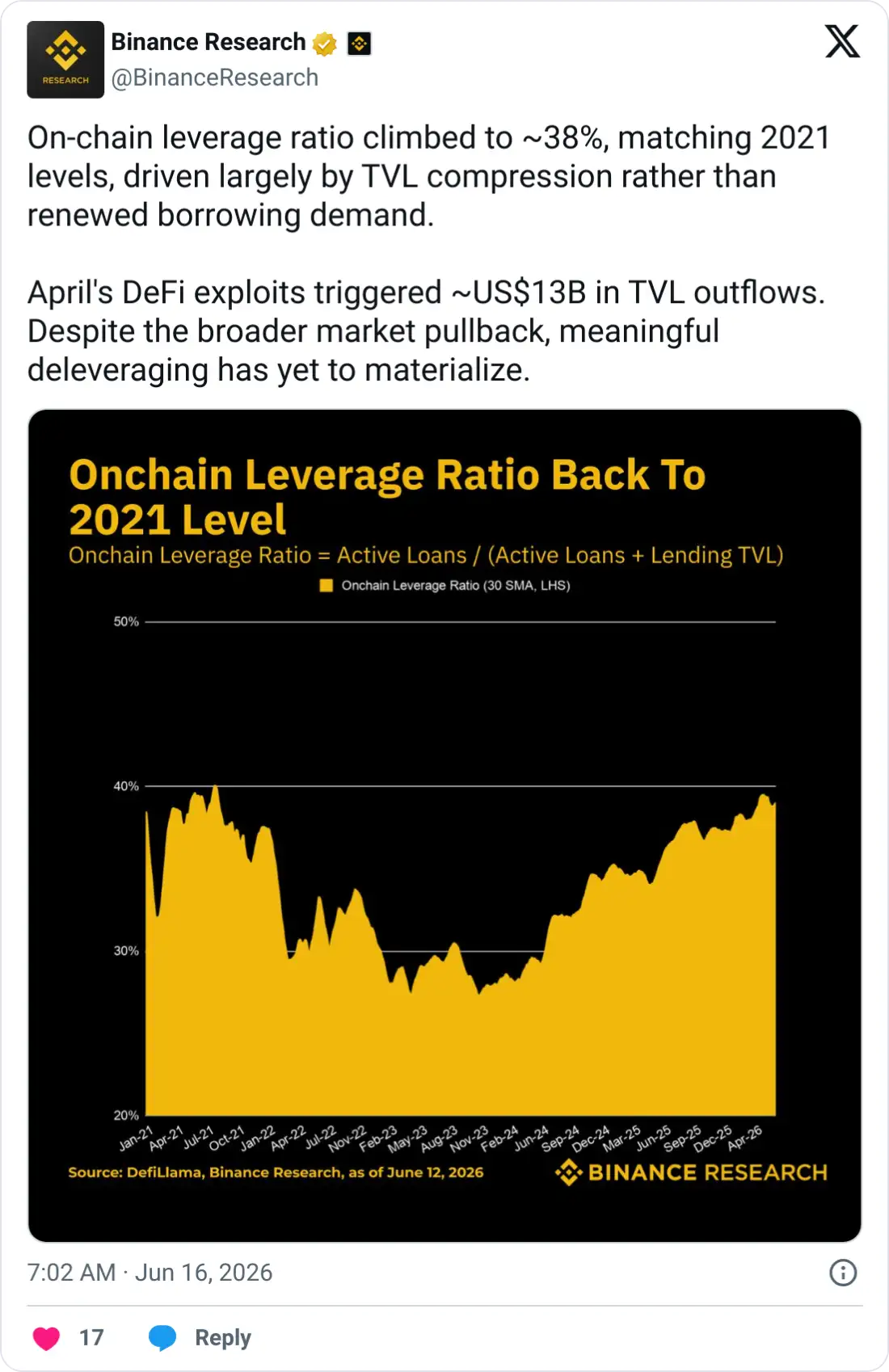
Binance Research said “deleveraging has yet to materialize,” because borrowing levels have not fallen in line with the decline in total value locked. Normal deleveraging would involve borrowers repaying loans, closing leveraged positions and reducing risk exposure after a market downturn.
Current DeFi conditions suggest that borrowers are still holding debt positions despite weaker market conditions and large outflows. Binance Research warned that the DeFi ecosystem may be more vulnerable to forced selling because the collateral base has weakened while borrowing has not adjusted enough.
The report said there is room for liquidation cascades if asset prices continue to fall. It also said volatility could increase if falling prices trigger forced liquidation of still-open borrowed positions.
Binance Research said the market pullback did not meaningfully reduce DeFi leverage because the decline came mostly from capital outflows and falling token prices, not debt repayment. Many DeFi borrowers avoided liquidation because DeFi loans are usually overcollateralized.
Some borrowers kept positions open because they expected a market rebound. Others held positions because their arbitrage and yield-generating strategies were still working. The report also noted that this happened while Bitcoin experienced an eight-month period of deleveraging.
FAQ
What is the main risk for Binance in the EU?
Binance may lose EU customer access if its Greek MiCA application is rejected.
What did Binance say about the application?
Binance said it believed the application was compliant with MiCA requirements.
What DeFi metric did Binance Research highlight?
Binance Research said DeFi’s on-chain leverage ratio reached approximately 38%.
Why is DeFi leverage still elevated?
Borrowing levels have not fallen in line with total value locked.
This article has been refined and enhanced by ChatGPT.


