




 USD
USD
Bitcoin Surpasses 20 Million Supply Milestone as Remaining Issuance Narrows Toward Final One Million Coins


Network Crosses 95% Supply Threshold Seventeen Years After Genesis Block Launch
TL;DR
- Bitcoin’s 20 millionth coin was mined on March 9, 2026, marking more than 95% of the protocol’s capped supply already issued.
- Fewer than 1 million BTC remain to be mined, with the final fractions expected around 2140 under Bitcoin’s fixed issuance schedule.
- The milestone arrives amid declining block rewards, currently 3.125 BTC per block after the 2024 halving.
We’ve launched the all-new COIN360 Perp DEX, built for traders who move fast!
Trade 130+ assets with up to 100× leverage, enjoy instant order placement and low-slippage swaps, and earn USDC passive yield while climbing the leaderboard. Your trades deserve more than speed — they deserve mastery.
Bitcoin reached a historic supply milestone on March 9, 2026 when the network produced the 20 millionth coin, pushing total issuance beyond the threshold representing more than 95% of the cryptocurrency’s fixed supply limit. The protocol caps total creation at 21 million coins, meaning fewer than 1 million units remain to be mined across the remainder of the network’s lifespan. The event arrived roughly 17 years, two months and about one week after the genesis block was mined on January 3, 2009, a block created by the network’s pseudonymous inventor that launched the decentralized monetary system.
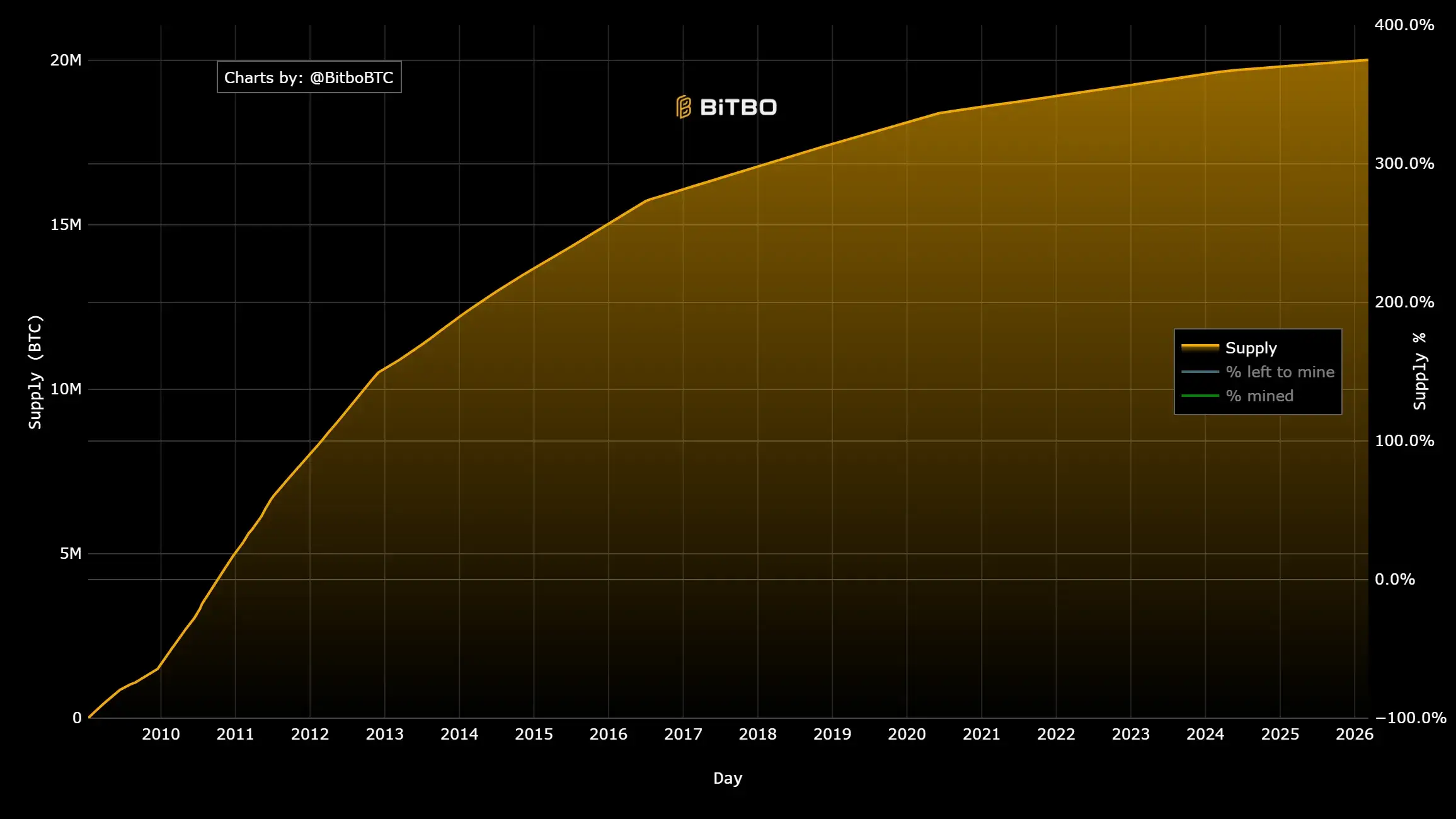
Bitcoin’s issuance curve is governed by code that reduces mining rewards at regular intervals, creating a predictable supply schedule extending far into the future. The system distributes new coins through block rewards granted to miners that validate transaction blocks and secure the network. The pace of issuance decreases automatically every 210,000 blocks through a programmed mechanism known as halving. Each reduction cuts the block reward paid to miners by half, gradually slowing the rate at which new coins enter circulation as the network matures.
The most recent halving occurred during 2024, when the block reward fell to 3.125 BTC for each validated block. Mining operations now collectively generate roughly 450 coins per day under that subsidy level. The next scheduled reward reduction is expected around 2028, when the subsidy will fall again to 1.5625 BTC per block. That declining issuance schedule ensures the remaining portion of supply will be mined far more slowly than the coins distributed during Bitcoin’s earlier years.
Bitcoin’s design front-loaded much of its supply issuance during the early life of the network, when mining difficulty was lower and competition among participants was limited. The first half of the eventual supply was produced relatively quickly after the launch of the system, while the second half required progressively longer periods as the reward reductions took effect. Mining has since evolved from hobbyist operations running CPUs to industrial-scale facilities operating specialized ASIC machines within large energy-intensive data centers.
Bitcoin’s issuance structure is publicly known decades in advance because the supply rules are embedded directly in the open-source protocol. Analysts often contrast that transparency with traditional monetary systems, where central banks adjust supply policies according to economic conditions. One industry executive described the predictability of Bitcoin’s issuance by stating, “The issuance schedule is transparent decades into the future. Humans value predictable rules, especially when it comes to money.”
Researchers say the remaining supply will be released gradually across the next century as the reward subsidy approaches zero under the protocol’s issuance schedule. The final fractions of new Bitcoin are expected to be mined around the year 2140 under the network’s programmed monetary rules. During that period, the security of the network is expected to rely increasingly on transaction fees paid by users submitting transactions to the blockchain rather than newly issued coins.
Market observers also note that a portion of existing Bitcoin supply may no longer be accessible because private keys were lost or destroyed over time. Some estimates place the number of permanently inaccessible coins between 2.3 million and 3.7 million units, which would reduce the amount of Bitcoin actively circulating among users. Those losses have occurred through forgotten passwords, discarded storage devices, or early mining participants who never preserved the credentials required to access their wallets.
Some analysts have said the milestone was largely anticipated because the issuance schedule has been publicly known since Bitcoin’s creation. Capriole Investments founder Charles Edwards described the development as already incorporated into market expectations, stating the event was “already priced in.”
This article has been refined and enhanced by ChatGPT.


