




 USD
USD
Bitcoin Breaks Six-Week Range as $3.35 Billion Liquidation Wave Hits Crypto


ETF demand, Treasury buybacks and Trump’s CLARITY Act push converge during broad market rally
TL;DR
- Bitcoin broke above a six-week trading range on Aug. 20 after long-dated Treasury buybacks helped lower yields and a heavily short-positioned derivatives market began unwinding.
- Crypto liquidations reached about $3.35 billion over 24 hours, with short liquidations accounting for $3 billion as Bitcoin and Ethereum led the squeeze.
- U.S. Bitcoin, Ethereum and Solana ETPs attracted $1.297 billion from Aug. 17 through Aug. 19, while President Donald Trump’s renewed CLARITY Act push added another catalyst after the initial breakout.
Trade smarter on Jupiter, Solana’s leading DEX built for fast execution and deep liquidity.
Swap tokens at competitive rates, route across multiple liquidity sources automatically, and access perpetuals, DCA, and advanced trading tools — all in one place!
Bitcoin broke out of a six-week trading range on Aug. 20 as lower long-term Treasury yields, institutional fund inflows and a large short squeeze drove a broad crypto rally, while President Donald Trump’s later call for Congress to pass the CLARITY Act added momentum after the initial move was already underway.
Bitcoin had traded between roughly $62,000 and $66,900 since July 8, a stretch in which volatility fell to multiyear lows and short-liquidation levels accumulated between $65,000 and $67,000. The BTC price then moved through that upper band and extended above $71,000 for the first time since June.
The first major macro catalyst came from the U.S. Treasury, which said it would at least double long-dated bond buybacks to $4 billion. The announcement pulled the 30-year Treasury yield back from 5.337%, described in the supplied information as its highest level since 2007, and helped push traders back toward risk assets.
Bitcoin gained more than 8% within roughly one hour after breaking the upper end of its range. The move forced bearish traders to buy back positions into relatively thin supply, creating additional upward pressure as successive liquidation levels were triggered.
Trump’s remarks followed much of that initial move. He urged Congress to pass the CLARITY Act, floated the possibility of sizable U.S. Bitcoin purchases and said regulators were examining a compliant U.S. pathway for Hyperliquid. The sequence distinguishes the original breakout from the later political and regulatory catalyst: the Treasury move and liquidation mechanics came first, while Trump’s comments extended the rally.
Short squeeze drives biggest liquidation event since October 2025
The broader crypto market added more than $220 billion in value over 24 hours as Bitcoin and Ethereum led gains across major assets. CoinGlass data showed approximately $3.35 billion in total crypto liquidations during the same period, the highest daily total since Oct. 10, 2025.
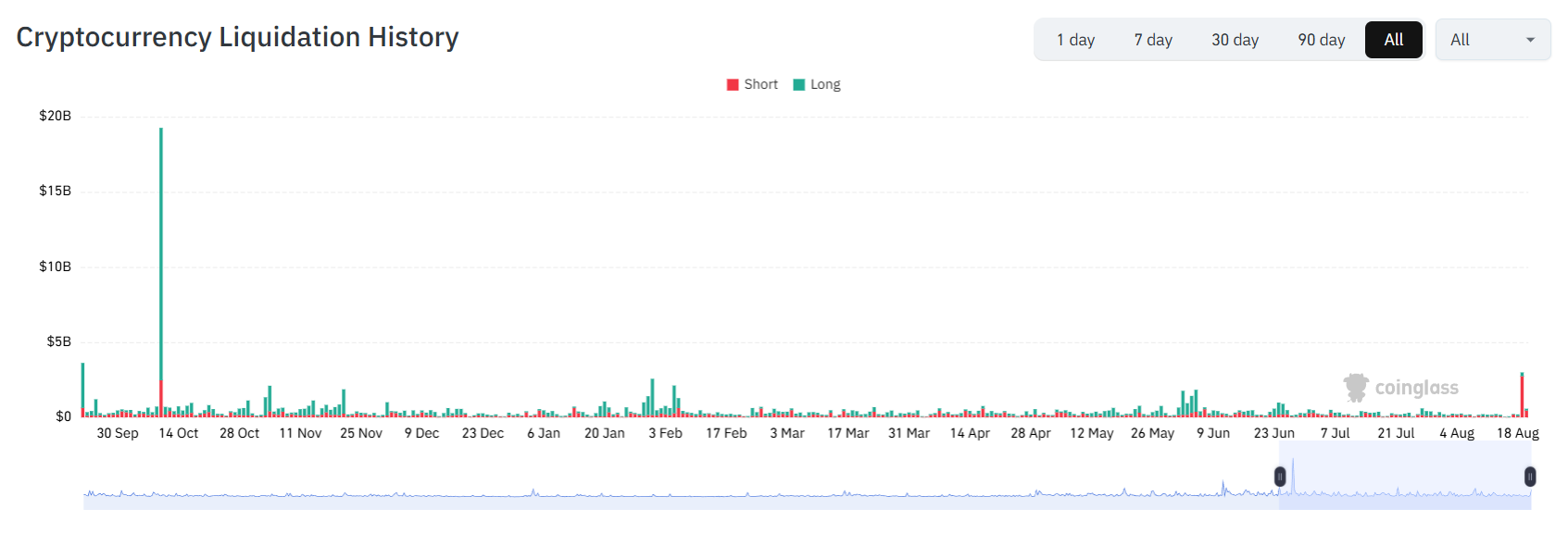
That earlier October event had included $2.46 billion in short liquidations and $16.78 billion in long liquidations. The Aug. 20 episode had the opposite directional profile, with bearish positions absorbing most of the damage as prices moved higher.
The decline in Bitcoin’s long-short accounts ratio showed that more accounts were positioned short than long as the breakout began. Rising prices then forced short sellers to close those positions by buying back exposure, which added demand and pushed prices through further liquidation levels.
Coinalyze data showed aggregate open interest rising 9.11% to $131.25 billion after the flush. Bitcoin open interest increased 7.18% to $23.4 billion, while Ethereum open interest climbed 12.36% to $13.2 billion, indicating that derivatives exposure was being rebuilt quickly rather than remaining sidelined.
Ethereum also registered the largest single-network forced closure of derivatives positions at $610 million, a figure reported as up 7.27% over 24 hours in the relevant category dataset. HYPE recorded the strongest cited open-interest increase at 29%, with that rise occurring after Trump’s Hyperliquid remarks rather than during Bitcoin’s original breakout.
Bitcoin daily trading volume rose 250% to $59 billion. Coinbase’s Fear and Greed reading moved from 41, classified as “fear,” to 59, classified as “greed,” as positioning and sentiment shifted rapidly.
The meme-coin segment, with a reported market capitalization of about $23.8 billion at publication, recorded what was characterized as its biggest daily liquidation spike, with the relevant liquidation measure increasing about 12.25% to 15.1 million.
Bitcoin and Ethereum ETF demand accelerates
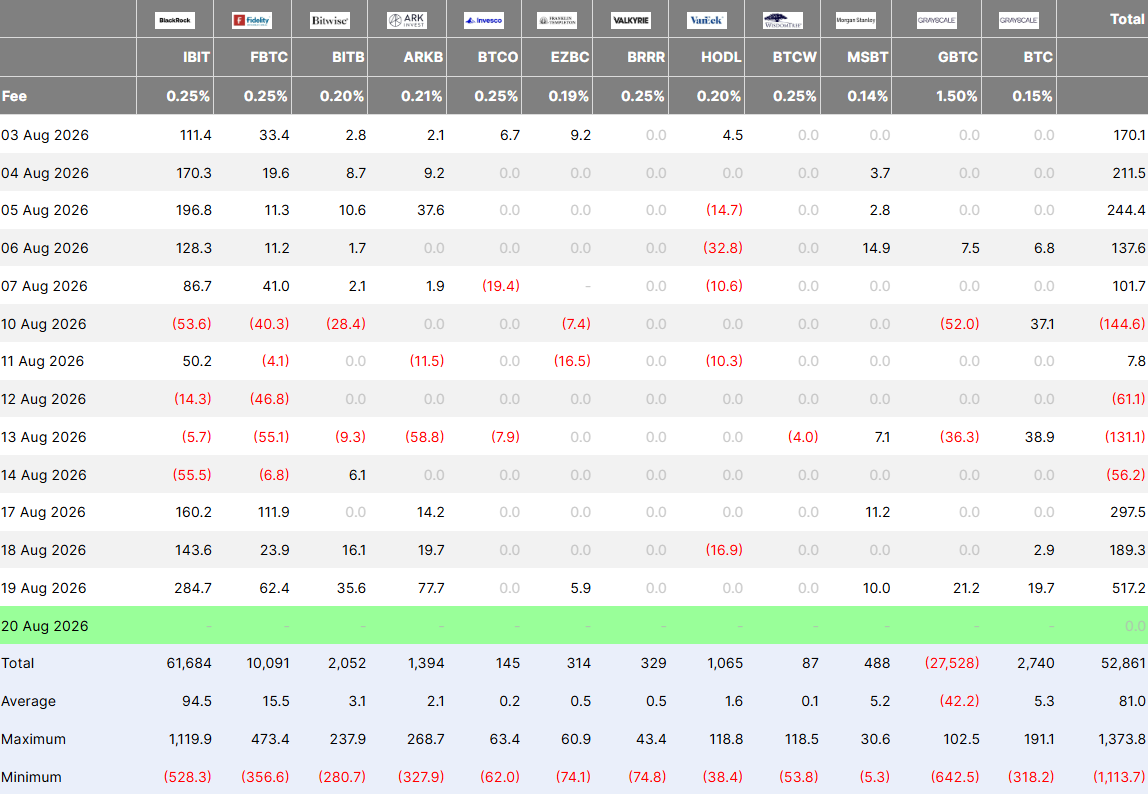
Institutional flows were already strengthening before the breakout. U.S. Bitcoin, Ethereum and Solana ETPs recorded $1.297 billion of combined net inflows from Aug. 17 through Aug. 19, with Bitcoin accounting for 77.4% of the total.
Farside Investors data showed the Bitcoin inflows were concentrated among several large products. BlackRock’s IBIT contributed $588.5 million over the three sessions, Fidelity’s FBTC added $198.2 million, and ARK 21Shares’ ARKB supplied $111.6 million, including $77.7 million on Aug. 19.
Ethereum ETF demand also rebounded sharply after weakness earlier in the year. These ETFs recorded $189.15 million of net inflows on Aug. 19, the largest single-day intake since Oct. 28, 2025. Ethereum ETFs had accumulated $534.2 million during August by the time of publication, their strongest monthly total of 2026, while combined net assets reached $12.06 billion, the highest since May 21.
Four of the 11 listed Ethereum products recorded no flows during that session. Across the Aug. 17-19 period, BlackRock’s iShares Ethereum Trust accumulated $212.7 million.
The ETH price was quoted at $2,250 in one snapshot, up 16.3% over 24 hours. A later market observation placed the ETH price near $2,270, just below the previous day’s three-month high after a 19% gain. SOL, XRP and DOGE also posted double-digit advances.
Solana products attracted much less capital than Bitcoin and Ethereum. The Bitwise Solana Staking ETF supplied $7.2 million across Aug. 18 and Aug. 19, while the Grayscale Solana Trust ETF recorded a $3.1 million outflow on Aug. 19.
CLARITY Act debate follows the initial breakout
Erald Ghoos, CEO of OKX Europe, had said hours before the rally that crypto appeared to be nearing a bottom as capital that had moved into AI and semiconductor stocks began returning to digital assets.
Ghoos said passage of the CLARITY Act could strengthen confidence in the U.S. market. “If and when the Clarity Act gets passed, I think that will blow new life into crypto enthusiasm and trust in the biggest economy in the world, which will then also transpire to the rest of the world,” Ghoos said.
He also tied U.S. regulation to European rules, rising institutional participation and easier access to decentralized finance. “With more institutional interest than ever, regulatory clarity from the U.S. and Europe, DeFi being more accessible, the pieces of the puzzle are starting to fall together, for real mass adoption.”
Ghoos’s position differed from that of Haider Rafique, OKX’s global managing partner, reflecting a debate over how much regulatory optimism had already been incorporated into Bitcoin’s market value rather than a uniform view that eventual passage would automatically cause another repricing.
Retail activity had also weakened before the rally. Trading at Upbit and Bithumb in South Korea was reported to have fallen 50%, but Ghoos argued that retail capital was following momentum rather than permanently leaving crypto.
“I predict that the capital is not going to stay gone,” Ghoos said. “They’re thinking where is the opportunity? Where is the hype? Where can we make money?”
Ghoos pointed to Europe as an example of activity shifting among platforms after regulatory changes. After Binance stopped serving EU customers when it failed to secure a MiCA license, OKX recorded a 160% increase in EU app downloads during the following 12 days, according to Ghoos.
Altcoins join the rally
Several individual tokens recorded sharp gains alongside Bitcoin and Ethereum, although performance varied across the market.
The HYPE gains followed Trump’s statement that regulators were working on a possible U.S. pathway for Hyperliquid. Its separate price readings reflect different points during the same fast-moving session rather than a single closing value.
The next several trading sessions were identified as the test of whether the ETF inflow spike represented a durable change in institutional demand or a single unusually strong episode. Open interest had already begun rebuilding after the liquidation flush, while funding remained positive and spot demand had led the futures market during the breakout.
This article has been refined and enhanced by ChatGPT.


