


 USD

Bitcoin Falls Below $74,000 as Hot CPI Raises December Fed Hike Bets

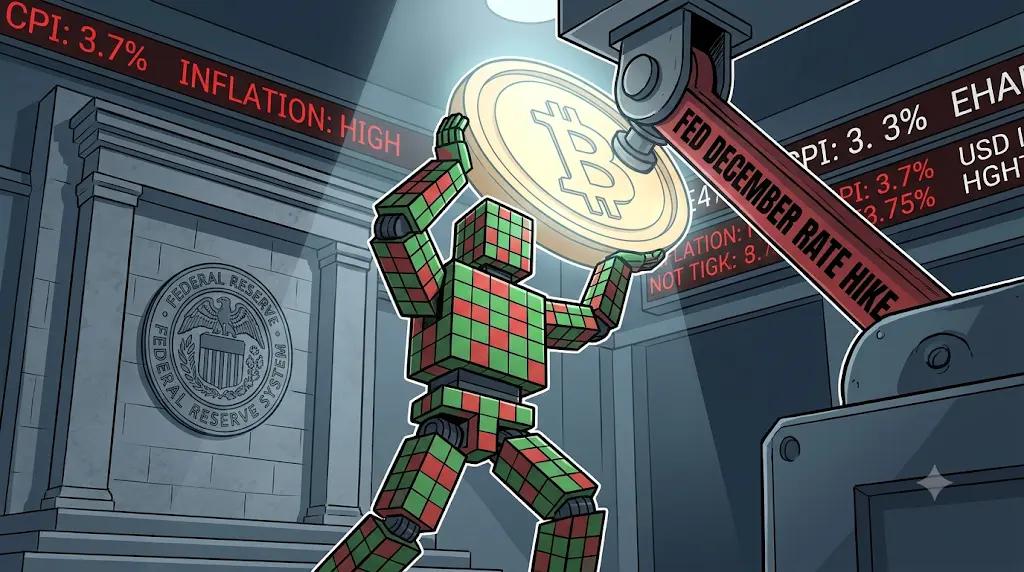
October inflation exceeded forecasts, sending cryptocurrencies lower as traders reassessed interest rates and key Bitcoin support levels
TL;DR
- Bitcoin fell below $74,000 after hotter-than-expected U.S. inflation data, triggering leveraged liquidations and renewed selling pressure across the crypto market.
- Federal Reserve Governor Christopher Waller raised the possibility of a larger December interest rate hike, although a quarter-point increase remained the favored outcome.
- Analysts identified $73,000 as a critical Bitcoin support level, warning that further losses could push the cryptocurrency toward $69,000.
Trade smarter on Jupiter, Solana’s leading DEX built for fast execution and deep liquidity.
Swap tokens at competitive rates, route across multiple liquidity sources automatically, and access perpetuals, DCA, and advanced trading tools — all in one place!
Bitcoin price fell below $74,000 on Tuesday, November 10, 2026, after U.S. consumer inflation exceeded forecasts, raising concerns that the Federal Reserve could accelerate interest rate hikes at its December meeting. The selloff extended losses across major cryptocurrencies and triggered forced liquidations of leveraged positions. Traders also increased their expectations for a larger rate increase after Federal Reserve Governor Christopher Waller indicated that persistent inflation could justify more aggressive action.
The Bureau of Labor Statistics reported that the Consumer Price Index (CPI) rose faster than economists expected in October, marking the third consecutive month of hotter-than-forecast inflation. Although headline inflation slowed from September, both headline and core readings exceeded estimates by 0.1 percentage points. Core inflation, which excludes food and energy, maintained the same monthly pace for a third consecutive month.
October U.S. Inflation Breakdown
Shelter accounted for more than 30% of the monthly headline increase, while price pressures remained widespread across services. The government also did not publish its standard annual inflation rate for October because the 2025 federal shutdown had prevented the collection of comparable data. September's last available annual headline inflation reading stood at 3.7%, above the Fed's 2% inflation target, which is formally measured using the Personal Consumption Expenditures index.
Fed Rate Hike Expectations Shift After Waller's Inflation Warning
The inflation release followed comments by Federal Reserve Governor Christopher Waller in London, where he indicated that another elevated core inflation reading could justify a larger rate increase. Waller said he would support a quarter-percentage-point hike in December even if inflation improved, but suggested that persistently strong price pressures could warrant a bigger move.
"In that case, I believe a 50-basis-point hike in the policy rate should be considered at the December meeting," Waller said. "Hiking only 25-basis-points would put our credibility at risk, a risk I am not eager to take."
The Fed currently holds its benchmark interest rate at 3.75% to 4.00%, having raised rates by a quarter-point in September before leaving them unchanged in October. A half-point increase in December would lift the range to 4.25%-4.50%. Higher borrowing costs could discourage leveraged investments in cryptocurrencies while making interest-bearing traditional assets more attractive.
Market expectations shifted following the inflation release and Waller's remarks. CME FedWatch data as of 16:28 UTC showed an 88.3% probability of a quarter-point December increase and an 11.7% chance of a half-point hike. Separately, Reuters reported that financial analysts had raised their estimated probability of the larger move to nearly 15% by midmorning.
Jeff Anderson, head of US at crypto trading firm STS Digital, said interest rate markets were already incorporating additional tightening.
"Following today's CPI release, markets are now pricing approximately 27 basis points of tightening into the December rate curve," Anderson said. "The prospect of another rate hike is becoming increasingly difficult to ignore."
Bond markets also reacted to the inflation surprise. The two-year U.S. Treasury yield, which closely reflects expectations for Federal Reserve policy, recorded its largest increase since April 2025. The dollar strengthened, while U.S. equities opened lower.
Higher rates could also affect crypto investment strategies that rely on borrowed capital. Adam Haeems, head of asset management at Tesseract Group, explained how rising funding costs could reduce returns for investors using leverage.
"Carry strategies earn the gap between what their assets yield and what they pay to borrow, so they are squeezed when borrowing costs rise relative to that yield," Haeems said. "Over the past two weeks the rate paid to USDC lenders on Aave’s main market ranged from about 3.2% to 7%, while three-month Treasury yields stayed close to 4.2%."
Bitcoin and Ethereum Slide as Analysts Identify Key Support Levels
The crypto market declined following the CPI announcement, with Bitcoin, Ethereum and Solana recording losses across the reporting periods.
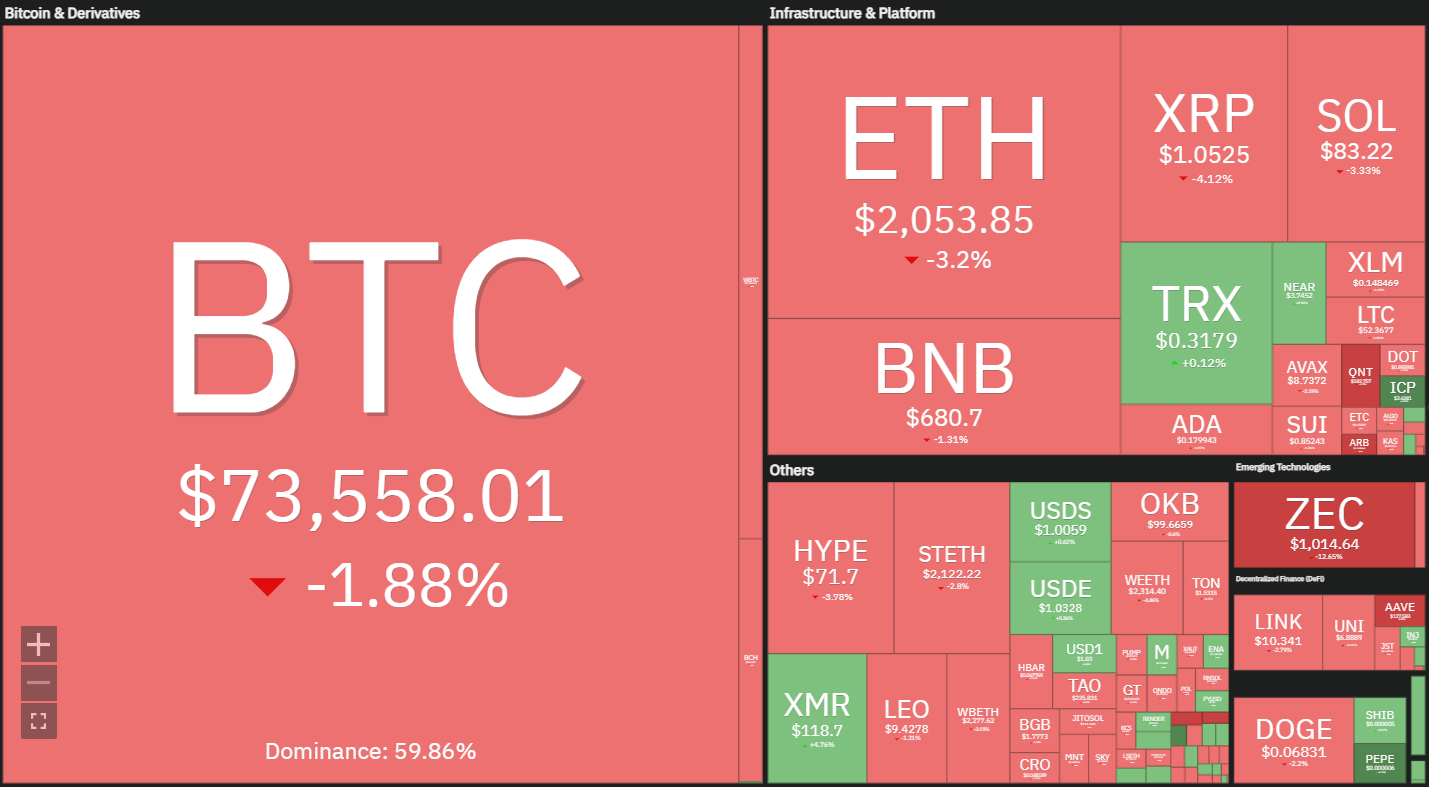
The selloff triggered approximately $178 million in leveraged crypto long liquidations within an hour of the announcement. Forced liquidations occur when exchanges close leveraged positions after traders' collateral becomes insufficient. Bitcoin had already declined roughly 4.5% over the preceding seven days, while U.S. spot Bitcoin exchange-traded funds recorded another $201 million in net outflows on Monday.
Lewis Huang, an analyst at Bitget, identified an important technical threshold for Bitcoin price.
"For Bitcoin, higher yields and a stronger dollar could add to recent selling pressure," Huang said. "The 200-day moving average near $73,200 is a key support level to watch. A sustained move below it could increase the risk of a deeper pullback."
Matt Mena, senior crypto research strategist at 21Shares, pointed to the $73,000 level, which coincides with Bitcoin's pre-election 2024 all-time high and its April 2025 lows. Mena warned that a sustained break below that threshold could send the asset toward $69,000, near its 2021 cycle high. He also identified the 50-week moving average as an important support indicator, while a further downturn could pressure Ethereum's $2,000 support and potentially bring $1,800 into focus.
Mena also outlined a potential recovery scenario if Bitcoin maintains support and equities continue to rebound. Under those conditions, 21Shares sees the cryptocurrency potentially retesting $78,000, with a successful move above that level opening the possibility of $85,000 by year-end. Historical performance provides another reference point: November has been Bitcoin's strongest month since 2010, delivering an average return of 34.4% and a median gain of 8.6%.
Paul Howard, senior director at Wincent, said institutional derivatives activity could influence how Bitcoin responds to macroeconomic developments.
"As institutional participation in digital assets continues to mature, the growing use of derivatives and sophisticated hedging strategies is helping to reshape Bitcoin's volatility profile," Howard said. "Institutional investors are increasingly able to manage their exposure through options and other risk-management instruments rather than responding to every macroeconomic development by buying or selling the underlying asset."
Howard nevertheless considered a gradual downward drift more likely than a sustained return toward the previously anticipated $100,000 level without a meaningful shift in monetary policy, regulatory clarity or institutional capital flows.
Inflation Concerns Follow Democratic Midterm Victory as December Meeting Nears
The inflation release came one week after Democrats won control of both the House and Senate in the U.S. midterm elections, adding a political dimension to the economic policy debate. Anderson suggested that the incoming congressional balance could increase pressure to address inflation, although he remained skeptical about whether further rate hikes would tackle its underlying causes.
"There is also likely to be growing political pressure from a blue Congress to bring inflation under control, potentially reinforcing the case for higher rates," Anderson said.
Congress does not set Federal Reserve interest rates, but lawmakers can influence economic policy and cryptocurrency regulation. The CLARITY Act, legislation intended to establish clearer U.S. crypto rules, has been stalled since January amid disagreements between Democrats and Republicans. The change in congressional control therefore coincides with renewed concerns about borrowing costs and the regulatory outlook for the industry.
The Federal Reserve's final scheduled policy meeting of the year will take place on December 8-9. The next CPI report is scheduled for December 10, meaning policymakers will make their December interest rate decision before receiving November's consumer inflation figures. That leaves the central bank weighing October's higher-than-expected reading alongside other available economic indicators as markets assess the possibility of further monetary tightening.
This article has been refined and enhanced by ChatGPT.


