


 USD

CFTC Challenges State Prediction Market Cases as Congress Considers Betting Ban

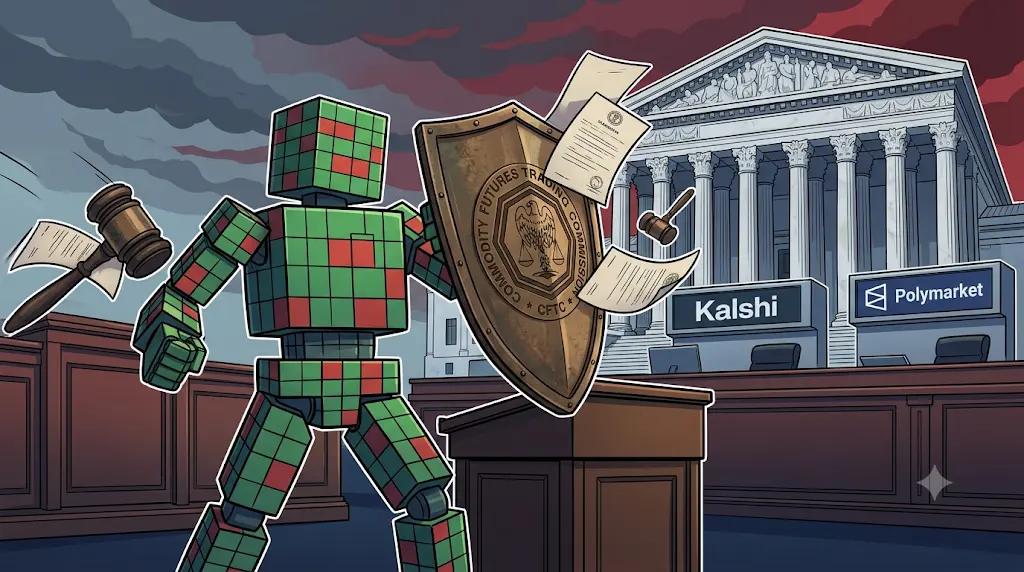
Federal regulators defend their authority as lawmakers target insider trading and Meta tests a points-based prediction app.
TL;DR
- CFTC Chair Michael Selig accused states of threatening prediction market executives with criminal prosecution and called for Supreme Court intervention.
- House Oversight Chair James Comer urged Congress to consider restricting or banning government officials from trading on prediction markets.
- Meta began internally testing Takes, an employee prediction market app using virtual "cred" points instead of real money, according to The Wall Street Journal.
Trade smarter on Jupiter, Solana’s leading DEX built for fast execution and deep liquidity.
Swap tokens at competitive rates, route across multiple liquidity sources automatically, and access perpetuals, DCA, and advanced trading tools — all in one place!
Commodity Futures Trading Commission (CFTC) Chair Michael Selig criticized state enforcement actions against prediction market platforms on November 13, 2026, arguing that disputes over their legality should be settled in court rather than through criminal prosecution. His remarks came as House Oversight Committee Chair James Comer called for possible restrictions on government officials' prediction market trading over insider trading concerns. Separately, Meta began testing a prediction market app that lets employees forecast events without wagering real money, according to The Wall Street Journal.
CFTC Chair Challenges States Over Prediction Market Enforcement
Speaking at the Cantor Convergence conference, Selig described state lawsuits against prediction market operators as "really egregious" and defended what he has long characterized as the CFTC's "exclusive jurisdiction" over federally regulated event contracts.
"We're seeing states bring criminal charges, essentially trying to lock up founders and CEOs of these companies that are offering lawful products under a federal regime," Selig said.
His comments followed legal disputes involving roughly a dozen states and cities over whether event contracts offered by platforms such as Kalshi and Polymarket constitute illegal gambling. The platforms maintain that their contracts are lawful and fall under federal oversight, while states have challenged the products under gambling laws.
"Somebody says it's gambling, somebody says it's a derivative," Selig said. "That's not something that should be at the risk of going to jail."
Rather than contesting individual enforcement actions across multiple states, Selig argued that the jurisdictional dispute should reach the Supreme Court.
"I don't understand whether we're going to have every major CEO of an exchange locked up in a jail cell in Utah, or if we can just go to the Supreme Court and hash this thing out on the merits," he said.
The confrontation has already produced direct legal action involving federal regulators. On Thursday, the Justice Department and CFTC sued Arkansas Attorney General Tim Griffin to block his enforcement action against Kalshi.
Louisiana also filed a lawsuit that day targeting several companies, including Kalshi, Polymarket, Robinhood and Coinbase.
"I am concerned that some of the states are getting very aggressive," Selig said. "We’ll continue to defend our jurisdiction."
House Oversight Chair Calls for Restrictions on Government Officials' Bets
A separate congressional investigation has raised concerns about government officials potentially using nonpublic information to profit from prediction market contracts.
House Oversight Committee Chair James Comer, R-Ky., released findings on Friday from an investigation launched in May examining insider trading risks involving government officials, military personnel and individuals holding security clearances.
According to Comer, the committee reviewed 1,700 pages of documents and received five bipartisan staff briefings from prediction market companies.
The investigation followed several incidents involving alleged or reported misuse of privileged information. An active-duty U.S. Army soldier reportedly used confidential information to place bets on Polymarket ahead of the capture of former Venezuelan President Nicolás Maduro.
Other government personnel, including a former White House teleprompter operator, were also identified as having used inside information to profit from prediction market wagers. Political candidates have separately faced allegations of insider trading on the platforms.
"Congress must consider additional reforms to prevent public corruption and restore the American people's trust in government," Comer said Friday.
The committee recommended that Congress consider legislation restricting the types of prediction market contracts federal employees, lawmakers and congressional staff can trade. An outright prohibition was also presented as a possible approach.
"Whether it's an outright prohibition on trading on prediction markets or restrictions on some subset of contracts like government-related contracts, applying these restrictions to officials in all branches of government would strengthen ethical expectations that government personnel should not personally and financially benefit from access to non-public information associated with their work as government servants…" the committee's memo stated.
The committee also called for greater information sharing between prediction market companies and federal agencies to help enforce any restrictions.
Kalshi and Polymarket have said they have strengthened their controls to prevent government officials from trading on inside information.
Congress has separately begun addressing the issue. In April, the Senate voted to pass a resolution banning members from trading on prediction markets.
Meta Tests Points-Based Prediction App Amid Regulatory Disputes
Meanwhile, Meta has begun internally testing a prediction market application called Takes, allowing employees to make predictions about future events without using real money.
The Wall Street Journal reported the development Friday, citing people familiar with the matter.
Takes operates through a virtual points system called "cred." Participants can wager points on event outcomes, earning additional cred when their predictions are correct and losing points when their forecasts are wrong.
The testing follows June reports that Meta CEO Mark Zuckerberg directed employees to develop a standalone prediction market application. The project was initially called Arena and was designed around a points-based system, although Meta had not ruled out eventually introducing real-money betting.
The Wall Street Journal's latest account did not establish whether real-money contracts remain under consideration. Meta declined to comment on the project or provide a timetable for a public release.
The employee trial comes as established real-money prediction market operators face lawsuits over their legal status, with Kalshi and Polymarket defending federal oversight of their event contracts against state gambling enforcement actions.
This article has been refined and enhanced by ChatGPT.


