


 USD

CFTC Clears Stock Perpetual Futures as Wall Street Coalition Sues to Block Approval

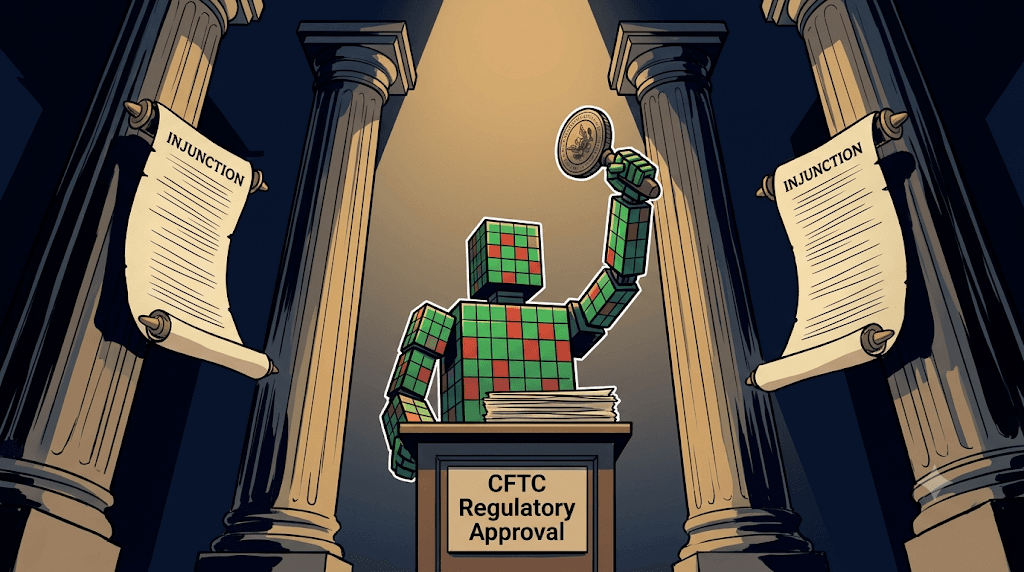
Capital Markets Alliance challenges the regulator's authority, arguing stock-linked contracts belong under SEC oversight
TL;DR
- The CFTC approved single-stock perpetual futures for regulated U.S. exchanges on November 3, 2026, extending a trading model popularized in cryptocurrency markets.
- Capital Markets Alliance, backed by Cboe, Citadel Securities and Healthy Markets Association, filed a same-day lawsuit challenging the approval.
- The coalition argues the products qualify as security-based swaps under SEC jurisdiction, while the CFTC maintains that its decision complies with U.S. law.
Trade smarter on Jupiter, Solana’s leading DEX built for fast execution and deep liquidity.
Swap tokens at competitive rates, route across multiple liquidity sources automatically, and access perpetuals, DCA, and advanced trading tools — all in one place!
The U.S. Commodity Futures Trading Commission (CFTC) cleared single-stock perpetual futures for trading on regulated American exchanges on Tuesday, November 3, 2026, but immediately faced a federal lawsuit from a Wall Street-backed coalition seeking to block the move. Capital Markets Alliance challenged the regulator's authority to approve the contracts, arguing that they fall under the jurisdiction of the Securities and Exchange Commission (SEC) rather than the CFTC.
The decision would allow perpetual futures tied to individual U.S. stocks to trade on regulated domestic exchanges for the first time, bringing a derivatives product widely used in cryptocurrency markets into traditional equities. However, the legal challenge places the approval at the center of a dispute over how these contracts should be classified and which federal regulator should oversee them.
CFTC Opens U.S. Market to Stock-Based Perpetual Futures
CFTC Chairman Michael Selig announced that equity perpetual futures had been deemed approved under CFTC Regulation 40.3. The contracts could be offered through exchanges registered with both the CFTC and SEC to trade security futures products, creating a regulated domestic route for instruments that have become popular on offshore cryptocurrency trading platforms.
Perpetual futures, commonly called perps, allow traders to speculate on an asset's price movements without owning the underlying asset. Unlike conventional futures contracts, they have no expiration date. Cryptocurrency exchange BitMEX helped popularize the instruments in 2016, establishing a trading model that has since attracted attention from traditional financial markets.
Selig said the CFTC's decision "builds on that milestone by extending the availability of the perpetual futures contract instrument in the U.S. beyond digital commodities and into traditional securities." He also argued that regulated domestic trading would give American market participants access to the products under U.S. safeguards rather than being "forced to turn to offshore, and often unregulated, venues."
The announcement followed several regulatory applications submitted in September. Coinbase, Kalshi and Kraken parent company Payward, through its Bitnomial exchange, sought authorization to offer perpetual futures linked to individual American stocks. OG.com joined the effort days later, proposing contracts that could trade around the clock on weekdays. Selig did not identify which exchanges would introduce the approved products or provide a trading launch schedule.
Citadel-Backed Coalition Challenges Approval in Federal Court
Capital Markets Alliance filed its lawsuit in the U.S. District Court for the Southern District of New York on the same day as the CFTC announcement, seeking to overturn the approval and prevent it from taking effect while the litigation proceeds.
The recently formed organization represents traditional financial market participants, including exchanges, broker-dealers and investment firms. A Capital Markets Alliance spokesman identified Cboe, Citadel Securities and Healthy Markets Association among its members.
The coalition argues that stock perpetual futures should be classified as security-based swaps, placing them under the SEC's regulatory authority. Its lawsuit contends that the CFTC improperly approved products that fall within another regulator's jurisdiction.
Capital Markets Alliance also accused the CFTC of violating the Administrative Procedure Act. The lawsuit argues that the derivatives regulator failed to adequately explain its decision, address its departure from an earlier regulatory position or consider the potential consequences for investors.
The CFTC rejected the legal challenge. An agency spokesman said:
"It is troubling that an anonymous group is seeking to use litigation to interfere with CFTC regulated markets."
The spokesman added:
"Our markets should be governed by law, not litigation campaigns intended to block innovation."
The American Securities Association (ASA) also criticized the decision. ASA President and CEO Chris Iacovella argued that classifying the contracts as security futures allowed the CFTC to bypass restrictions governing retail participation in security-based swaps.
"By labeling stock perps as security futures, the CFTC sidestepped the SEC’s jurisdiction and Congress’ ban on selling security-based swaps to retail investors,” Iacovella said.
Earlier Crypto Perpetual Futures Approval Also Faces Legal Challenge
The latest dispute follows the CFTC's earlier efforts to establish a domestic market for cryptocurrency perpetual futures.
The regulator approved Bitcoin perpetual futures contracts for Kalshi in May and separately granted regulatory relief allowing Coinbase to provide access to certain cryptocurrency perpetual futures listed on an affiliated foreign exchange.
Those decisions also prompted litigation. CME Group's Chicago Mercantile Exchange sued the CFTC in June, arguing that cryptocurrency perpetual futures should be treated as swaps rather than conventional futures because the contracts have no expiration dates.
CME contended that the regulator exceeded its authority by approving the products under the futures framework. The distinction carries regulatory consequences because swaps are subject to different requirements, potentially including stricter reporting, margin and registration obligations.
The CFTC moved to dismiss CME's lawsuit in September, arguing that the exchange lacked legal standing because it had not demonstrated financial harm. The regulator also maintained that CME could list similar contracts itself.
Separately, President Donald Trump said during an August 19 White House event that the CFTC was working to bring Hyperliquid, a decentralized cryptocurrency exchange known for perpetual futures trading, into the United States in a "fully compliant and legal fashion." Neither the CFTC nor Hyperliquid had announced a formal plan for the platform's domestic expansion at that time.
The Capital Markets Alliance lawsuit now places the regulator's stock-based perpetual futures policy under a separate legal challenge, with the coalition seeking to stop the contracts from taking effect under the CFTC's approval.
This article has been refined and enhanced by ChatGPT.


