




 USD
USD
Charles Schwab to Add Solana, Avalanche and Chainlink to Crypto Platform

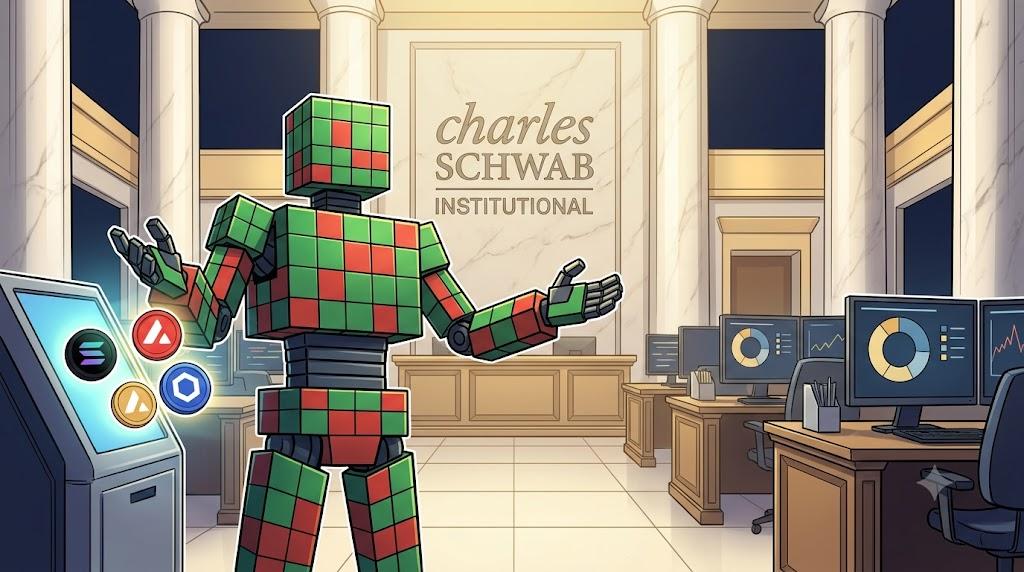
Brokerage broadens direct digital-asset access after launching bitcoin and ether trading
TL;DR
- Charles Schwab plans to add SOL, AVAX and LINK to Schwab Crypto after initially launching direct bitcoin and ether trading.
- The three assets are expected to become available “in the coming months,” although Schwab has not set a specific launch date.
- Schwab charges 0.75% per crypto transaction, while staking, wallet transfers and several other account functions remain unresolved.
Trade smarter on Jupiter, Solana’s leading DEX built for fast execution and deep liquidity.
Swap tokens at competitive rates, route across multiple liquidity sources automatically, and access perpetuals, DCA, and advanced trading tools — all in one place!
Charles Schwab announced on August 27, 2026, that it plans to add Solana, Avalanche and Chainlink to Schwab Crypto, expanding its direct cryptocurrency offering beyond bitcoin and ether. Eligible clients will be able to buy and sell SOL, AVAX and LINK through Schwab Crypto accounts when the additional assets become available.
Schwab said the additions are part of its effort to “thoughtfully expand” its digital-asset offering with established cryptocurrencies that align with client demand. The assets are expected to become available “in the coming months.” Schwab has provided no specific launch date and said it may delay, modify or withdraw support depending on regulatory, operational or market developments.
The planned expansion follows Schwab Crypto’s May 2026 rollout of direct bitcoin and ether trading. Adding the three assets would bring the platform’s directly tradable cryptocurrency lineup to five assets: BTC, ETH, SOL, AVAX and LINK.
Joe Vietri, Head of Digital Assets at Charles Schwab, said the expansion is intended to fit cryptocurrency exposure into clients’ broader relationship with the brokerage. “With this expansion, clients will have more choices to build a digital asset allocation alongside the investing and banking experience they know and trust at Schwab,” Vietri said.
“These additions are consistent with our approach to provide clients with access to familiar cryptocurrencies backed by an ecosystem of education, tools, resources, and support to make informed decisions about how crypto might fit into their broader investing goals,” Vietri added.
Schwab oversees more than $12 trillion in client assets and has about 39 million active brokerage accounts. A more precise company figure cited for the end of July showed $13.04 trillion in client assets and 39.9 million active brokerage accounts, giving the planned listings access to customers who already use Schwab for stocks, funds, cash and retirement savings.
The expansion also fits Schwab’s broader digital-asset strategy. By June 2026, Schwab had introduced direct retail crypto trading and was preparing transfer, trading and custody services for independent financial advisors.
SOL, AVAX and LINK serve different blockchain roles
The three planned additions have different functions despite commonly being grouped among larger crypto assets. SOL is Solana’s native asset, AVAX supports the Avalanche ecosystem, and LINK supports Chainlink’s oracle and cross-chain infrastructure.
SOL pays transaction fees on Solana and can be delegated to validators through staking. Demand for the token can reflect activity across decentralized exchanges, payments, tokenized assets and consumer applications operating on Solana.
AVAX is used to pay transaction fees and supports staking within the Avalanche ecosystem. Avalanche also provides infrastructure for organizations building customized blockchain environments, while application use, network adoption and validator participation can influence demand for AVAX.
LINK supports Chainlink services that deliver external data to blockchain applications and help separate blockchain networks exchange information. Its infrastructure role therefore extends across multiple blockchain ecosystems rather than being limited to one application network.
The five cryptocurrencies available or planned for Schwab Crypto could still behave as a concentrated allocation during a broad market selloff. SOL and AVAX share exposure to conditions affecting smart-contract networks, while LINK has a different functional role but remains closely tied to broader cryptocurrency market sentiment.
Schwab’s 0.75% fee applies to each transaction
Schwab charges 75 basis points on the dollar value of every cryptocurrency transaction, equal to 0.75% of the amount bought or sold. The charge applies separately to purchases and sales.
A purchase valued at $1,000 followed by a sale at the same value would incur $15 in total trading charges because the fee applies on both sides. Ten separate transactions of that size would generate $75 in charges. Quoted prices, supported order types and execution quality can also affect the final cost of trading.
Staking, transfers and account functionality remain unresolved
Schwab has confirmed buying and selling for the planned assets, while several functions remain unresolved in the product documentation. Those include whether clients can deposit tokens from external wallets, withdraw purchased assets to self-custody, stake SOL or AVAX, use specific market and limit orders, and how Schwab will source prices and execute trades.
Those distinctions affect how clients can use the assets. Trading access alone can provide price exposure, while using SOL in an application, delegating AVAX to a validator or holding tokens in a personal wallet would require additional account functionality.
SOL and AVAX can generate protocol rewards through suitable staking arrangements, but Schwab has made no commitment to offer staking. Wallet transfers also remain unconfirmed, so the announced expansion currently establishes direct buying and selling rather than broader blockchain functionality.
Charles Schwab Premier Bank offers the crypto accounts, but cryptocurrencies held through them are outside FDIC deposit insurance and SIPC protection. The assets are speculative and can lose their entire value, even though they may appear alongside other financial products within the same Schwab relationship.
Schwab Crypto accounts are available across most U.S. states, with New York and Louisiana excluded. The service is also unavailable in U.S. territories and international jurisdictions, and applicants remain subject to eligibility review.
The source material also notes that SOL, AVAX and LINK have each experienced severe historical declines, making position size relevant to the amount an investor can afford to lose without affecting essential savings or long-term financial plans.
The usefulness of the expanded platform will depend on the final account terms. Schwab’s transaction fee is already established, while transfer rights, staking access, order types and execution details will determine the functionality available when the three planned listings go live.
This article has been refined and enhanced by ChatGPT.


