




 USD
USD
Senate Blocks CLARITY Act as Crypto Market Pulls Back

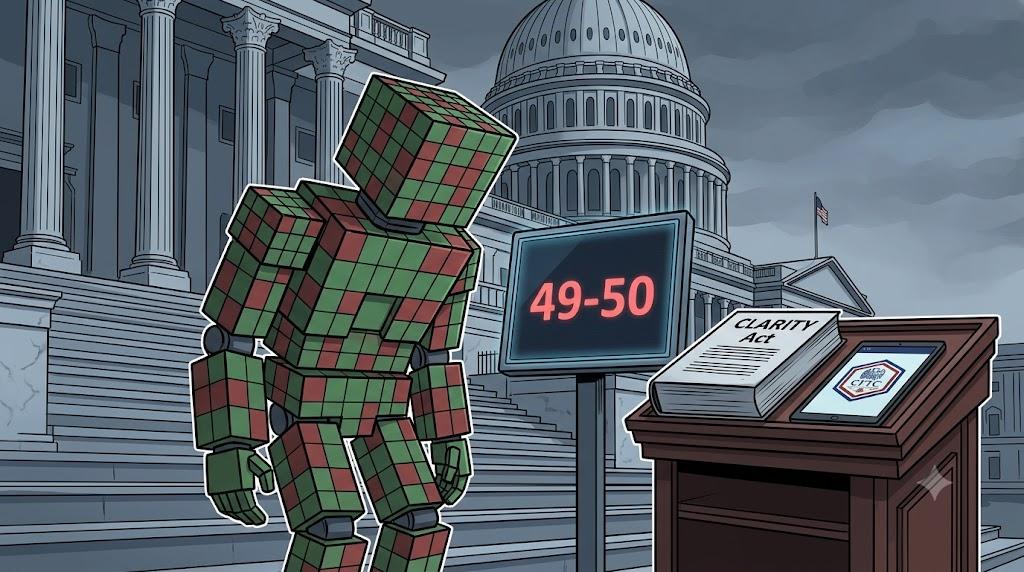
Ethics Fight Over Trump Crypto Interests Derails Procedural Vote
TL;DR
- The Senate failed to advance the Digital Asset Market Clarity Act on September 15, 2026.
- The procedural motion required 60 votes but fell short after months of negotiations.
- Democratic objections centered on ethics rules covering President Donald Trump’s crypto interests.
- Banking, stablecoin, DeFi and national-security provisions also remained under dispute.
- Bitcoin, Ethereum, Solana and XRP traded lower around the vote as Treasury yields rose ahead of a Federal Reserve decision.
Trade smarter on Jupiter, Solana’s leading DEX built for fast execution and deep liquidity.
Swap tokens at competitive rates, route across multiple liquidity sources automatically, and access perpetuals, DCA, and advanced trading tools — all in one place!
The U.S. Senate failed on September 15, 2026, to advance the Digital Asset Market Clarity Act, halting an attempt to move the proposed federal crypto market structure framework into formal debate.
The vote concerned cloture on the motion to proceed, not final passage of the legislation. The motion required 60 votes.
A preliminary count during the vote showed 39 senators in favor and 36 against. A later completed tally showed 49-50.
Despite the conflicting counts, the outcome was clear: the legislation did not reach the threshold needed to advance.
What Would the CLARITY Act Do?
The legislation, H.R. 3633, is designed to establish a federal market structure for digital assets.
It would create separate categories for:
- Digital commodities: Assets whose value is mainly tied to the use and operation of a blockchain network.
- Digital securities: Assets linked to investment contracts or centralized development and control.
Under the proposed framework:
- The Commodity Futures Trading Commission would oversee digital commodities.
- The Securities and Exchange Commission would retain authority over digital securities.
The House passed the bill in July 2025 by 294 votes to 134.
The Senate Banking Committee later approved its version 15-9 on May 14, 2026.
Even if the September cloture vote had succeeded, the CLARITY Act would not have immediately become law. Senators would still have needed to debate amendments, hold a final Senate vote and reconcile any differences with the House version.
Ethics Dispute Becomes Main Obstacle
One of the biggest disputes involved restrictions on federal officials' crypto interests.
Negotiations had stalled before the August 2026 recess as Democrats sought tighter ethics rules.
The debate became particularly significant because President Donald Trump and his family had crypto-related businesses and reported financial interests, including holdings connected to World Liberty Financial and the TRUMP memecoin.
Those interests were valued in the hundreds of millions of dollars.
Republicans released heavily revised legislative text on September 13 and 14 following negotiations with Democrats.
Sen. Cynthia Lummis, R-Wyo., the bill's lead architect, said Democrats had secured 126 concessions and had written more than half of the 635-page bill.
Republican negotiators likewise said the final version contained 126 substantive Democratic changes.
Revised Ethics Rules Fail to Win Democratic Support
The updated text strengthened restrictions covering certain federal officials, judges and their spouses.
Covered holdings would need to be:
- Divested, or
- Placed in blind trusts
Officials would also face limits on issuing or sponsoring certain crypto tokens.
Another provision required public officials to divest a “significant financial interest” or place it in a blind trust.
Republicans also expanded the role of state attorneys general in enforcement, another change requested by Democrats.
However, Democrats argued that the ethics provisions remained too narrow.
One concern was that the Justice Department would ultimately decide whether to pursue enforcement involving the president.
Democrats submitted another counterproposal on Monday night seeking broader restrictions covering Trump's crypto interests and those of his children.
The proposal included a requirement that officials holding a “very large interest in a crypto company” sell the position rather than simply place it in a blind trust.
Lummis rejected the counterproposal before the vote and had described the Senate decision as “now or never” because of the shrinking legislative calendar.
Key Democrats Vote Against Advancing the Bill
Several Democrats who had been viewed as possible supporters ultimately opposed the procedural motion.
They included:
- Kirsten Gillibrand
- Catherine Cortez Masto
- Angela Alsobrooks
- Cory Booker
- Mark Warner
Warner said lawmakers had made progress on several other disputes but had not resolved the ethics issue.
“We got close to resolving some of the toughest outstanding issues around law enforcement and national security, but ultimately, the failure to address this fundamental conflict of interest made it impossible for me to support moving forward,” Warner said. “That is why I voted no today.”
Sen. Elizabeth Warren had also outlined what she viewed as gaps in the ethics provisions.
Sen. Raphael Warnock opposed advancement without stronger rules addressing corruption concerns.
Republican Support Was Also Uncertain
The bill did not have uniform Republican support either.
Republicans held 53 Senate seats, so even unanimous GOP backing would have required at least seven additional votes.
Another assessment indicated supporters effectively needed at least a dozen Democrats because several Republicans were uncertain or opposed.
Sen. Susan Collins described the bill as a “moving target” and said she needed more time to study its more than 600 pages and recently added ethics rules.
She also raised concerns about possible deposit losses at community banks.
Collins became the seventh Republican identified as raising community-bank-related concerns.
Sen. John Curtis supported cloture but said he would oppose final passage without further changes.
Sen. John Cornyn was still considering his position before the Senate action.
Stablecoins and Banks Add Another Dispute
Ethics was not the only unresolved issue.
Banking groups objected to provisions affecting stablecoins and crypto platforms offering yield or reward products.
Banks argued that stablecoin rewards could compete with traditional deposits and reduce funding available for lending.
Crypto industry representatives and White House officials disputed those concerns.
Republicans revised the bill to address banking-industry objections, but banking groups continued opposing parts of the package.
The final text also added provisions covering “non-decentralized finance protocols.”
Updated language addressed circumstances under which such protocols could fall under CFTC oversight.
Illicit-finance and national-security rules remained part of the negotiations as well.
Warner said lawmakers had come close to resolving some of those issues before the ethics dispute prevented him from supporting advancement.
SEC and CFTC Continue Acting Without Congress
Federal regulators were already pursuing crypto policy separately.
On March 17, the SEC and CFTC issued a joint interpretation classifying 16 crypto assets as digital commodities, including:
The CLARITY Act would go further by placing the regulatory structure into federal law rather than relying mainly on agency action.
Crypto market analyst Ted Pillows said failure to advance the bill would push the process into 2027 and noted that the SEC and CFTC intended to continue issuing rules under existing authority.
Grayscale likewise said regulators were continuing their digital-asset work.
SEC Chair Paul Atkins urged lawmakers to advance legislation but said the agency would continue acting regardless.
“But let me be equally clear: with or without that legislation, this Administration will deliver for American investors and technological innovators—which is immensely important to our markets and to those who participate in them,” Atkins said.
Crypto Prices Fall Around Senate Vote
Crypto markets moved lower around the Senate vote, although political developments were not the only source of pressure.
Treasury yields were also rising ahead of the Federal Reserve's Wednesday decision.
Bitcoin had approached $80,000 earlier in the week and reached roughly $79,600 on Monday as traders increased bets that lawmakers could reach a deal.
Political uncertainty pushed Bitcoin below $77,000 before the vote. It later moved toward $76,000, while Ethereum fell below $2,400.
U.S. equities were also declining as Treasury yields rose.
Markets were pricing a high probability of a quarter-point Federal Reserve rate increase, creating another source of pressure.
Because both developments occurred around the same time, the crypto sell-off cannot be attributed solely to the failed Senate vote.
CLARITY Act Faces a Tighter Calendar
The Senate could hold another procedural vote if lawmakers reached an agreement and leadership found enough floor time.
However, the November 2026 midterm elections created a compressed legislative calendar.
House action would also be necessary if the Senate eventually passed revised legislation.
The House had canceled its final two weeks of September, pushing any subsequent House consideration until after the elections under the timetable described at the time.
The failed vote therefore left the crypto industry without a comprehensive federal statute dividing market oversight between the SEC and CFTC.
Agency rulemaking could continue independently, but the CLARITY Act was intended to give the framework greater permanence through legislation.
The bill's next path depended on whether lawmakers could bridge remaining disputes over ethics, stablecoin rewards, banking, DeFi, national security and federal regulatory authority before the legislative calendar tightened further.


