




 USD
USD
Coinbase’s 2026 “Everything Exchange” Plan Pitches 24/7 Stocks, Prediction Markets, and Stablecoin Rails as Critics Hammer Base Listings and Security Gaps

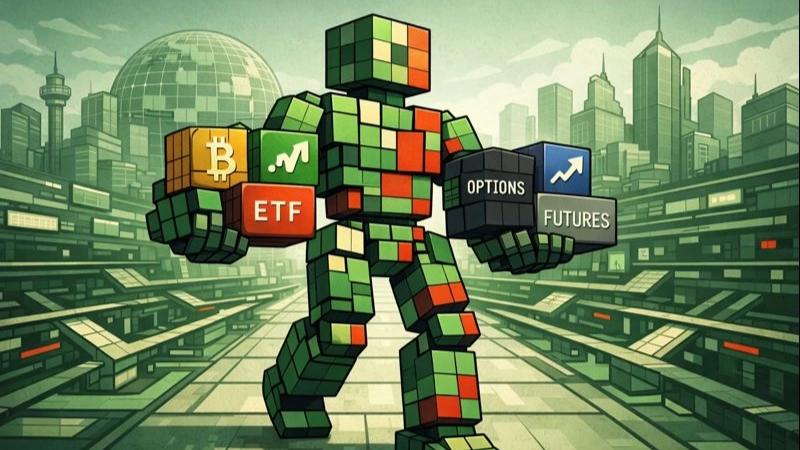
A super-app blueprint meets a trust problem Coinbase can’t hand-wave away
TL;DR
- Coinbase is selling a 2026 strategy that turns the exchange into an “everything exchange” spanning crypto, equities, prediction markets, and commodities across spot, futures, and options, but the same messaging is reigniting old debates about listings fairness on Base and whether user safety is treated like a feature instead of a priority.
- Backlash accelerated after creator-coin volatility on Base and public criticism from security researchers, putting Coinbase’s brand promise—being the “#1 financial app in the world”—into the same arena as questions about reliability, transparency, and support quality.
We’ve just launched the all-new COIN360 Perp DEX, built for traders who move fast!
Trade 130+ assets with up to 100× leverage, enjoy instant order placement and low-slippage swaps, and earn USDC passive yield while climbing the leaderboard. Your trades deserve more than speed — they deserve mastery.
Coinbase opened 2026 by trying to expand its identity from “place to trade coins” into a full-spectrum financial platform, with CEO Brian Armstrong laying out priorities that bundle crypto with equities, prediction markets, and commodities while pushing stablecoins and Base as the rails for broader adoption. Armstrong’s public roadmap framed the goal bluntly—making Coinbase the “#1 financial app in the world”—and pitched “major investments” in automation and product quality as the operational backbone for a larger product suite that would increasingly look like a brokerage, a derivatives venue, a payments app, and an onchain portal rolled into one.
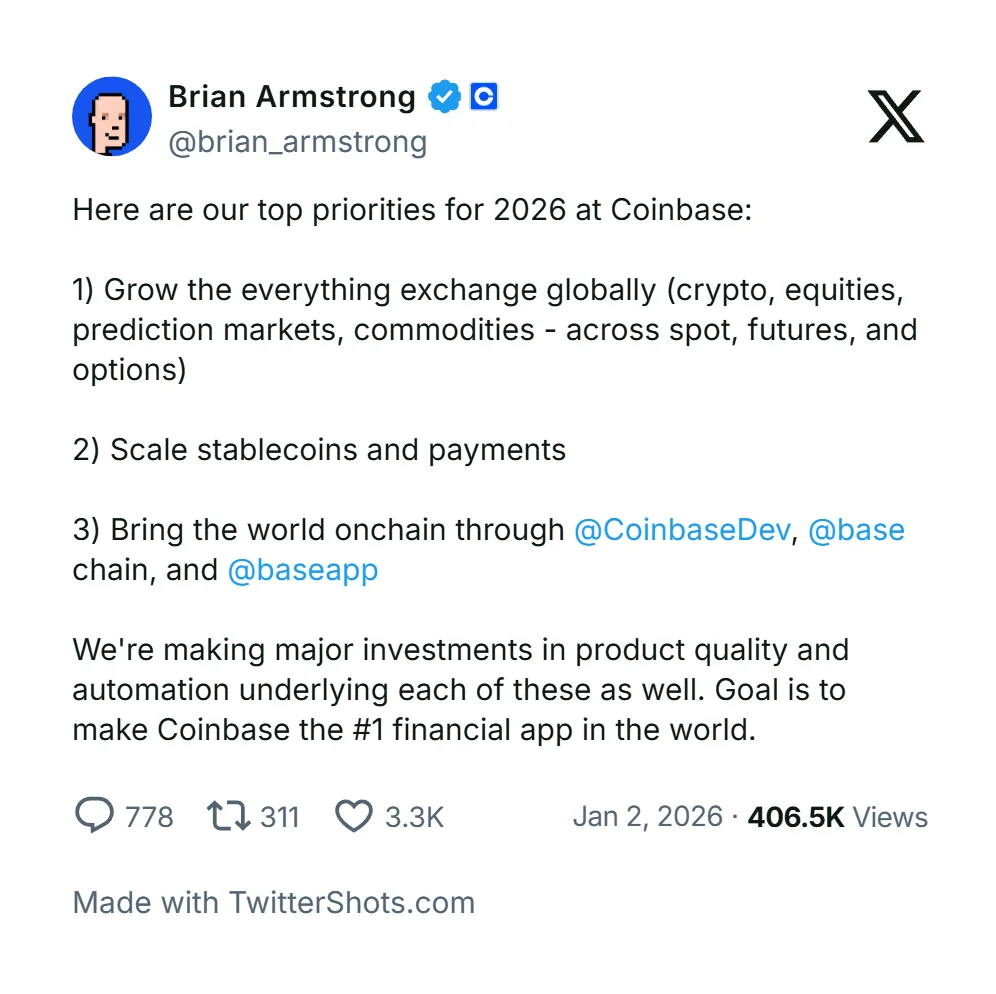
That ambition is being marketed as a structural response to how users already behave in crypto—watching crypto price moves, checking a crypto price index, tracking coin market cap shifts, and trading around the clock—then asking why stocks and related exposure should remain locked behind weekday market hours and fragmented apps.
Product moves from late 2025 were used to support the claim that Coinbase isn’t merely brainstorming the everything-exchange thesis. Coinbase launched U.S. equities trading within the main app and announced onchain prediction markets through a partnership with Kalshi, a regulated venue described as operating under a CFTC-approved framework. Reporting around the Kalshi integration described event contracts structured as binary, yes-or-no markets and referenced leaked screenshots showing a Coinbase-branded prediction interface supporting USDC or USD trading across categories such as economics, politics, sports, and technology.
Tokenized equities also featured prominently, with Coinbase described as aiming to issue tokenized equities in-house rather than leaning on third-party providers, a move that would put it in more direct competition with both traditional brokerages and crypto-native rivals. Market appetite for tokenized stock exposure was illustrated through an industry metric that put tokenized-equity transfer volumes at about $2.46 billion after a roughly 76% increase over 30 days, while Coinbase’s institutional scale was framed through a shareholder-letter figure citing $516 billion in managed assets, described as 16% of total crypto market capitalization.
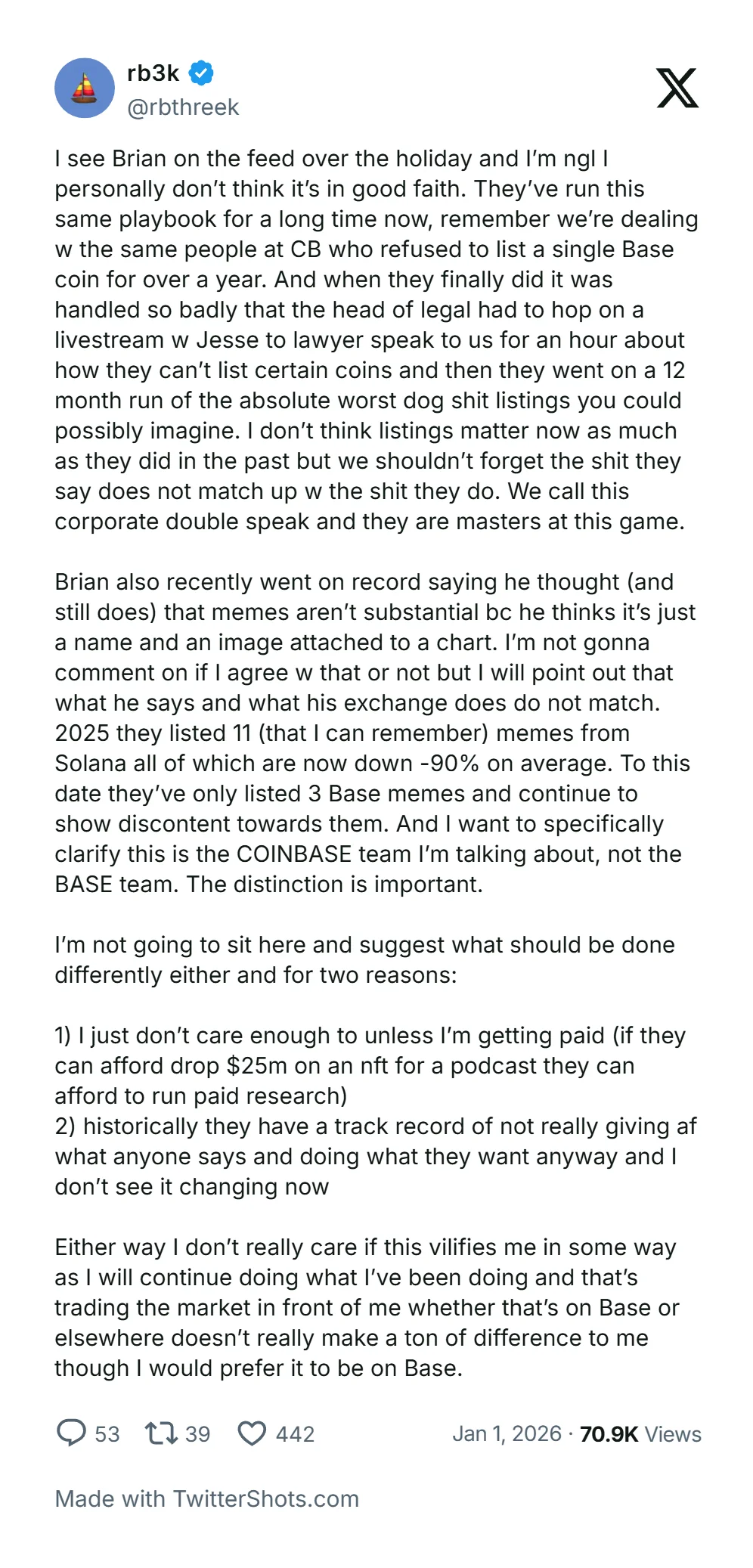
Pushback arrived fast, and it didn’t read like ordinary timeline noise. Criticism from Base developers and traders revived claims of “corporate double-speak,” arguing Coinbase’s talk of openness and decentralization hasn’t consistently matched the lived reality of listings and ecosystem support. Traders pointed to what they described as earlier reluctance to list Base-native tokens, then contrasted Coinbase’s Solana memecoin listing pace with the relatively limited number of Base meme coins listed to date, turning listings into an optics war rather than a pure product debate.
Discussion escalated further after a creator token tied to YouTuber Nick Shirley on Base was reported as briefly nearing a $9 million valuation before dropping 67% within hours, prompting renewed arguments over whether creator coins are a genuine onboarding path or simply a faster conveyor belt for short-term speculation. Armstrong responded by pointing to decentralized exchange integrations as the primary way to access “millions of tokens,” while also cautioning that centralized listings are harder for reasons “not all in our control,” and that a listing shouldn’t be treated as an endorsement—language that may play well as compliance posture but also lands poorly for builders who interpret it as Coinbase widening the funnel without taking responsibility for what comes through it.
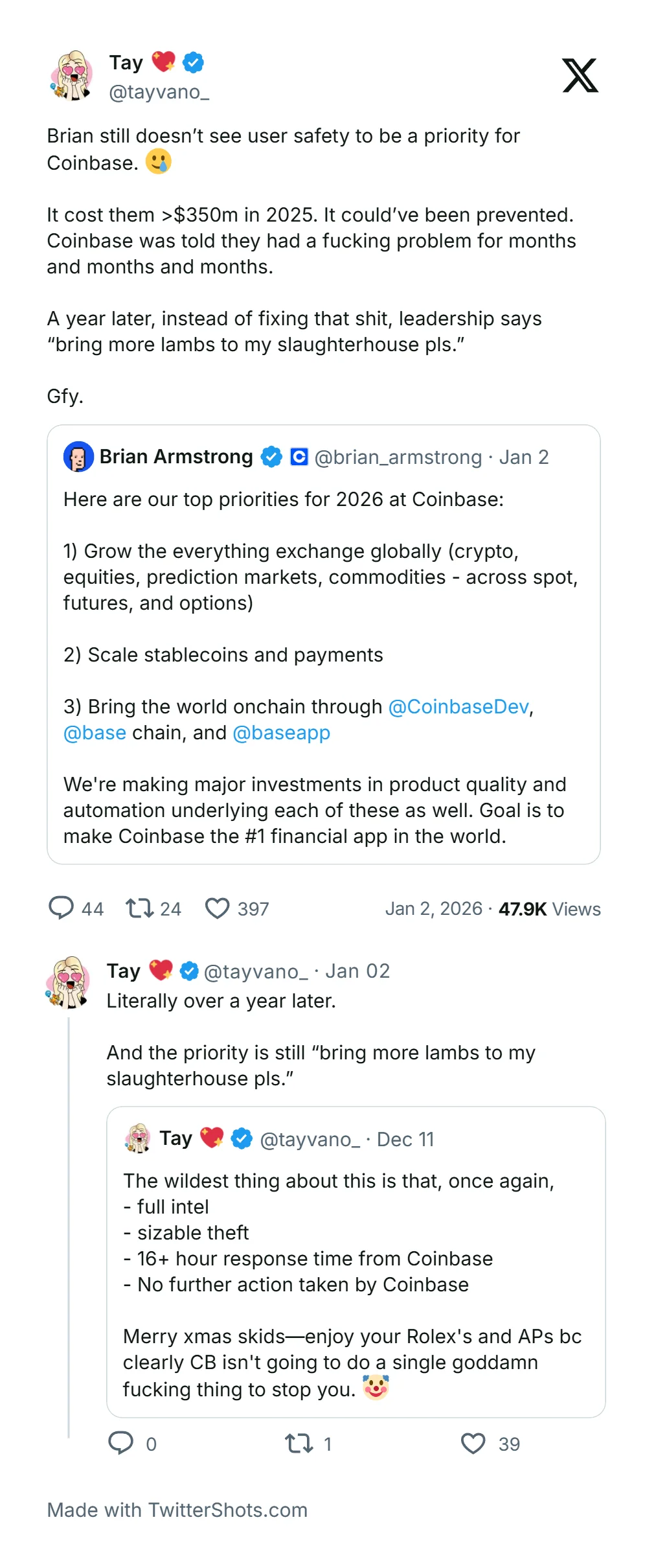
Security criticism ran on a parallel track and hit the roadmap narrative where it’s most fragile: trust. Crypto security researcher Taylor Monahan criticized Armstrong’s priorities as sidelining user safety and alleged that user harm “cost them >$350m in 2025” and “could’ve been prevented,” tying the frustration to earlier reporting around suspected Coinbase Commerce exploit activity highlighted by ZachXBT. That thread referenced more than $15.9 million in suspicious USDC outflows on Polygon over a 16-hour window in April 2024, followed by bridging to Ethereum, swapping into ETH, and dispersal across wallets, alongside claims that funds later moved through mixers and gambling platforms. Broader complaints also cited account lockouts and alleged gaps in breach transparency, feeding the perception that Coinbase is sprinting toward a super-app future while still dragging unresolved operational risk behind it like a tin can tied to the bumper.
Coinbase Institutional’s research messaging added another layer to the “everything exchange” thesis by arguing that equity perpetual futures could become a major retail trading vehicle, effectively fusing crypto-derivatives mechanics with stock exposure. The pitch was that perps—popularized in crypto markets for allowing leveraged positions without fixed expirations—are evolving into composable DeFi primitives that can integrate with lending and collateral frameworks, then extend into tokenized-equity markets where 24/7 accessibility and capital efficiency could appeal to global retail demand for U.S. stock exposure.
That argument sketches a future where stocks trade through crypto-native instruments during weekends and nights, but it also amplifies the same underlying question Coinbase keeps running into: whether users will embrace a unified platform not just because it’s convenient, but because it’s consistently reliable, transparent, and aligned with the incentives it claims to represent.
This article has been refined and enhanced by ChatGPT.


