




 USD
USD
Ethereum Researcher Urges ‘Bunker Mode’ as AI Cryptography Debate Intensifies


Vitalik Buterin urges caution while Coinbase cryptography chief disputes evidence of an imminent ECDSA break
TL;DR
- Ethereum Foundation researcher Justin Drake wants large crypto holders to prepare a controlled migration to fresh addresses whose public keys remain hidden.
- Drake says an AI-assisted ECDSA break could arrive before quantum “Q-Day,” but no practical classical attack has been demonstrated.
- Vitalik Buterin supports taking AI-driven cryptography risks seriously while warning against rushed wallet migrations.
Trade smarter on Jupiter, Solana’s leading DEX built for fast execution and deep liquidity.
Swap tokens at competitive rates, route across multiple liquidity sources automatically, and access perpetuals, DCA, and advanced trading tools — all in one place!
Ethereum Foundation researcher Justin Drake urged the crypto industry on Oct. 7 to begin planning “bunker mode,” a controlled migration of assets to fresh addresses that have never exposed their public keys. The proposal is a precaution against a hypothetical AI-assisted break of ECDSA, not evidence that Bitcoin or Ethereum cryptography has already been broken.
“Today I call upon the blockchain industry to calmly begin planning for ‘bunker mode’,” Drake wrote on X. “My personal recommendation is to set in motion a controlled mass migration of assets to fresh addresses, i.e. addresses whose pubkeys remain hidden behind a hash.”
ECDSA is used to authorize transactions on Bitcoin and Ethereum. Once an address signs a transaction, its public key becomes visible onchain, while an address that has only received funds can keep that key concealed behind a hash. Drake recommended that large and sophisticated holders keep most funds in addresses that have never signed a transaction and move remaining balances to a fresh address after spending.
AI math progress drives the warning
Drake defined the feared “break” as private-key recovery in about one week using available hardware such as a large GPU cluster. He said the worst-case timeline could be “months not years” and cited 722 mathematical results published by OpenAI as evidence of rapid AI-driven progress. OpenAI published new mathematical results from an internal frontier model on Oct. 6, including machine-generated proofs formalized in Lean, but did not report an attack on blockchain cryptography.
Drake also questioned whether “our magic 64-byte ECDSA signatures” could face unexpected mathematical shortcuts. He pointed to approximately 20,000 early Bitcoin addresses holding 50 BTC each and Project Eleven’s tracker of exposed Bitcoin public keys. Drake urged Binance, Bitbank, Robinhood, Bitfinex and Tether to harden cold storage.
Ethereum’s security roadmap is another focus. The Ethereum Foundation formed a dedicated post-quantum team earlier in 2026, while Drake wants greater use of hash-based cryptography and end-to-end formal verification. “Those timelines must now be revisited and accelerated in light of mathematical superintelligence,” Drake wrote. “I’ll be pushing for maximum defensive acceleration.”
Buterin urges preparation without panic
Ethereum co-founder Vitalik Buterin backed taking the risk seriously but rejected an emergency migration. “I don't recommend anyone scramble to move their funds to new wallets today. But we should take the risks to cryptography from AI-accelerated math seriously,” he wrote on X.
Buterin said the concern could extend to lattice-based cryptography such as ML-DSA, which NIST standardized in 2024 as a post-quantum digital-signature algorithm. He said AI-driven mathematical advances could erode assumed security margins over the next two years, writing: “If AI will bring us 50 years of math in 2 years,” comparable breakthroughs could improve attacks against lattice cryptography.
Ethereum’s “lean” roadmap has moved toward hash-only systems over the past year, including WOTS and SPHINCS, while reducing reliance on lattice-based signatures such as ML-DSA and Falcon. Buterin said systems that still depend on structured cryptography may eventually need security parameters, including key sizes, increased by as much as ten times.
Security experts split over Drake’s warning
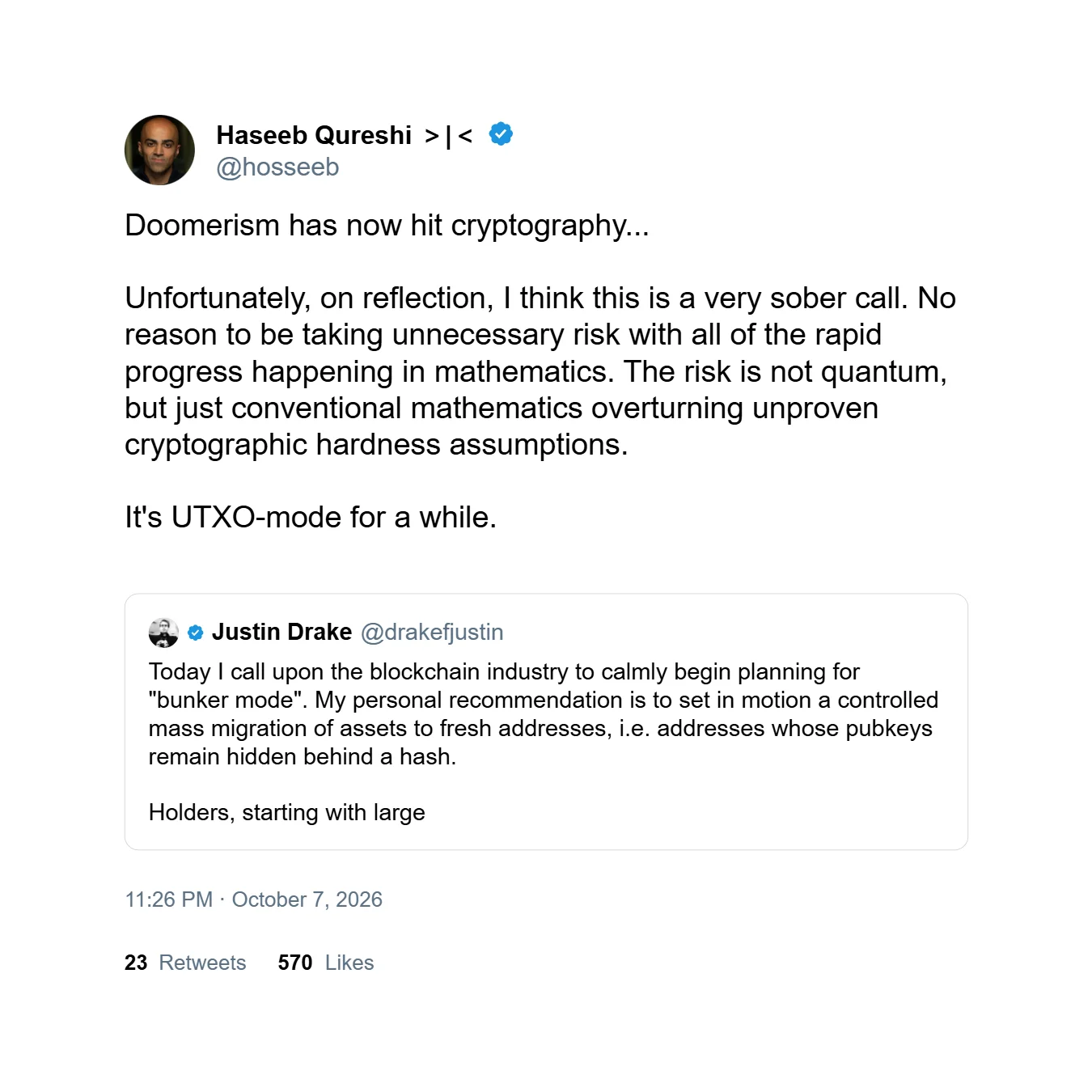
Dragonfly managing partner Haseeb Qureshi sided more closely with Drake, calling the proposal “a very sober call.” Qureshi said: “The risk is not quantum, but just conventional mathematics overturning unproven cryptographic hardness assumptions.” BitGo separately said it had been offering “bunker mode” since 2013.
Coinbase Head of Cryptography Yehuda Lindell rejected the premise more sharply. “To my understanding, there is no evidence whatsoever pointing to a break of decades old hardness assumptions like elliptic curve cryptography,” Lindell wrote. He called unsupported warnings “the very definition of FUD — it cannot be proven wrong but there’s also no evidence whatsoever of it being true.”
Buterin’s immediate position remained cautious. Users who can keep funds in addresses that have not signed transactions may reduce public-key exposure, while multisig operators can gather signatures offchain and rotate signer keys. Buterin also warned that migration itself carries operational risk, saying he has personally lost more money through failed migrations than through hacks.
This article has been refined and enhanced by ChatGPT.


