


 USD

House Democrats Weigh Expanded SEC Role in New Crypto Framework

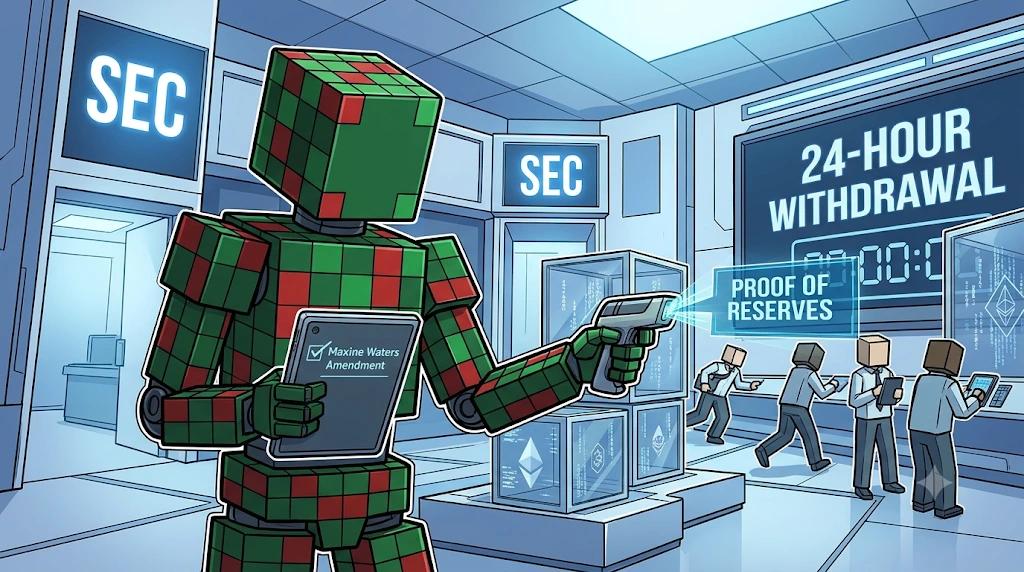
Waters' customer-protection proposals could shape legislation after the CLARITY Act's Senate defeat
TL;DR
- House Democrats are reportedly discussing new crypto market-structure legislation that would expand SEC authority, reduce the CFTC's role and tighten government ethics restrictions.
- Rep. Maxine Waters' earlier proposal included stricter exchange safeguards, withdrawal deadlines, reserve verification and protections against conflicts of interest.
- Previous bipartisan negotiations addressed some of these issues, but disagreements over regulatory jurisdiction, ethics and customer protections remain obstacles to new legislation.
Trade smarter on Jupiter, Solana’s leading DEX built for fast execution and deep liquidity.
Swap tokens at competitive rates, route across multiple liquidity sources automatically, and access perpetuals, DCA, and advanced trading tools — all in one place!
House Democrats are reportedly considering a new cryptocurrency market-structure framework that would give the Securities and Exchange Commission (SEC) greater authority, reduce the Commodity Futures Trading Commission's (CFTC) role and strengthen government ethics restrictions following the CLARITY Act's defeat in the Senate.
According to a November 4, 2026, post by journalist Eleanor Terrett, the discussions draw partly on earlier investor-protection proposals from Rep. Maxine Waters, although no new legislative text has been published.
Terrett's account was based on industry sources who had spoken with Democratic congressional staff. The discussions suggest lawmakers could revisit customer protections and regulatory responsibilities already debated during earlier attempts to establish comprehensive federal rules for digital assets.
The development follows Democrats' November 3 midterm victory, which gave the party control of both chambers of Congress and further complicated efforts to revive the CLARITY Act. As COIN360 previously reported, the election outcome has increased expectations of tougher crypto oversight, although stablecoin regulation and tokenization initiatives may continue advancing under existing laws.
Waters' Earlier Amendment Outlined Stricter Exchange Protections
Waters' July 2025 proposal offers an indication of the consumer safeguards that could feature in a new Democratic framework. Amendment #31, a nine-page measure, sought to impose additional obligations on cryptocurrency exchanges, brokers, custodians and other companies providing digital asset services to retail customers.
The amendment included specific requirements governing withdrawal processing, reserve verification, customer support, security disclosures and transaction settlement. Unlike broader regulatory principles, many of its provisions established measurable deadlines and compliance obligations.
The proposal also required eligible firms to join the Securities Investor Protection Corporation (SIPC) or establish an equivalent arrangement for protecting customer assets. Customer holdings would have to remain in segregated, bankruptcy-remote accounts, while lending, staking or rehypothecating those assets would require affirmative consent that customers could revoke.
Trading safeguards were another major component. Customer orders would receive priority over proprietary orders under best-execution requirements, and affiliated proprietary trading firms or market makers would be prohibited from trading against customers on the same platform.
Additional provisions included an indicator showing the proportion of customers holding an asset at a loss and compensation mechanisms involving bonds, insurance or insured trusts. Those mechanisms would address losses resulting from covered entities' regulatory violations rather than guaranteeing compensation for ordinary market losses.
Waters' amendment also proposed an initial one-year effectiveness period, up to 18 months for joint SEC and CFTC rulemaking, and a possible additional year for smaller entities.
The measure never advanced to a House floor vote. The House Rules Committee voted 8-4 on July 14, 2025, against making it eligible for consideration, leaving the proposal in committee. Its earlier rejection means the provisions should not be treated as existing legal requirements or confirmed elements of a future Democratic bill.
September's CLARITY Compromise Already Addressed Some Customer Safeguards
Several issues raised by Waters had already appeared in the later CLARITY Act negotiations, although the earlier proposals and the September compromise differed in how specifically they defined customer rights.
The Congressional Research Service's September 15 analysis identified customer-property protections, restrictions on commingling assets and provisions addressing how digital asset customers would be treated in bankruptcy.
The legislation also included CFTC registration requirements for digital asset exchanges, brokers and dealers, alongside regulatory principles covering market manipulation, conflicts of interest and customer protection. Bank Secrecy Act obligations formed another part of the framework.
The SEC would retain responsibility for investment-contract offerings, including a disclosure-based exemption for qualifying token originators raising up to $200 million.
Senators Cynthia Lummis, John Boozman and Tim Scott said their September 14 revision incorporated 126 substantive changes requested by Democrats. That figure represented the sponsors' accounting of negotiated revisions, rather than confirmation that Democratic lawmakers had endorsed the resulting legislation.
Among the revisions were government ethics provisions drawing on an approach associated with Sens. Thom Tillis and Ruben Gallego, including enforcement authority for state attorneys general. The proposed rules addressed certain covered officials with substantial financial interests, requiring divestment or the use of blind trusts.
Treasury authority to restrict stablecoin incentives during periods of substantial bank deposit outflows was also included. However, lawmakers remained divided over the scope and enforceability of the ethics provisions.
Waters' earlier amendment went further in specifying customer-facing deadlines, recurring verification requirements, consent rules and restrictions on affiliated trading. A revised Democratic framework could seek to turn some of the broader principles negotiated in September into more explicit obligations backed by reporting standards and penalties.
Greater SEC Authority Could Reshape Crypto Exchange Oversight
A central issue in the reported Democratic discussions is how federal oversight would be divided between the SEC and CFTC.
The CFTC already regulates derivatives markets and holds antifraud and antimanipulation authority in spot commodity markets. However, comprehensive supervision of spot cryptocurrency exchanges would require additional statutory authority, which the September CLARITY framework sought to establish.
A Democratic proposal could instead expand SEC supervision of crypto intermediaries, issuers or customer-protection standards. Lawmakers could also reconsider the legal definitions used to determine which digital asset activities fall under each regulator.
Such changes could impose additional registration, disclosure, order-handling and custody obligations on exchanges. Custodians could face stricter asset segregation and verification requirements, while smaller platforms could encounter higher fixed compliance costs.
A March 2026 SEC-CFTC interpretation classified Bitcoin as a digital commodity. That classification remains distinct from the rules governing exchanges and other businesses handling customer assets. Consequently, changes to intermediary oversight would not necessarily require lawmakers to change Bitcoin's underlying classification.
For customers keeping BTC on centralized exchanges, withdrawal requirements, reserve verification and bankruptcy protections would directly concern the companies holding their assets. Investors using self-custody would face a different set of exposures because they retain control of their holdings.
Existing investor-protection mechanisms also have important differences. Investor-advocate staff at the Public Company Accounting Oversight Board (PCAOB) have warned that ordinary proof-of-reserves reports are not equivalent to full financial audits and may omit liabilities, ownership rights or borrowed assets.
SIPC protection similarly does not extend to non-security cryptocurrencies merely because they are held through a SIPC-member brokerage. An equivalent protection mechanism specifically created for digital assets would therefore require its own eligibility criteria, funding arrangements and coverage limits.
Operational capacity presents a separate issue from asset backing. An illustrative scenario involving a fully backed exchange holding $1 billion in customer cryptocurrency and processing transfers equal to 15% of balances daily shows how delays can occur. Under those hypothetical assumptions, a 20% withdrawal rush creates a $50 million processing gap, while a 40% rush produces a $250 million gap. Those figures illustrate potential processing constraints rather than actual losses or deficiencies at an exchange.
New Legislation Still Faces Congressional and Regulatory Hurdles
The earlier CLARITY Act stalled on September 15 after a motion to proceed received 49 votes in favor and 50 against, falling short of the 60 votes needed to advance. Four Republicans voted against the procedural motion. The outcome was not a final vote on the legislation itself.
Any replacement legislation would still require both chambers of Congress to approve identical text before obtaining a presidential signature or securing a veto override.
Negotiations would need to address several disputed issues, including the division of SEC and CFTC jurisdiction, the cost of additional exchange obligations, decentralized finance oversight, software developer protections, stablecoin incentives and government ethics enforcement.
Federal agencies can continue pursuing regulatory changes within their existing authority while congressional discussions proceed. The SEC's recent initiatives include its August Regulation Crypto Assets proposal, a September 17 Innovation Exemption and an October 1 custody proposal, with comments on the latter due December 7.
However, legislation would be necessary to establish certain compensation mechanisms or provide comprehensive federal jurisdiction over spot cryptocurrency markets.
A framework combining CFTC spot-market supervision with enforceable customer protections could introduce higher initial compliance costs while providing legal requirements less dependent on changing agency guidance. Continued disagreements over jurisdiction and ethics would leave firms and customers operating under existing federal law, state rules and individual platform terms.
The reported Democratic discussions therefore concern both the allocation of regulatory authority and the possibility of creating more specific legal protections for customers when cryptocurrency platforms delay withdrawals, handle assets improperly or fail.
This article has been refined and enhanced by ChatGPT.


