




 USD
USD
Ethereum Foundation Deploys 70,000 ETH to Validators as Strawmap Targets 10,000 TPS and Vitalik Buterin Completes Multi-Million ETH Sales


Treasury Staking Rollout, Seven Hard Fork Plan Through 2029, and 16,420 ETH Sales Unfold
TL;DR
- Ethereum Foundation began staking 70,000 ETH on February 24, 2026, with an initial 2,016 ETH deposit and 2.8% APY yield rate.
- Strawmap roadmap outlines seven hard forks through 2029, targeting 10,000 TPS on Layer 1 and up to 10 million TPS on Layer 2.
- Vitalik Buterin sold between 10,723 ETH and approximately 16,420 ETH starting February 2, 2026, with transactions valued at about $21.7 million at an average of $2,027 per ETH.
We’ve launched the all-new COIN360 Perp DEX, built for traders who move fast!
Trade 130+ assets with up to 100× leverage, enjoy instant order placement and low-slippage swaps, and earn USDC passive yield while climbing the leaderboard. Your trades deserve more than speed — they deserve mastery.
Ethereum Foundation initiated staking operations for a portion of its treasury on February 24, 2026, depositing 2,016 ETH into the network’s validator activation queue as the first phase of a broader 70,000 ETH allocation. The move follows a Treasury Policy introduced in June 2025 and represents roughly 40.5% of the Foundation’s deployable ETH balance, previously estimated at 172,650 ETH. All staking rewards will be returned directly to the Foundation’s treasury. Ethereum’s validator ecosystem currently generates about 2.8% APY, according to the CoinDesk Composite Ether Staking Rate.
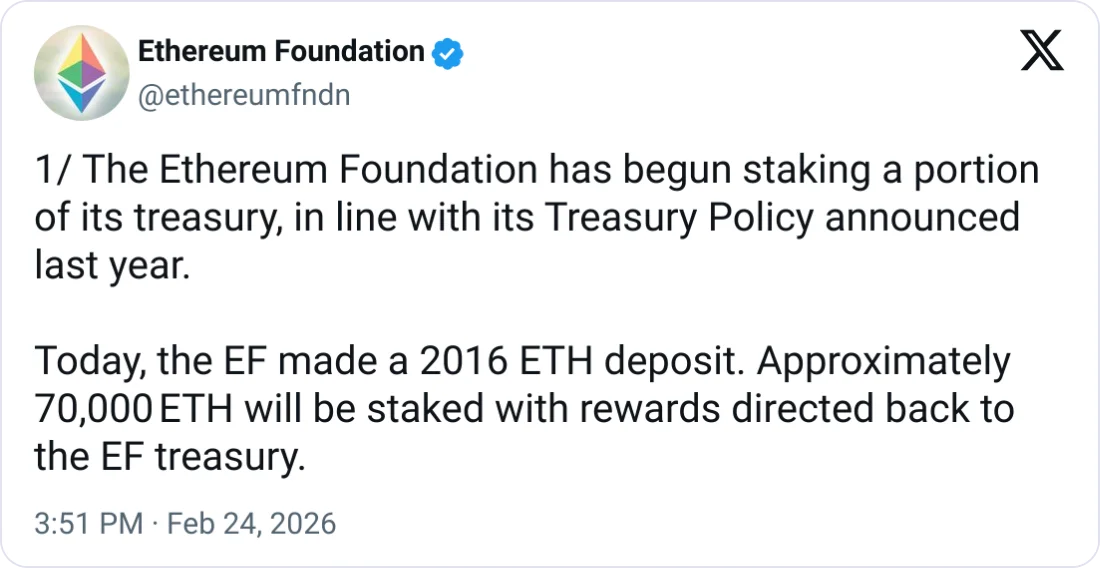
Validator infrastructure will rely on open-source software developed by Attestant, also known as Bitwise Onchain Solutions. The Foundation confirmed it will use Dirk, a distributed key signer that fragments signing authority across jurisdictions, and Vouch, a validator coordination tool designed to support client diversity. The setup combines self-managed hardware and hosted environments while incorporating minority client implementations. Staking income is earmarked for protocol research and development, ecosystem grants, community support initiatives, and other public goods funding programs.
Treasury deployment occurred while Ethereum’s crypto price traded below $2,000, based on COIN360 data. Broader market tracking through the crypto price index and coin market cap rankings showed ETH remaining under pressure amid a reported 38% monthly decline. The Foundation’s staking shift followed community criticism over previous reliance on direct ETH sales for operational funding, with treasury yield generation presented as an alternative to liquidations.
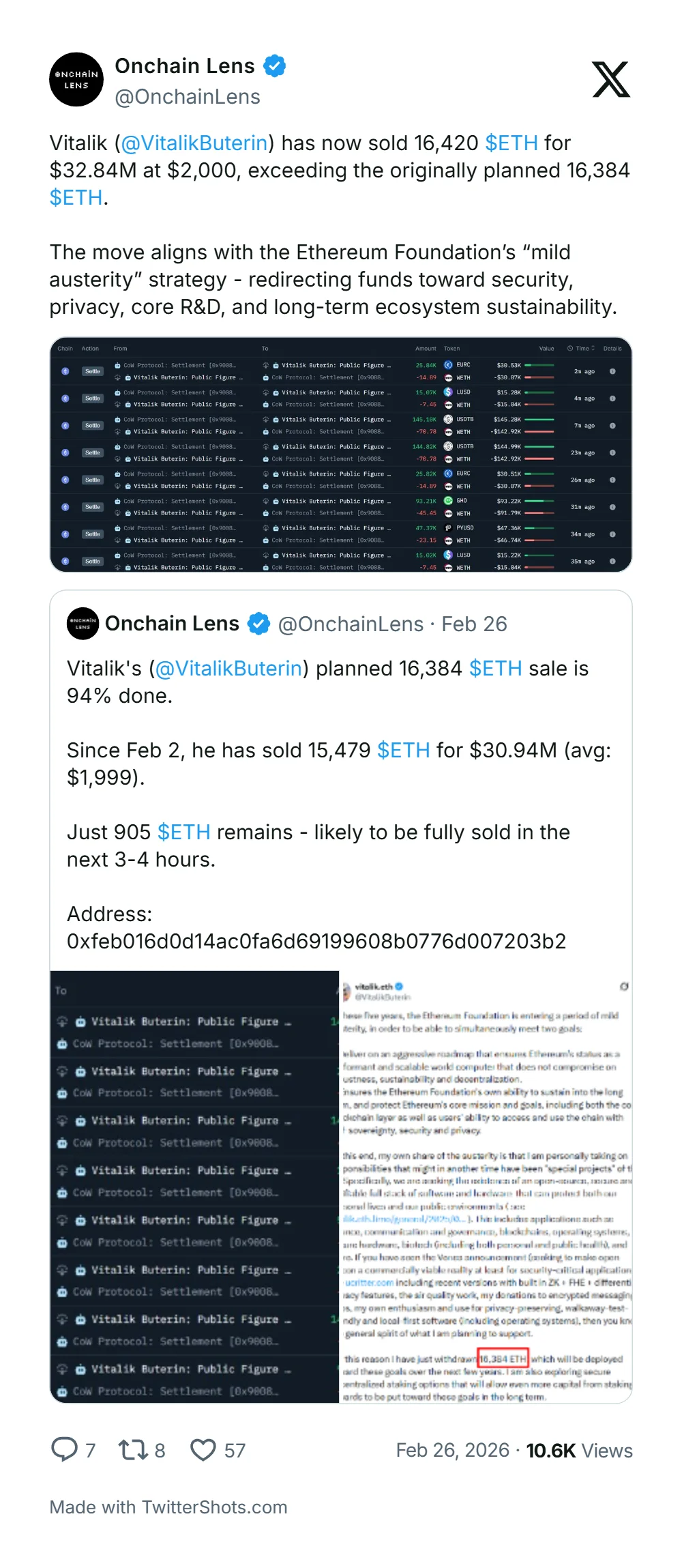
Separate on-chain data shows Vitalik Buterin began selling portions of his personal ETH holdings starting February 2, 2026. Arkham Intelligence and Onchain Lens tracked 10,723 ETH sold for approximately $21.7 million at an average crypto price near $2,027 per ETH. Alternative blockchain monitoring estimates place cumulative sales closer to approximately 16,420 ETH. Transactions were executed in smaller swaps. January disclosures indicated a commitment of 16,384 ETH, valued at about $43 million at the time, toward open-source software, secure hardware, governance research, biotech, communication systems, and operating system initiatives.
Ethereum core researchers also published a preliminary “Strawmap” roadmap in late February 2026 outlining a long-term protocol upgrade path extending through the end of 2029. The draft document sketches seven potential hard forks spaced roughly every six months. Early upgrade names include “Glamsterdam” and “Hegotá,” both referenced as 2026 milestones. Contributors described the Strawmap as a coordination framework rather than a fixed implementation schedule.
Technical goals detailed in the Strawmap include reducing Layer-1 finality from minutes to a seconds-scale target of roughly 6–16 seconds or less through phased consensus improvements. Block production slot durations could gradually move from 12 seconds toward 2 seconds. Base layer throughput expansion under the “Gigagas” framework targets approximately 10,000 transactions per second, supported by embedded zero-knowledge execution environments.
Layer-2 scaling ambitions under the “Teragas” concept project ecosystem-wide capacity reaching up to approximately 10 million transactions per second through data availability sampling and enhanced infrastructure. The roadmap also outlines a phased shift toward quantum-resistant cryptographic signature schemes and the introduction of protocol-level privacy primitives allowing shielded ETH transfers. Researchers noted that upgrades remain subject to community governance processes and iterative development feedback through 2029.
This article has been refined and enhanced by ChatGPT.


