




 USD
USD
Ethereum Foundation Faces Leadership Exit and Funding Warning


Developer support concerns grow after Hsiao-Wei Wang’s resignation
TL;DR
- Hsiao-Wei Wang resigned as Ethereum Foundation co-executive director and board member, effective June 18, 2026.
- Former Ethereum Foundation contributor Trent Van Epps warned that core development could face a funding crunch within three to nine months.
- Ethereum’s developer funding concerns center on an estimated $30 million annual need, senior turnover and the foundation’s move toward a leaner role.
Trade smarter on Jupiter, Solana’s leading DEX built for fast execution and deep liquidity.
Swap tokens at competitive rates, route across multiple liquidity sources automatically, and access perpetuals, DCA, and advanced trading tools — all in one place!
The Ethereum Foundation is facing renewed leadership and funding pressure after Hsiao-Wei Wang resigned as co-executive director and board member, effective June 18, 2026, while former contributor Trent Van Epps warned that Ethereum core development could face a funding crisis within three to nine months without a more stable support model.
Wang framed her departure as a personal decision made after a sabbatical, not as a public dispute with the organization. “After my sabbatical, I have decided to step down as co-executive director and board member of the Ethereum Foundation, effective today,” Wang wrote. She said the break gave her “space to reflect on my priorities and the kind of life I want to build next,” adding, “I’ve come to feel that this is the right moment for me to step back.”
Wang thanked Bastian Aue, an Ethereum Foundation board member, for helping manage the transition while she was away. “During my break, Bastian guided the transition with care and thoughtfulness, and I appreciate the work he and many others have put into that process,” Wang wrote. Her departure left Aue effectively carrying the foundation’s executive structure, with no successor structure announced.
Wang used her resignation message to emphasize Ethereum’s wider contributor base beyond the foundation. “Ethereum has always been bigger than any one role, any one organization, or any one moment,” she wrote. Wang said Ethereum’s strength comes from people “who keep building permissionless infrastructure across the ecosystem to unlock freedoms that didn’t exist before,” and said she was proud of work done “not only at the EF, but across the builders, researchers, educators, node operators, validators, users, and many other contributors.”
Executive turnover deepens during Ethereum Foundation reset
Wang’s exit followed Tomasz Stanczak’s departure from the co-executive director role in February 2026. Wang and Stanczak had been named co-executive directors in March 2025 as part of a governance reset after Aya Miyaguchi moved into a president role. Both executives were gone within roughly fifteen months of taking the roles, creating a leadership-continuity problem at a time when the foundation is already trying to reduce its central role.
After Stanczak stepped down, Aue was named interim co-director alongside Wang. Wang’s resignation made Aue effectively the sole executive director, with no public succession timeline available for replacing her. The change came during a wider period of Ethereum Foundation turnover, with at least eight senior figures reported to have left the organization over the previous five months and approximately 19 departures placed across 2026.
The senior exits reportedly included top researcher Dankrad Feist, researchers Carl Beek and Julian Ma, and at least two veteran members of the foundation. Other departures were tied to the Protocol Cluster transition, including Barnabe Monnot, Tim Beiko and Alex Stokes. The pattern raised questions over mandate uncertainty, resource allocation, governance direction and the foundation’s role relative to the broader Ethereum ecosystem.
Ethereum co-founder Vitalik Buterin praised Wang after her resignation, calling her “a steadfast contributor” to Ethereum. Buterin credited Wang with a decade of work across research, consensus and community-building, and said she put “a lot of work into building an excellent Ethereum community in Taipei, with people and events that were among my favorites.”
Buterin also described the difficulty of Wang and Stanczak’s assignments. “Last year she, along with @tkStanczak, voluntarily took on the burden of what is perhaps the most challenging position in the Ethereum Foundation, at one of the most challenging times for Ethereum,” Buterin said.
We’ve launched the all-new COIN360 Perp DEX, built for traders who move fast!
Trade 130+ assets with up to 100× leverage, enjoy instant order placement and low-slippage swaps, and earn USDC passive yield while climbing the leaderboard. Your trades deserve more than speed — they deserve mastery.
Developer funding concerns center on client teams
Van Epps, who worked at the Ethereum Foundation from May 2021 to April 2026, warned that Ethereum core development could face a slow-burning funding crisis. His work focused on core development coordination and Protocol Guild funding, placing his warning inside the same developer-support system now under scrutiny.
“From recent conversations across all core development, there is a risk we will enter a slow-burning funding crisis within the next 3-9 months,” Van Epps said. He said the pressure may look episodic from the outside but reflects “larger structural issues related to gathering and allocating funding.”
Van Epps estimated that maintaining Ethereum’s current core development capacity requires roughly $30 million per year. That baseline covers more than ten Ethereum client teams and associated projects, including execution clients, consensus clients, researchers, coordination groups and infrastructure work needed to keep Ethereum reliable and upgradeable.
The warning centers on two converging pressures: the expiration of the Client Incentive Program and the Ethereum Foundation’s deliberate treasury spending reduction. The Client Incentive Program expired in April 2026, and no replacement program had been announced. The program launched in 2021 as a four-year initiative that funded Ethereum client teams through validator-based staking rewards.
The Client Incentive Program supported teams maintaining key Ethereum execution and consensus clients, including Geth, Erigon, Lighthouse and others. Payouts unlocked over time and depended on continued network contribution. Its expiration removed one of Ethereum’s few recurring and structured funding streams outside direct Ethereum Foundation grants.
Ethereum Foundation Q1 2026 grants still covered Geth, Erigon, Lighthouse, validator security tooling, cryptography research and core infrastructure. The issue is not that funding stopped entirely, but that recurring visibility weakened while the foundation is tightening its treasury policy.
Van Epps warned that if no replacement appears within the next few months, the most exposed teams may be those maintaining execution and consensus clients on thinner runways. Those teams are needed to keep Ethereum’s Glamsterdam upgrade roadmap on schedule. Van Epps also identified quantum-security research and Layer 1 scaling work as long-horizon projects that become vulnerable when funding visibility shortens.
Van Epps said underinvestment may not show immediate damage, but the consequences could become visible later, when reversing the damage could be harder and more expensive. He also warned that unstable funding could push out contributors with years of institutional knowledge, including expertise in scaling, client maintenance, protocol coordination and preparation for future threats such as quantum computing.
Treasury policy and “Subtraction” strategy face scrutiny
The Ethereum Foundation’s “Subtraction” strategy is central to the debate. The approach refers to the foundation’s long-standing philosophy of reducing its own influence and encouraging the wider Ethereum ecosystem to take on more responsibility. Van Epps said the strategy succeeded in communicating that the foundation does not want to remain Ethereum’s sole center of power, but was less successful in ensuring that other institutions actually stepped in to fill the gaps.
Van Epps said the Ethereum Foundation still occupies a unique position because of its reputation, historical role in protocol leadership, connection to Buterin, ownership of major communication channels and trademarks, and long-standing support of core developers and researchers. He said the foundation has repeatedly insisted it does not want to be “the sole center of power.”
Van Epps argued that without an explicit plan defining “the contours of what it won’t or can’t do,” other parts of the ecosystem are left scrambling to create alternative funding bodies. Van Epps now works with Protocol Guild, a project designed to channel independent funding to Ethereum developers outside the Ethereum Foundation’s traditional grant structure. Van Epps said the existing patronage model “hasn’t scaled,” and called for willing funders to step forward.
The Ethereum Foundation’s treasury plan adds another layer to the funding discussion. The foundation has spent much of its ETH holdings over the last decade helping bootstrap Ethereum’s growth and has begun reducing spending to preserve remaining funds. A treasury plan announced in June 2025 outlined a gradual reduction in annual spending from roughly 15% of the foundation’s treasury to a 5% endowment-style baseline by 2030.
The foundation has also faced criticism over ETH sales from its treasury. It recently introduced a more transparent treasury policy explaining when it would look to sell ETH. The policy said the foundation would seek to “earn acceptable returns on treasury assets,” signaling a more formal treasury-management approach after long-running community complaints about how the foundation manages its ETH holdings.
The Ethereum Foundation began staking its treasury earlier in 2026 and set an ultimate goal of staking around 70,000 ETH, valued at roughly $119 million. The staking plan appears aimed at addressing criticism that the foundation’s holdings should be managed more actively rather than used only for operational sales.
Dankrad Feist separately argued that the Ethereum community should create a new organization with at least $1 billion in ETH funding to “save Ethereum.” Feist said, “The community needs to create an organization that's economically aligned with Ethereum and accountable to it.” He also said the proposed organization needed “a leader who is competent and wants to fight.”
Buterin had already signaled a reduced organizational role for himself and the Ethereum Foundation before Wang’s resignation. On May 24, Buterin wrote that the foundation’s board was “in the process of expanding,” and that his own power within the organization would “continue to decrease.” Buterin described that transition as something he wanted and credited Miyaguchi with executing much of the organizational change.
About one month before Wang’s resignation, Buterin said the Ethereum Foundation would become a “smaller ship.” The foundation’s stated direction is a leaner organization focused on censorship resistance, privacy and security. The Ethereum Foundation had also been making “large changes” since early 2025 to improve its relationship with ecosystem builders and active participants.
Buterin also said Ethereum needed “new plans” for its relationship with layer-2 networks. That issue sits alongside leadership changes, treasury reform, developer funding and the debate over what the Ethereum Foundation should or should not control.
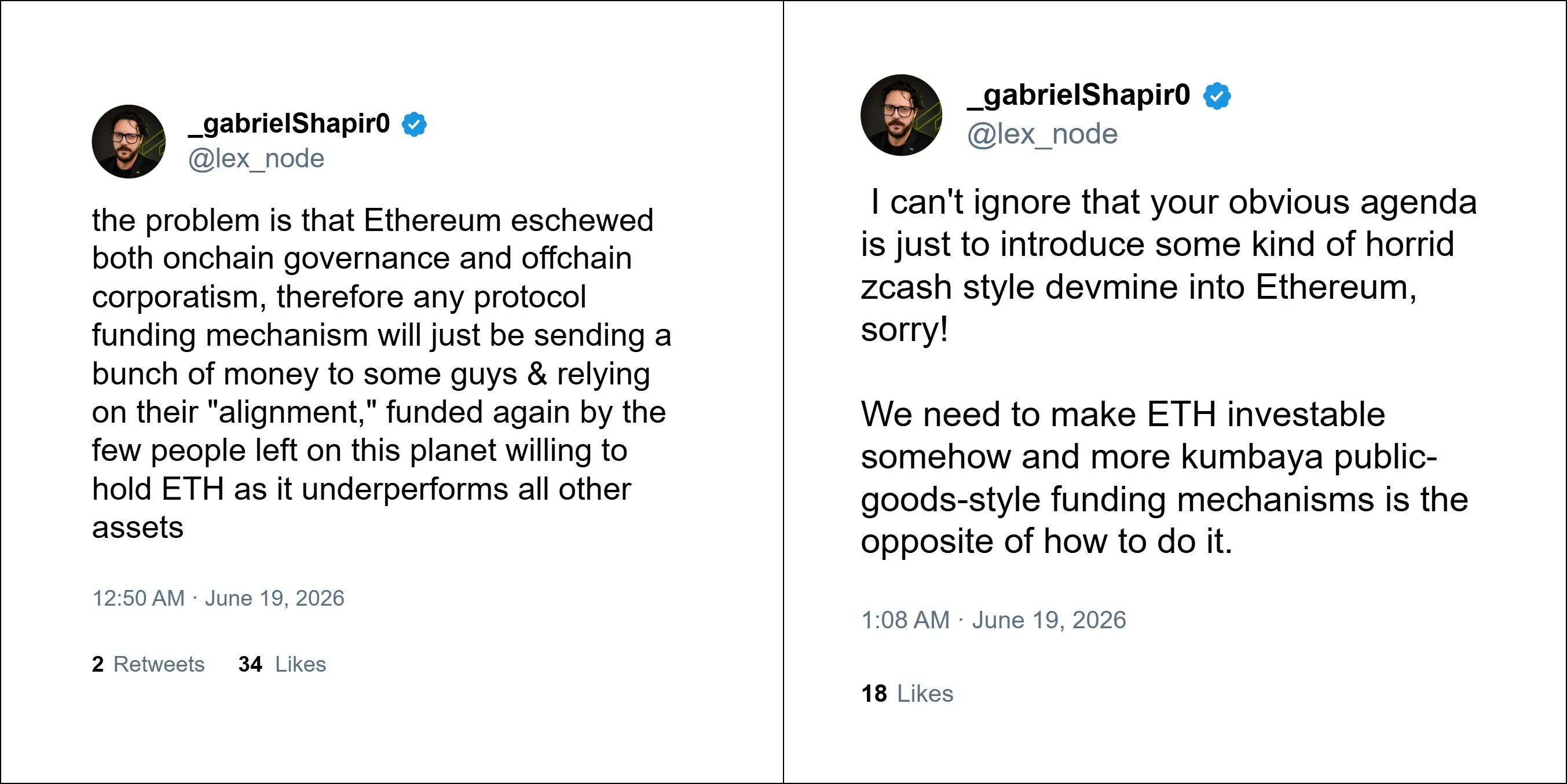
Gabriel Shapiro, a crypto-legal commentator posting as @lex_node on X, pushed back against Van Epps’ funding argument. Shapiro said Ethereum’s rejection of both on-chain governance and traditional corporate structures makes any protocol-level funding mechanism dependent on “sending a bunch of money to some guys & relying on their ‘alignment.’” Shapiro also accused Van Epps of pushing for “some kind of horrid zcash style devmine.”
Shapiro argued that Ethereum’s priority should be making ETH “investable” rather than expanding public-goods-style funding. The dispute captures a split between supporters of sustainable public-goods funding for developers and critics who worry protocol-funded mechanisms could weaken ETH’s investment narrative or resemble rent extraction.
COIN360 crypto price data showed ETH near $1,690 at one point on June 19, 2026, down roughly 3.3% on the day. ETH was also nearly 66% below its $4,946 all-time high, which was placed in August 2025.
The price movement was broadly in line with market-wide pressure and was not presented as a Wang-specific repricing. The larger unresolved issue is whether the Ethereum Foundation can stabilize leadership and developer funding while continuing its effort to become less central to Ethereum’s long-term governance.
FAQ
Who resigned from the Ethereum Foundation?
Hsiao-Wei Wang resigned as co-executive director and board member.
Who warned about Ethereum’s funding risk?
Former Ethereum Foundation contributor Trent Van Epps warned about the risk.
What funding amount did Van Epps cite?
Van Epps estimated roughly $30 million per year.
Who is effectively leading the foundation now?
Bastian Aue was described as effectively carrying the executive structure.
This article has been refined and enhanced by ChatGPT.


