




 USD
USD
Ethereum Expands Security Push With Post-Quantum Plans, FOCIL, and DAO-Backed Funding


Foundation Sets Post-Quantum Roadmap as Hegota Upgrade Targets Censorship Resistance
TL;DR
- Ethereum advances post-quantum security with live devnets and dedicated research teams
- Researchers propose FOCIL to harden censorship resistance in the 2026 Hegota upgrade
- Unclaimed DAO hack funds, now valued near $200M, redirected to Ethereum security efforts
We’ve launched the all-new COIN360 Perp DEX, built for traders who move fast!
Trade 130+ assets with up to 100× leverage, enjoy instant order placement and low-slippage swaps, and earn USDC passive yield while climbing the leaderboard. Your trades deserve more than speed — they deserve mastery.
Ethereum developers and researchers are advancing parallel efforts to harden the network against future quantum computing threats while embedding stronger censorship-resistance directly into the protocol, according to recent disclosures from the Ethereum Foundation and core researchers published in late January 2026. The initiatives include the formation of a dedicated post-quantum team, live multi-client development networks, new research incentives totaling $2M, and a proposal to modify Ethereum’s fork-choice rule under the upcoming Hegota upgrade.
Ethereum Foundation cryptographer Antonio Sanso said the network is currently about 20% of the way toward full post-quantum resilience when considering the execution layer, consensus layer, and data availability components together. Sanso said progress is uneven across those areas and stressed that post-quantum security is not a single switch but a collection of changes that must be coordinated across the protocol. “The research part is probably the part that has been already figured out… we have a clear plan in mind, and we’re probably going to execute in the next years,” Sanso said.
The Ethereum Foundation has established a dedicated post-quantum team led by cryptographic engineer Thomas Coratger, with contributors including Emile, who is involved in the leanVM project, a minimalist zero-knowledge virtual machine intended to support future cryptographic primitives. The Foundation has begun running multi-client post-quantum devnets involving consensus and execution clients such as Lighthouse, Prysm, Grandine, and Zeam, alongside bi-weekly coordination calls focused specifically on post-quantum engineering.
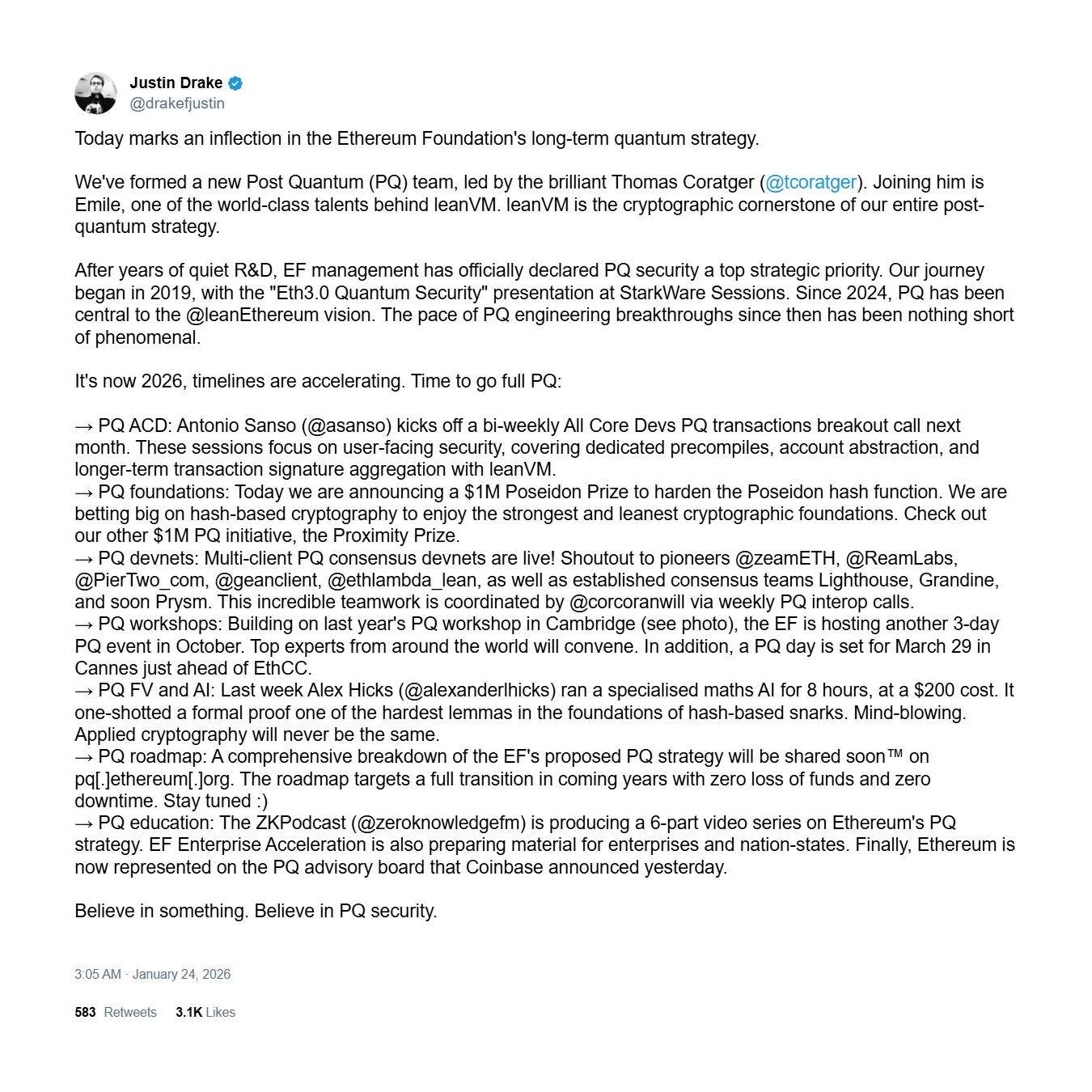
Developers involved in the effort said post-quantum signatures are significantly larger than existing elliptic-curve signatures, with even the smallest candidates being roughly 10× larger, creating cost and bandwidth challenges. To address this, Ethereum researchers are exploring zero-knowledge STARK-based compression techniques and dedicated protocol precompiles to handle post-quantum signature verification more efficiently, according to the interview.
The Foundation has also introduced new financial incentives to attract external cryptographers. A $1M Poseidon Prize was announced to strengthen the Poseidon hash function’s resistance in a post-quantum context, complementing the previously announced $1M Proximity Prize. Researchers said these initiatives are intended to accelerate work on cryptographic primitives that are critical for Ethereum’s long-term security roadmap.
Alongside cryptographic changes, Ethereum researchers are proposing protocol-level defenses against transaction censorship. Thomas Thiéry, a researcher with the Robust Incentives Group, has introduced Fork Choice-Enforced Inclusion Lists, known as FOCIL and tracked as EIP-7805, as a candidate feature for the Hegota upgrade planned for the second half of 2026. The mechanism would require validators to favor forks that include a defined set of valid transactions, rather than relying on external builders or relays to guarantee inclusion.
Thiéry said the goal is to distribute censorship resistance across the validator set and reduce dependence on centralized block-building infrastructure. “Without FOCIL, the protocol would remain vulnerable to large-scale censorship events. Ethereum should proactively design for long-term resilience, rather than reactively respond,” he said. The proposal modifies fork-choice logic so that transaction inclusion guarantees are enforced by the protocol itself.
Developers noted that FOCIL is still under active discussion and does not yet support blob transactions or private order flow mechanisms. The proposal had previously been considered for an earlier upgrade but was deferred, and researchers said further testing and specification work is ongoing as part of core development discussions tied to Hegota.
Ethereum researchers have framed both post-quantum security and censorship resistance as long-term protocol design challenges rather than short-term fixes, with work progressing through devnets, research grants, and formal Ethereum Improvement Proposals during 2026.
Ethereum’s security push is also being reinforced through capital redeployment tied to one of the network’s earliest crises. Longtime Ethereum developer Griff Green said unclaimed funds from the 2016 DAO hack are being redirected into a newly established Ethereum security initiative. “The DAO is back!” Green said, adding that funds originally set aside to reimburse so-called edge-case victims would now be used “to support Ethereum security.” Green said about 20% of the original $6 million in restitution funds were never claimed and are now valued at “somewhere around $200 million.”
According to a blog post published Thursday, the initiative, called TheDAO Security Fund, will deploy approximately 70,500 ETH from an ExtraBalance Withdrawal contract and about 4,600 ETH in ether and DAO tokens from The DAO’s curator multisig, which Green said has no clear claimants. The assets will be staked, with generated revenue directed toward security-focused operations aligned with the Ethereum Foundation’s Trillion Dollar Security initiative.
This article has been refined and enhanced by ChatGPT.


