




 USD
USD
Cleveland Fed Experiment Finds Bitcoin Gains Can Pull New Buyers Into Crypto

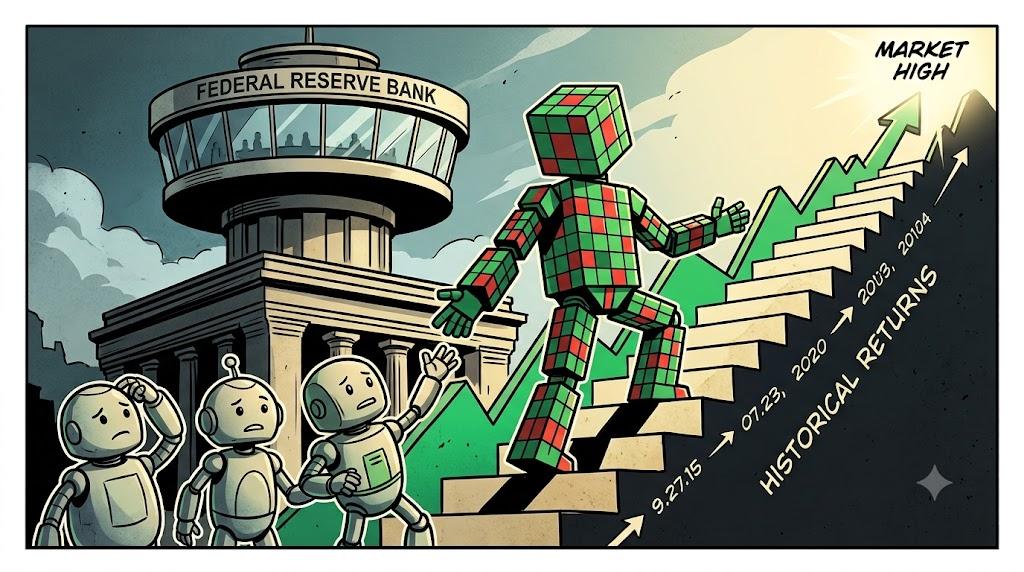
Randomized study links past returns to expectations, portfolio shifts and later ownership
TL;DR
- A Federal Reserve Bank of Cleveland experiment found that showing households Bitcoin’s recent gains increased expected crypto returns, desired allocations and later self-reported ownership.
- Bitcoin information raised subsequent crypto ownership by 2.41 and 2.48 percentage points across two treatments, equal to roughly a 23% increase from the pre-experiment ownership rate.
- The strongest effects appeared among people with limited crypto knowledge, while respondents who already considered crypto a bad investment reacted much less.
Trade smarter on Jupiter, Solana’s leading DEX built for fast execution and deep liquidity.
Swap tokens at competitive rates, route across multiple liquidity sources automatically, and access perpetuals, DCA, and advanced trading tools — all in one place!
A Federal Reserve Bank of Cleveland experiment found that showing U.S. households Bitcoin’s recent positive performance made them more likely to later report owning cryptocurrency, supporting a behavioral channel in which past gains raise expected returns and change investment decisions. The findings come from Do You Even Crypto, Bro? Cryptocurrencies in Household Finance, a July 2026 working paper by Michael Weber, Bernardo Candia, Olivier Coibion and Yuriy Gorodnichenko.
The Cleveland Fed classifies the study as preliminary working-paper research. The views expressed are those of the authors and do not represent the Federal Reserve Bank of Cleveland or the Federal Reserve System.
Researchers conducted the experiment during the second quarter of 2025, randomly assigning participants to a control group and six groups that received different financial information concerning Bitcoin, the S&P 500, GameStop or the Federal Reserve’s inflation forecast. Random assignment allowed the researchers to compare how different information changed expectations, desired portfolios and subsequent self-reported ownership.
One Bitcoin group was told that Bitcoin had returned 14.3% over the previous 12 months. Another group was shown a Bitcoin price chart covering the same period. Other participants received information about the S&P 500, a GameStop chart or the Federal Open Market Committee’s inflation outlook, while the control group received no additional information.
Bitcoin gains first changed return expectations
Participants who received Bitcoin’s numerical return increased their expected cryptocurrency return for the following year by 3.2 percentage points relative to the control group. Respondents shown the Bitcoin price chart raised their expected return by about 1.2 percentage points.
Those changes then affected intended portfolios. The Bitcoin treatments increased respondents’ desired crypto allocation by about 2 percentage points from a 4.3% average in the control group, representing a substantial increase relative to the allocation respondents otherwise wanted to hold.
Respondents largely made room for the additional crypto exposure by reducing desired allocations to cash, checking accounts and savings accounts. They also increased planned stock holdings.
Researchers later surveyed participants again to test whether changed expectations and portfolio preferences were followed by changes in actual reported ownership.
About 11% of respondents owned crypto before the experiment, making the treatment-related increase roughly 23% relative to the starting ownership rate.
The ownership analysis covered 5,352 respondents across the second through fourth quarters of 2025 and controlled for whether participants owned cryptocurrency before receiving the information. Ownership was measured through respondents’ own survey answers rather than transaction records.
Because relatively few respondents changed ownership status between survey waves, researchers combined the two Bitcoin treatment groups for part of the analysis. The pooled result was statistically significant, with a p-value of 0.017.
The randomized design distinguishes the findings from a simple observation that existing crypto holders tend to expect higher returns. By assigning information treatments randomly, the researchers could connect changes in expectations and later ownership to the information participants received.
The experiment does not establish that every Bitcoin rally will produce the same amount of new demand or quantify how much resulting purchases could move prices. It also does not determine whether Bitcoin is overvalued or prove that new retail buyers sustain market rallies.
Less-informed investors reacted most strongly
The Bitcoin treatments had their strongest effect among participants who said they avoided cryptocurrency because they did not know enough about it. People who already regarded crypto as a bad investment changed their desired allocations much less, and the combined Bitcoin treatments produced no statistically significant ownership effect for that group.
Broader household survey data showed a similar divide based on familiarity. About 40% of non-owners said they knew little about cryptocurrency, and close to 90% of that group would not provide a numerical forecast for expected crypto returns.
Those respondents with weaker prior knowledge were among the most responsive after receiving Bitcoin information, indicating that recent positive performance had a stronger effect on people who had not yet formed firm views than on respondents with established negative opinions.
The researchers also found some spillover from other risk assets. Participants shown S&P 500 information became more likely to own cryptocurrency later, though stock-return information did not change desired portfolio allocations. Participants shown a GameStop chart increased their desired crypto allocation, but that treatment did not produce a statistically significant difference in later ownership.
Bitcoin produced the clearest sequence from new information to higher expected crypto returns, higher desired exposure and greater subsequent ownership.
“Positive returns attract new participants, which raises the price further,” the authors wrote. “The experience of high returns in the past does not seem to lead individuals to expect any mean reversion; extrapolation of past returns into future returns seems to be the rule.”
The authors said that pattern represents one mechanism through which speculative bubbles can develop, with recent gains increasing expected future returns and attracting additional participants.
Beliefs explained ownership better than demographics
The research also used Nielsen Homescan Panel data tracking tens of thousands of U.S. households and their spending behavior to examine broader differences between crypto owners and non-owners over time.
Reported cryptocurrency ownership rose from roughly 3% of respondents in 2021 to about 11% in 2022 and around 12% by mid-2023. Ownership later fell by several percentage points before recovering to roughly 12% as Bitcoin traded above $120,000 in 2025.
Demographic differences were substantial but did not explain participation as strongly as investors’ beliefs about returns and risk.
Higher income, employment and greater financial wealth were also associated with cryptocurrency ownership. However, researchers found that expected returns and perceived risk had around twice the explanatory power of detailed demographic characteristics when accounting for who owned crypto.
The difference between owners and non-owners was particularly visible in their return expectations.
Researchers said the gap in beliefs between owners and non-owners was much less pronounced for stocks, bonds and gold.
Bitcoin wealth gains also affected household purchases
The same research linked Bitcoin gains to changes in spending among households already exposed to cryptocurrency, particularly purchases of durable goods.
Researchers estimated that a hypothetical household holding its entire financial portfolio in crypto would be 1.4 percentage points more likely to buy a durable good during the quarter if Bitcoin’s price doubled.
The strongest effects appeared in large, occasional purchases such as computers and refrigerators. Researchers found less evidence of a sustained increase in recurring spending on food, utilities and other nondurable goods, and the spending effect faded by the following quarter.
That pattern differed from traditional financial wealth, where gains in stocks and bonds showed a stronger relationship with routine consumption. The authors compared the cryptocurrency response with temporary windfalls, including gambling proceeds, where gains are more likely to finance one-time purchases than permanently increase household spending.
The household findings identify two separate behavioral channels tied to rising Bitcoin prices: existing holders can experience higher paper wealth that affects durable-goods purchases, while potential investors can revise return expectations, change desired portfolios and become more likely to enter the cryptocurrency market.
FAQ
Why did Bitcoin information affect ownership?
It raised expected future crypto returns and increased respondents’ desired cryptocurrency exposure.
Who responded most strongly to Bitcoin’s gains?
People with limited cryptocurrency knowledge and without firmly negative investment views.
Did every risk-asset treatment increase crypto ownership?
No. GameStop increased desired crypto allocation without a statistically significant later ownership effect.
What does the study establish about Bitcoin rallies?
Past positive returns can influence expectations, portfolio preferences and subsequent self-reported crypto ownership.
This article has been refined and enhanced by ChatGPT.


