




 USD
USD
Florida Senate Passes First State-Level Stablecoin Regulation Bill in Unanimous 37–0 Vote, Sending SB 314 to Gov. Ron DeSantis


State Lawmakers Advance Stablecoin Oversight Framework Aligning With Federal GENIUS Act and Requiring Licensing, AML Compliance
TL;DR
- Florida lawmakers approved Senate Bill 314 in a 37–0 Senate vote on March 6, 2026, creating what supporters describe as the first comprehensive state-level regulatory framework for payment stablecoins in the United States.
- The measure previously passed the Florida House through House Bill 175 and now awaits Gov. Ron DeSantis’ signature within 30 days to become law.
- The legislation requires stablecoin issuers to obtain licensing, follow anti–money laundering rules, maintain 1:1 reserve backing, and comply with financial oversight standards tied to the federal GENIUS Act.
We’ve launched the all-new COIN360 Perp DEX, built for traders who move fast!
Trade 130+ assets with up to 100× leverage, enjoy instant order placement and low-slippage swaps, and earn USDC passive yield while climbing the leaderboard. Your trades deserve more than speed — they deserve mastery.
Florida lawmakers approved a measure establishing a regulatory framework for payment stablecoins after the state Senate passed Senate Bill 314 on March 6, 2026, in a unanimous vote of 37–0. The legislation had already cleared the Florida House through a companion measure, House Bill 175, completing the state’s legislative process and sending the bill to Governor Ron DeSantis for final approval. State law allows the governor up to 30 days to sign or veto the legislation. The proposal establishes licensing and oversight rules for companies issuing stablecoins within the state’s financial regulatory system and integrates those activities into Florida’s existing money services business framework.
Samuel Armes, founder of the Florida Blockchain Business Association, described the vote as a milestone for digital asset policy in the state, writing that the measure had cleared both legislative chambers and would soon be enacted. “The bill has passed both chambers and will become law within a month,” Armes said following the Senate vote. Lawmakers structured the legislation to regulate “qualified payment stablecoin issuers,” placing them under financial oversight similar to other money transmission businesses operating in the state. Regulatory supervision will be carried out primarily by the Florida Office of Financial Regulation, which oversees financial services companies.
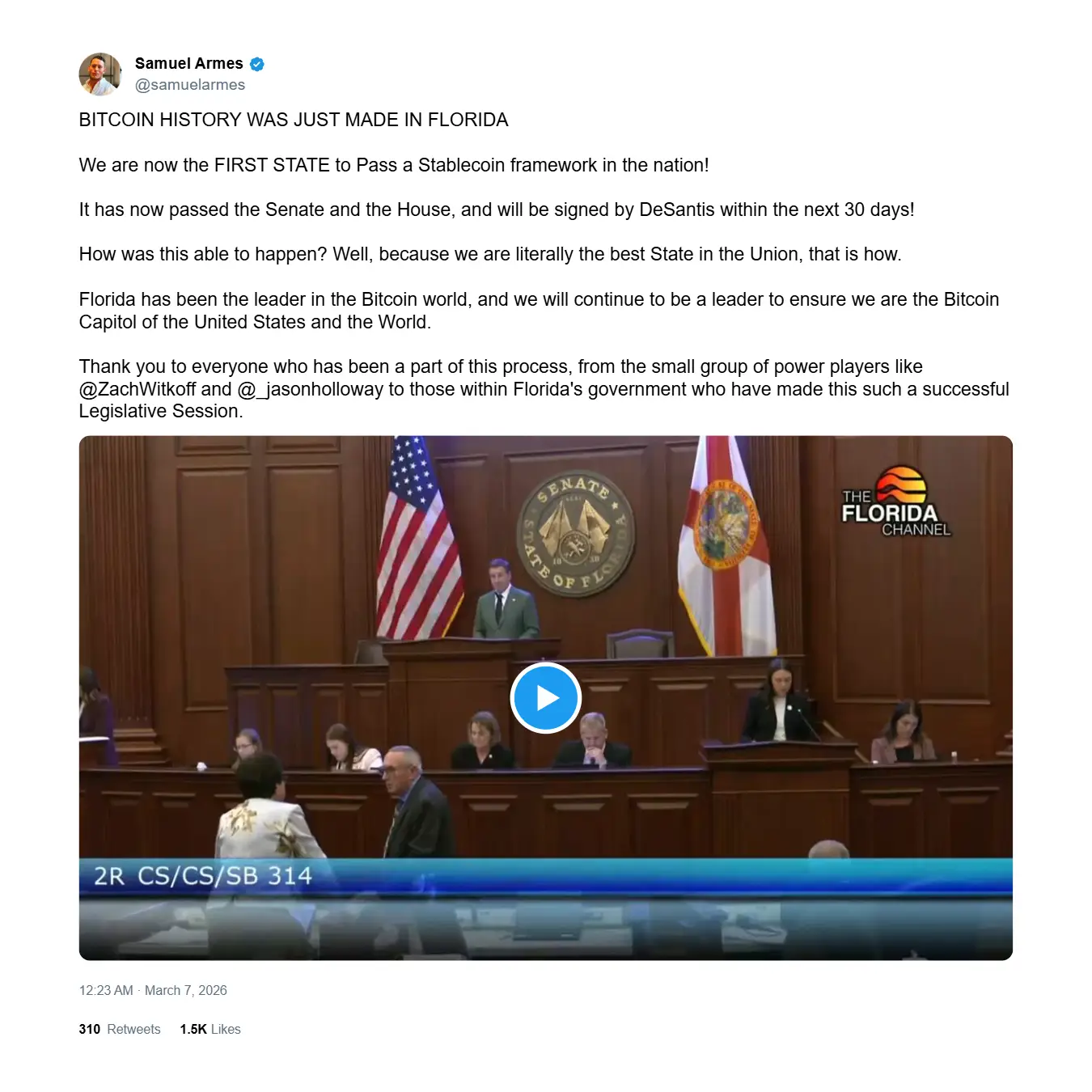
Lawmakers drafted the measure to amend the state’s Money Services Business Anti-Money Laundering Act to explicitly include stablecoins within its regulatory scope. Stablecoin issuers will therefore be required to obtain licenses, comply with anti-money-laundering obligations, and operate under reporting standards similar to those governing other financial intermediaries handling digital transfers of value. The legislation also clarifies that certain payment stablecoins should not be treated as securities, resolving a regulatory classification issue that has created uncertainty in other jurisdictions. The framework instead treats issuers as money services businesses operating under state financial laws.
Stablecoin companies headquartered outside Florida may also fall under the framework if they intend to operate in the state. Those issuers must provide written notification to the Florida Office of Financial Regulation before offering services locally. Regulatory authority may also involve coordination with federal oversight agencies such as the Office of the Comptroller of the Currency depending on the issuer’s size and structure. The legislation sets a threshold under which stablecoin issuers reaching a valuation above $10 billion may be subject to expanded federal supervision alongside state oversight by regulators monitoring digital asset activity.
Issuers operating under the Florida framework must maintain reserves backing their tokens at a one-to-one ratio, meaning every unit issued must be supported by an equivalent amount of reserve assets. Companies must also maintain detailed records of transactions and adhere to compliance standards similar to those used by regulated financial institutions. Transactions exceeding $10,000 must be reported to regulators, while suspicious activity must be flagged through anti-money-laundering reporting channels. Stablecoin operators will also be required to implement customer verification systems and monitoring procedures designed to detect illicit financial activity.
Another provision addresses the treatment of yield-bearing stablecoins, a category that has drawn scrutiny from policymakers concerned about competition with traditional bank deposits. The legislation prohibits issuers from paying interest or yield to stablecoin holders if federal law restricts such payments. Lawmakers drafted the rule to align with broader federal regulatory debates over whether stablecoins offering returns could function similarly to bank accounts. Compliance obligations under the state framework mirror those imposed on traditional financial institutions, including strict know-your-customer procedures and operational transparency requirements.
Florida lawmakers structured the state framework to align with the federal GENIUS Act, which became law in July 2025 and established nationwide standards for regulating payment stablecoins. The federal legislation requires issuers to maintain reserve backing with U.S. dollars or similarly low-risk assets and created a baseline structure for stablecoin oversight across federal financial regulators. Florida’s legislation incorporates many of those principles into state law while allowing local regulators to oversee licensing, supervision, and enforcement for companies operating within the state’s jurisdiction.
Lawmakers also approved a related measure, CS/CS/SB 1440, during the same legislative session to expand confidentiality protections for virtual currency businesses and stablecoin issuers. The companion bill protects certain non-public operational data from disclosure during regulatory oversight processes, including sensitive business information and trade secrets submitted to financial authorities. The provisions apply to digital asset firms operating under Florida’s financial regulations, including companies issuing payment stablecoins and other blockchain-based financial services.
Growth in the global stablecoin sector formed part of the broader context surrounding the legislation. The market capitalization of stablecoins has expanded to about $312.85 billion after rising from roughly $205 billion at the start of January 2025, according to industry data cited alongside the policy discussions. Florida lawmakers have also considered broader digital asset legislation during the same session, including House Bill 183, which would allow public funds managed by the state to allocate up to 10% of their portfolios to cryptocurrencies, exchange-traded funds, non-fungible tokens, and other blockchain-based financial instruments.
Governor DeSantis must sign Senate Bill 314 before the measure can take effect under state law. If enacted, Florida would become the first U.S. state to implement a comprehensive statutory framework specifically governing the issuance and oversight of payment stablecoins under state financial regulation.
This article has been refined and enhanced by ChatGPT.


