




 USD
USD
France Counts 77 Crypto Kidnapping Cases Since January

Authorities move to protect digital asset holders as physical extortion cases rise
TL;DR
- France has recorded 77 crypto-linked kidnapping, abduction, unlawful confinement, extortion, attempted abduction or attempted extortion cases since the start of 2026.
- French Interior Minister Laurent Nunez called the situation “serious” and outlined an “ambitious” plan after meeting crypto-sector representatives.
- Authorities have arrested about 200 people and enrolled 724 crypto-sector participants in immediate-identification systems.
Trade smarter on Jupiter, Solana’s leading DEX built for fast execution and deep liquidity.
Swap tokens at competitive rates, route across multiple liquidity sources automatically, and access perpetuals, DCA, and advanced trading tools — all in one place!
France has recorded 77 crypto-linked kidnapping, unlawful confinement, abduction, extortion, attempted abduction or attempted extortion cases since the start of 2026, French Interior Minister Laurent Nunez said, as authorities move to protect digital asset holders from a wave of physical attacks tied to crypto wealth.
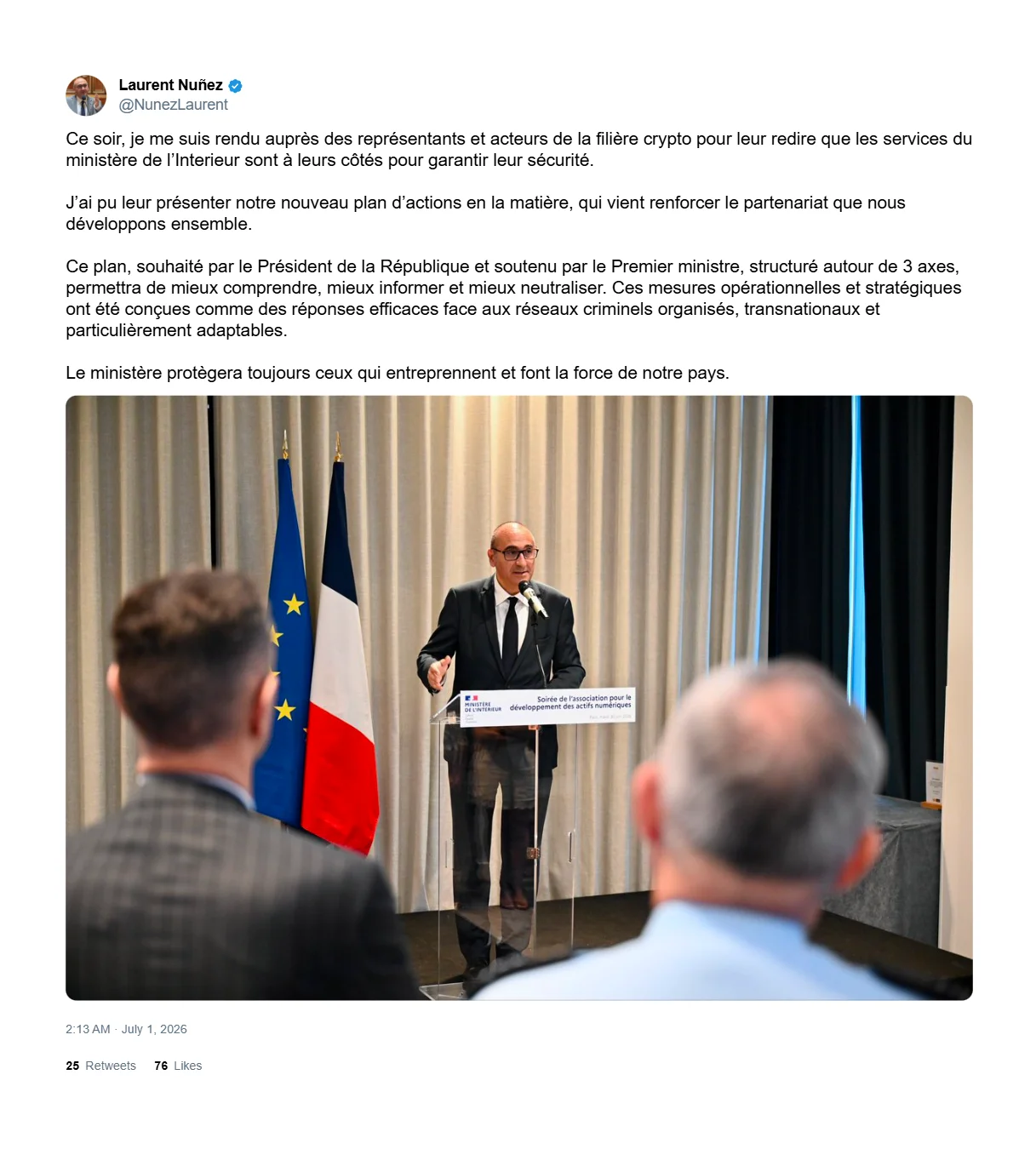
The information was released July 2, 2026, following Nunez’s June 30, 2026 meeting with representatives from France’s crypto sector. Nunez called the situation “serious” and said the government was preparing an “ambitious” strategy to target the criminal networks behind the attacks. He also told crypto-sector representatives that the Interior Ministry’s services were “at their side” to guarantee their security.
The cases show how crypto security in France has moved beyond wallets, seed phrases, hardware devices and multisig controls. Attackers are increasingly targeting people who can authorize transfers, turning visible crypto wealth, executive roles, public identities and exposed personal data into real-world liabilities.
France builds a protection plan around crypto holders
France’s new response is built around three pillars: stronger intelligence sharing, a deeper partnership with ADAN, the Association pour le Développement des Actifs Numériques, and tighter operational coordination between state services and foreign jurisdictions.
Nunez described stronger intelligence sharing as “fundamental and extremely effective,” saying authorities want to identify the teams ordering, organizing, recruiting for and executing the attacks. The focus on intelligence reflects concern that some people giving orders may be based outside France, making cross-border cooperation important to reach organizers rather than only the people carrying out violence locally.
The second pillar centers on ADAN through a network of experts designed to connect crypto-sector players with relevant state agencies. The third pillar focuses on coordination between French government departments, faster neutralization of offenders and cooperation with foreign states where perpetrators, handlers or organizers may operate.
French authorities have already arrested roughly 200 people, either after incidents or in anticipation of planned attacks. Authorities have also enrolled 724 crypto-sector participants into immediate-identification systems designed to help emergency services recognize high-risk individuals more quickly.
The figures point to a hybrid risk category involving cybercrime, organized crime, financial intelligence and executive protection. The French official figures and the private-sector security figures use different methodologies, so they cannot be treated as a direct comparison. Still, both point to the same direction: liquid digital wealth can become a physical target when attackers can connect a person to assets.
We’ve launched the all-new COIN360 Perp DEX, built for traders who move fast!
Trade 130+ assets with up to 100× leverage, enjoy instant order placement and low-slippage swaps, and earn USDC passive yield while climbing the leaderboard. Your trades deserve more than speed — they deserve mastery.
Criminal networks use remote organizers and local recruits
The attacks are often described as crypto “wrench attacks,” a term used for cases where criminals rely on threats, kidnapping, violence or forced confinement to make victims authorize transfers. The model does not require attackers to defeat a wallet system if they can coerce the person who controls it.
Thibaut Fontaine, Head of the OCLCO, said: “We are dealing with an organization that is quite symptomatic of the evolution of organized crime, with masterminds who act solely through their phones remotely.” The description suggests the people carrying out violence may not be the strategic operators behind the crimes.
Local petty criminals are reportedly recruited through social media as expendable participants. That structure makes arrests important but not always decisive if organizers can replace front-line actors. Intelligence quality also appears uneven, but even flawed data can become dangerous when criminals connect a person, address, role and assumed balance.
Useful information for attackers may sit outside the blockchain. Addresses, family links, executive roles, social media trails, leaked customer records, company filings, conference attendance and information about who can move funds can all help turn generic crime into targeted extortion.
Blockchain transparency can help investigators trace stolen funds after an attack, but it cannot prevent a kidnapping before it starts. That limitation explains why France is pairing crypto-sector coordination with emergency systems, intelligence flows and physical-security planning.
Chainalysis warned in its 2026 Crypto Crime Report introduction that physical coercion and violence are increasingly intersecting with on-chain activity as criminals force victims to transfer assets. CertiK separately said kidnapping was the primary vector in the verified physical coercion incidents it tracked worldwide.
Bitcoin developer Jameson Lopp warned that France is a global “canary in the coal mine.” Privacy advocates cited in the available information argue that the French crisis is not only about violent criminals, but also about surveillance, compliance trails, exposed identity data and financial transparency becoming useful to attackers.
High-profile cases show the risk moving into homes
France has become a focal point for violent crypto-extortion, with several high-profile incidents showing how attackers are moving from digital theft to household-level pressure. The cases show that phones, identities, access credentials and family vulnerability can become leverage in crypto-related crime.
Kidnappers seized Ledger co-founder David Balland and his partner in January 2025. The response involved judicial organized-crime coordination, GIGN deployment, cyber specialists, crypto ransom tracing and freezing, and more than 230 gendarmes. The case showed the full modern crypto-crime stack: physical victims, digital ransom assets, on-chain tracing and potentially distributed organizers.
France had already begun building a crypto-sector protection framework before the July 2026 figures became public. After meeting sector actors in May 2025, the Interior Ministry said protective measures would include priority emergency access, home-security audits for exposed people, briefings by elite units including GIGN, RAID and BRI, a cybercrime contact point and an ADAN-linked working group.
A 2025 decree published on Légifrance allows company officers and indefinitely liable partners to request confidentiality for personal home addresses in company registry filings. The measure is broader than crypto, but it is relevant for crypto executives and entrepreneurs because public registry data can make targeting easier.
A February 2026 case targeted the home of Binance France’s chief executive. The executive was not there, and intruders fled with two phones. A March 2026 case involved fake police officers who robbed a couple of 900,000 euros in Bitcoin. An April 2026 case involved two men who extorted 700,000 euros from a family of five.
The practical lesson for crypto firms is that custody controls alone are not enough when public records, staff pages, visible leadership roles, predictable routines, conference appearances and weak escalation procedures can expose people. Companies now need threat models covering who can authorize transfers, who appears publicly, what data exists about family members or home addresses and how quickly the firm can reach law enforcement.
High-profile holders and influencers face uneven but meaningful risk. Simple asset ownership is not the same as visible wealth, public location data and an identity trail that lets attackers map the person behind the wallet. The more criminals can connect identity, role, location, family and assumed balance, the more the crime resembles targeted organized extortion.
France’s response signals that crypto security may increasingly resemble banking-sector risk management, executive protection and organized-crime investigation rather than retail self-custody education. If attackers keep adapting through foreign organizers, proxies, leaked data, lower-level recruits and repeatable coercion playbooks, state and industry coordination will remain central to reducing exposure.
FAQ
What did Laurent Nunez announce?
He outlined a three-pillar plan focused on intelligence sharing, ADAN coordination and cross-border operational cooperation.
Why are these attacks called wrench attacks?
The term refers to coercion, threats or violence used to force victims to authorize crypto transfers.
Who is most exposed?
Crypto-sector actors, visible holders and people whose identity or role makes them useful to attackers.
What does the French response prioritize?
It prioritizes emergency identification, intelligence sharing, arrests, home-security planning and coordination with crypto-sector representatives.
This article has been refined and enhanced by ChatGPT.


