


 USD

Germany Approves Crypto Seizure Bill Allowing Asset Freezes Without Criminal Charges

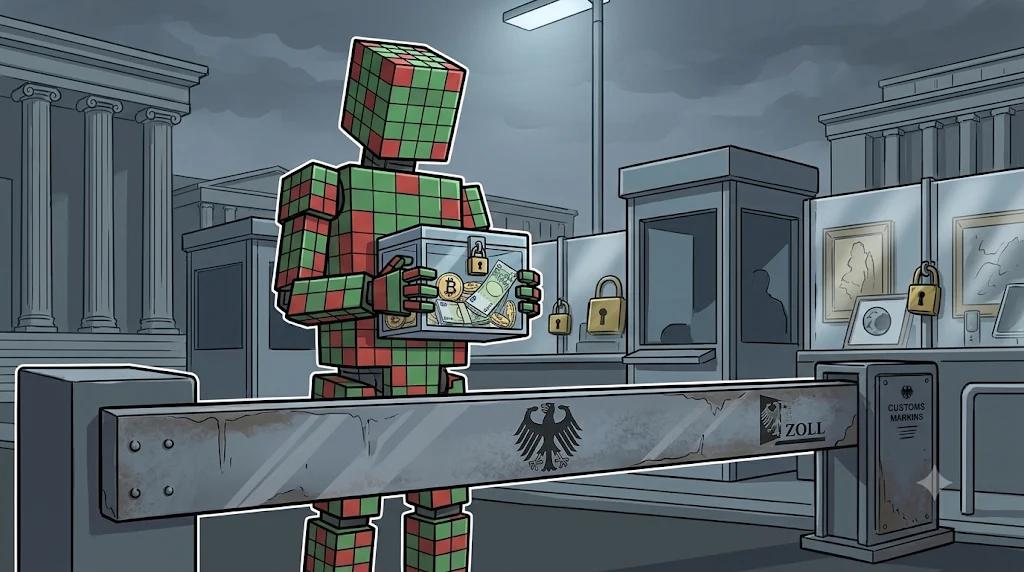
Customs Powers Face Legal Opposition as Legislation Awaits Final Approval
TL;DR
- Germany's Bundestag approved legislation on November 12, 2026, allowing customs authorities to freeze cryptocurrency and other high-value assets of questionable origin without opening a criminal case.
- The measure generally targets assets exceeding €100,000, with temporary freezes potentially lasting 180 days. Permanent confiscation would require a court ruling.
- The legislation still needs Bundesrat approval before its planned January 1 implementation, while German legal associations warn that the expanded powers could unfairly burden asset owners.
Trade smarter on Jupiter, Solana’s leading DEX built for fast execution and deep liquidity.
Swap tokens at competitive rates, route across multiple liquidity sources automatically, and access perpetuals, DCA, and advanced trading tools — all in one place!
Germany's lower house of parliament, the Bundestag, approved legislation on November 12, 2026, that would allow customs authorities to freeze cryptocurrency and other assets worth more than €100,000 without first opening a criminal investigation or filing charges. The Customs Financial Justice Act, or Zollfinanzgerechtigkeitsgesetz, targets high-value assets whose lawful origins are in doubt. The measure remains subject to approval by the Bundesrat, Germany's upper house, before its planned January 1, 2027, implementation.
The legislation forms part of Germany's broader effort to combat money laundering and organized crime. Under the proposed framework, customs authorities could intervene when they have "justified doubts" about how assets were obtained, using a mechanism the German government calls a "suspicious wealth order." The powers would specifically cover cryptocurrencies regulated under the European Union's Markets in Crypto-Assets (MiCA) framework, alongside other valuable property. Customs would also gain expanded authority to monitor digital cross-border payment routes and secure crypto assets.
German Finance Minister Lars Klingbeil defended the legislation as part of the government's tougher approach to financial crime.
"With this, we are sending a clear signal to criminals: we are getting tougher," Klingbeil said, according to the government.
The measure also reorganizes Germany's customs administration, strengthens its Financial Intelligence Unit and establishes a legal basis for using technologies such as artificial intelligence. It follows the government's action plan against organized crime, adopted on February 25, 2026.
How Germany's Proposed Crypto Seizure Powers Would Work
The legislation would allow customs officers to temporarily freeze suspicious assets without first linking them to a specific criminal offense. According to the German government's explanatory notes, owners of substantial assets should generally be able to explain how they acquired them, even when authorities struggle to establish an illegal origin. "Almost every law-abiding citizen will be able to explain where these assets came from," the notes state, as summarized by the Bundestag's news service.
Customs officers could initially freeze assets for 30 days, with a court authorized to extend the restriction by another 150 days. Klingbeil said the powers could allow authorities to hold assets for up to 180 days without a criminal conviction while owners demonstrate their lawful origin.
"The Porsche and the Rolex are then gone for now," he said, according to Berliner Zeitung.
Permanent confiscation would still require a court decision, which, following an amendment by the governing coalition, would be made by a panel of finance court judges rather than a single judge.
Legal Groups Challenge Expanded Customs Authority
Germany's legal sector has raised concerns that the legislation could shift too much responsibility for proving lawful ownership onto individuals. The Federal Bar Association (BRAK) opposed the proposal, arguing that customs authorities would have excessive discretion to question how assets were acquired. BRAK warned that missing documentation, including records involving inherited property, should not automatically be treated as evidence of illegal activity.
The German Bar Association (DAV) also rejected the measure, particularly provisions allowing customs to intervene when the legal origin of assets appears "not plausible." In a November statement, DAV criticized the proposed expansion of customs authority and the transfer of functions traditionally associated with police investigations to customs officials.
"The practical question for crypto holders is what will count as proof of lawful origin, which is a question for national (ie German) finance courts rather than EU (European Union) crypto regulation," said Andrew Withworth, founder and director of London-based regulatory advisory firm Global Policy.
His comments focused on the evidentiary requirements that cryptocurrency holders could face if their assets were frozen under the proposed framework.
The Bundestag's finance committee backed the legislation with support from the governing CDU/CSU and SPD parties, along with the far-right Alternative for Germany (AfD). The Left Party voted against the proposal, while the Greens abstained. The Greens pointed to Germany's estimated €100 billion money laundering problem and questioned the government's projected €308 million ($342 million) in additional revenue, arguing that the expected returns were limited relative to the scale of the problem.
The Left Party similarly questioned the effectiveness of the proposed seizure powers against sophisticated financial crime. It described the confiscation mechanism as "built for the cash courier, not the banker," arguing that the legislation was better suited to pursuing individuals physically transporting illicit assets than more complex money laundering operations.
Germany's Previous Bitcoin Seizures and Enforcement Actions
Germany has previously conducted large-scale cryptocurrency seizures tied to criminal investigations. In 2024, authorities in the state of Saxony began selling nearly 50,000 BTC seized from operators of the movie piracy website Movie2K. The disposal involved transfers worth hundreds of millions of dollars at a time. Blockchain analytics firm Arkham later said German authorities had failed to seize an additional 45,000 BTC connected to the same operation.
German authorities also worked with Swiss police in 2025 to shut down Cryptomixer, a cryptocurrency mixing service linked to laundering more than $1.4 billion in Bitcoin since 2016. Separately, Germany's finance ministry has drafted a proposal introducing a 25% tax on cryptocurrency gains from 2027.
Unlike previous enforcement actions tied to identified criminal activity, the new customs framework would permit authorities to freeze assets based on reasonable doubts about their lawful origins without first establishing a connection to a specific offense. The proposed powers remain subject to the Bundesrat's consideration before they can take effect.
This article has been refined and enhanced by ChatGPT.


