




 USD
USD
Google Flags Quantum Threat to Bitcoin and Ethereum With 9-Minute Attack Window and Multi-Layer Risk Across Billions in Assets

Researchers Outline Reduced Quantum Resource Thresholds, Bitcoin Exposure, and Ethereum’s Five Attack Paths
TL;DR
- Google says quantum systems could break crypto keys in minutes, including a Bitcoin attack window of about nine minutes.
- Ethereum faces five attack vectors spanning accounts, contracts, consensus, and data layers affecting tens of millions of ETH.
- Industry figures say upgrades are possible, with CZ stating “no need to panic” while researchers raise timelines toward 2032.
We’ve launched the all-new COIN360 Perp DEX, built for traders who move fast!
Trade 130+ assets with up to 100× leverage, enjoy instant order placement and low-slippage swaps, and earn USDC passive yield while climbing the leaderboard. Your trades deserve more than speed — they deserve mastery.
Google researchers detailed a sharp reduction in the resources required to break elliptic-curve cryptography, estimating that fewer than 1,200 logical qubits and 90 million Toffoli gates, or fewer than 1,450 logical qubits and 70 million Toffoli gates, could be sufficient to compromise widely used blockchain signatures. The same study said an attack could run on fewer than 500,000 physical qubits using a superconducting architecture and complete in minutes. The disclosure was paired with a zero-knowledge proof method so findings could be verified without exposing a working exploit.
Bitcoin’s transaction model was identified as vulnerable during the confirmation window once a public key is revealed, with researchers describing a scenario where an attacker attempts to derive the private key before settlement. The reported attack duration was about nine minutes against a confirmation time of roughly ten minutes, with a success probability just under 41%. Separate estimates said approximately 6.9 million BTC are already exposed, including about 1.7 million coins dating back to early network activity, while Taproot’s rollout in 2021 was cited for increasing the number of publicly exposed keys.
Ethereum’s architecture was presented as having a broader attack surface, with five defined vectors labeled Account Vulnerability, Admin Vulnerability, Code Vulnerability, Consensus Vulnerability, and Data Availability Vulnerability. The breakdown attributed about 20.5 million ETH to user account exposure, 2.5 million ETH alongside $200 billion in stablecoins and real-world assets tied to contract and admin control, 15 million ETH linked to protocol and Layer-2 code, 37 million ETH associated with validator stake, and another 15 million ETH connected to data availability mechanisms relying on KZG commitments.
Researchers described how externally owned accounts remain vulnerable after signing, while smart contract admin keys, validator credentials based on BLS signatures, and data availability systems introduce additional entry points not present in the same form on Bitcoin. The document also outlined potential impacts including compromised oracle systems, bridges, and stablecoin-linked infrastructure if administrative control is breached, alongside risks to validator integrity and proof systems that support rollups.
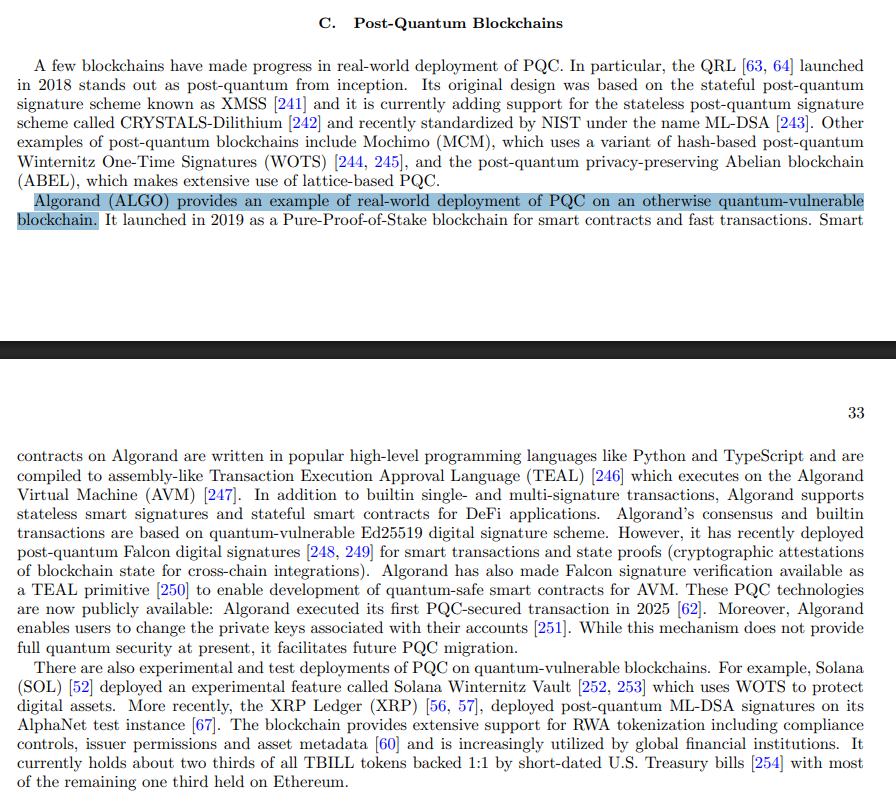
Algorand’s ALGO jumped 25% intraday as trading volume rose nearly fivefold following renewed focus on quantum vulnerability tied to Google’s whitepaper. The discussion pointed to Algorand’s existing use of post-quantum cryptography, specifically Falcon digital signatures, positioning it among networks already implementing defensive measures. Solana and XRP Ledger were also cited for ongoing experimental and test deployments of PQC frameworks as developers assess quantum-resistant upgrades across major blockchain infrastructures.
Market participants reacted with mixed assessments on urgency and timelines. Ethereum researcher Justin Drake said the findings represent a “breakthrough” and stated his confidence in “q-day by 2032” had increased, adding there is “at least a 10% chance” that a quantum computer could recover a secp256k1 ECDSA private key from an exposed public key within that timeframe. Boundless CEO Shiv Shankar said, “There’s no cause for panic,” while analysts at Bitfinex described quantum computing as an engineering challenge that is “far from an existential threat in the current form.”
Additional industry commentary framed the issue around adaptability rather than immediate disruption. Binance founder Changpeng Zhao said crypto systems can migrate to post-quantum cryptography and that there is “no need to panic,” while noting coordination challenges across decentralized networks. Tesla CEO Elon Musk said quantum computing could eventually recover lost wallet credentials, raising the possibility that forgotten access keys may be retrievable under future conditions.
Google said the purpose of the disclosure is to “raise awareness” and encourage migration to quantum-resistant systems rather than trigger immediate alarm, emphasizing the need for proactive upgrades across blockchain protocols. The findings arrive as crypto price movements tracked by the COIN360 crypto price index continue to respond to macro and technological developments, with market participants increasingly factoring long-term security assumptions into coin market cap positioning and broader crypto price expectations.
Clarifications emerging from a CoinDesk analysis showed the “nine-minute” scenario applies to a narrow mempool attack window rather than a blanket network failure, where a sufficiently advanced quantum system could derive a private key from a revealed public key before transaction confirmation. The explanation noted such hardware does not yet exist, with estimates pointing to fewer than 500,000 physical qubits compared with current machines operating near 1,000. A more immediate concern centers on roughly 6.9 million bitcoin already held in wallets with permanently exposed public keys, including early address formats and reused wallets, which could be compromised without time constraints if the required systems emerge.
This article has been refined and enhanced by ChatGPT.


