


 USD

Illinois Crypto Tax Faces Legal Challenge From DOJ, Banks and DeFi Firms

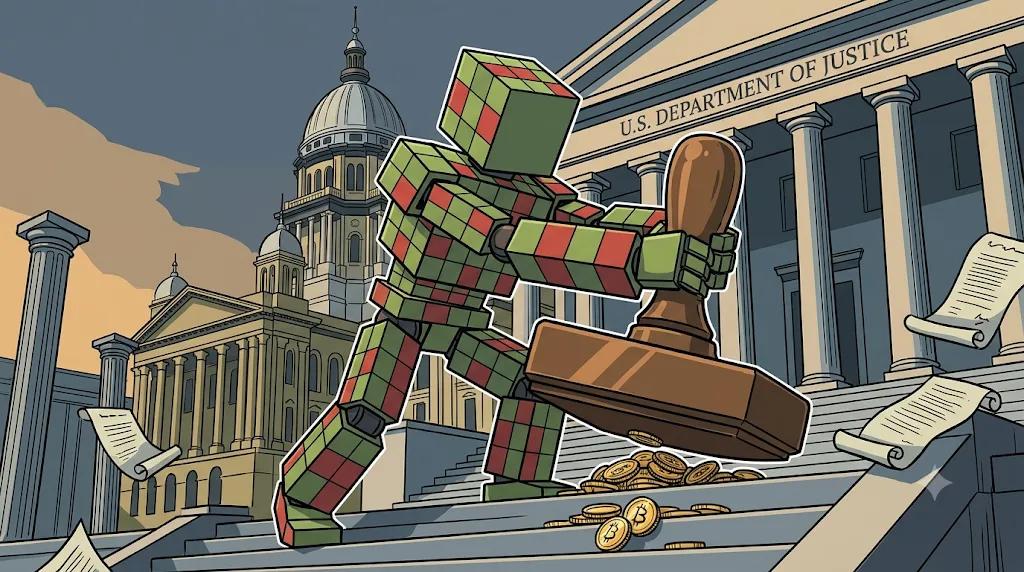
Industry coalition disputes the state's broker definitions as federal officials raise discrimination concerns
TL;DR
- The U.S. Department of Justice, banking trade groups and crypto organizations have backed a lawsuit challenging Illinois' Digital Asset Tax Act.
- An 18-member crypto coalition argues the law could force noncustodial software developers to collect taxes without controlling users' assets or knowing their locations.
- Illinois has agreed to delay the tax until July 2027, pending court approval, while opponents seek to block enforcement permanently.
Trade smarter on Jupiter, Solana’s leading DEX built for fast execution and deep liquidity.
Swap tokens at competitive rates, route across multiple liquidity sources automatically, and access perpetuals, DCA, and advanced trading tools — all in one place!
The U.S. Department of Justice (DOJ), major financial industry associations and cryptocurrency companies have joined a legal challenge against Illinois' Digital Asset Tax Act, arguing that its 0.2% tax on covered digital asset transactions unfairly targets crypto and imposes collection obligations that some businesses cannot fulfill. Court filings submitted in November 2026 challenge the law's constitutionality, broad broker definitions and treatment of decentralized finance (DeFi) platforms, as a lawsuit seeking to strike down the measure proceeds in Illinois state court.
Illinois Governor JB Pritzker signed the legislation in June as part of the state's fiscal 2027 budget. The measure applies to covered digital asset exchanges, transfers and storage services involving firms with more than $100,000 in receipts, taxing the full value of the assets involved rather than any resulting profit. That means a transaction can trigger the levy even without a sale, capital gain or change in ownership. The tax was projected to generate as much as $60 million in state revenue, but opponents argue comparable transactions involving dollars, gold and stocks face no equivalent state charge.
DOJ, Banking Groups and Crypto Firms Challenge Illinois Law
The legal challenge began in August, when The Digital Chamber, the Blockchain Association and the Crypto Council for Innovation brought a lawsuit in Sangamon County circuit court seeking to invalidate the legislation and permanently prevent its enforcement.
The DOJ filed a statement of interest on November 6, arguing that the tax conflicts with federal policy and undermines U.S. leadership in digital assets. Federal officials also criticized the law as vague and discriminatory because it singles out cryptocurrency transactions for treatment that does not apply to other asset classes.
The U.S. Chamber of Commerce and the Securities Industry and Financial Markets Association (SIFMA) separately submitted an amicus brief supporting the challenge. SIFMA represents hundreds of broker-dealers, banks and asset managers. Their filing warned that the law's broad scope could affect traditional financial institutions, custodians and advisers offering digital asset products, extending its reach beyond cryptocurrency-native businesses.
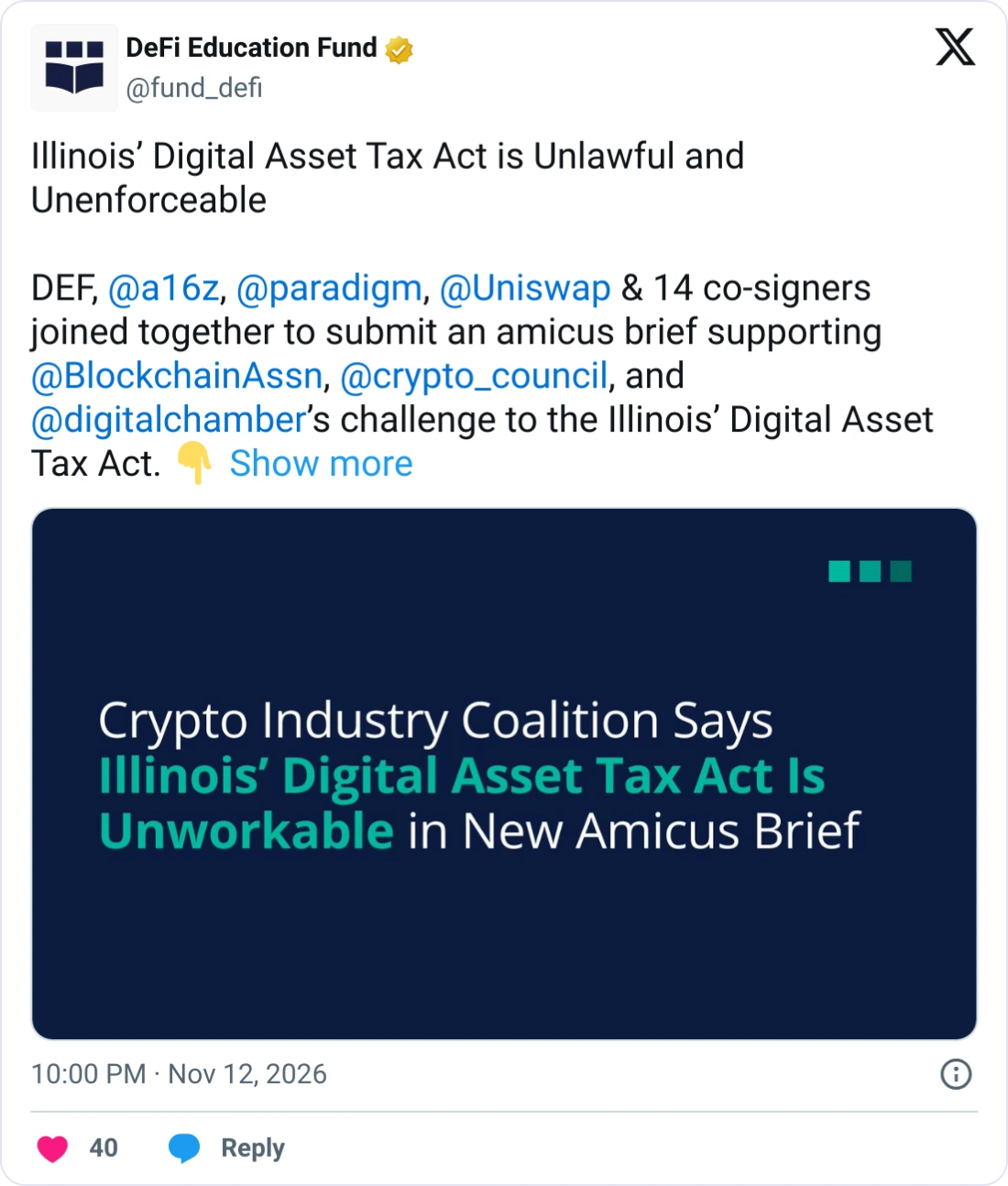
A separate industry amicus brief, described as filed on November 11, brought together the DeFi Education Fund, Andreessen Horowitz (a16z), Paradigm and Uniswap Labs, alongside 14 other signatories. The DeFi Education Fund announced its participation the following day. Supporters included Aave Labs, Aptos Labs, Chainlink Labs, Multicoin Capital, Phantom Technologies, Jito Labs, the Solana Policy Institute and Stand With Crypto.
The coalition argues that Illinois' definition of a digital asset broker could encompass software developers, decentralized protocols and other network participants that do not have conventional customer relationships. Unlike custodial exchanges, which hold customer assets and can directly deduct fees, these businesses may neither possess the assets involved in a transaction nor have the ability to collect payments from users.
The industry brief states that developers and providers of noncustodial software "keep no accounts or customer records and have no technological ability to collect or store them." It argues that applying the same obligations to such entities would make compliance practically impossible.
Self-Custody and Tax Collection Rules Face Scrutiny
A central dispute concerns who must collect the tax and who becomes responsible when collection fails. Section 3-35 of the Act makes a covered broker liable for the tax even if the broker never collects it from a customer. For example, a $50,000 digital asset swap would generate a $100 tax obligation.
The coalition argues that this provision creates particular problems for decentralized services that do not control users' funds. A self-custodial transaction may involve a website that prepares a swap, wallet software that enables the user to authorize it, and a smart contract that executes the exchange. Those functions can operate independently, without a single business controlling the customer's assets.
The distinction also affects how businesses identify taxable Illinois transactions. Under the law's sourcing rules, a customer may be presumed to be located in Illinois when records contain an Illinois mailing address or IP address. The broker bears responsibility for disproving that presumption. Developers handling only public wallet addresses may lack the information required to determine whether users fall within the state's jurisdiction.
Some noncustodial interfaces that charge their own fees may have direct payment relationships with users, making tax collection more feasible than it would be for autonomous protocols or wallet software. However, the coalition disputes whether decentralized exchanges and their interfaces should be classified as brokers in the first place.
The Illinois Department of Revenue's September 28 draft rules distinguish among different types of transaction fees. Payments going entirely to liquidity providers, along with network fees paid to validators, would not constitute the consideration triggering the tax. A protocol fee retained by a platform operator, however, could bring the activity within the taxable category.
The draft also contains a recordkeeping requirement that has drawn objections from self-custody advocates. Section 497.155(a)(3) calls for records of digital asset movements to include private keys, which authorize transactions and allow control over wallet funds. Developers of noncustodial wallet software do not necessarily possess those keys because users retain control of them.
An October 30 comment letter from a16z, the DeFi Education Fund and Uniswap Labs urged the Department of Revenue to exclude decentralized exchanges, their web interfaces and self-custody wallets from the broker definition. The groups also challenged the draft's treatment of withdrawals to users' private wallets and cross-chain bridging as taxable transfers, arguing that moving assets between wallets under the same owner's control should not create a tax obligation.
Constitutional Arguments and Delayed Enforcement
Beyond compliance difficulties, the industry coalition contends that the law violates the uniformity clause of the Illinois Constitution and the federal Internet Tax Freedom Act, which prohibits discriminatory taxes on electronic commerce. The brief estimates that 2.64 million Illinois residents hold digital assets, ranking the state fifth nationally by the number of holders.
Crypto Council for Innovation CEO Ji Hun Kim and Blockchain Association executive Ashok Pinto criticized the legislation in a joint statement, saying, "This tax is unclear, discriminatory, unconstitutional, and harmful to the future of finance."
Illinois originally planned to implement the tax on January 1, 2027. The state subsequently agreed to postpone both its effective date and enforcement until July 1, 2027, although that arrangement still requires court approval.
The dispute will proceed alongside the Department of Revenue's rulemaking process. The agency's final regulations could determine which digital asset businesses face collection duties, while the Sangamon County court must address the broader challenge to the legislation's validity.
This article has been refined and enhanced by ChatGPT.


