


 USD

JPMorgan Forecasts 10% Annual Bitcoin Returns Over Next Decade


First long-term BTC outlook tops traditional-asset assumptions but flags portfolio risks
TL;DR
- J.P. Morgan Asset Management projects a 10% compounded annual Bitcoin return over the next decade.
- Bitcoin remains outside the firm’s main covariance models because of 55% volatility and unstable correlations.
- BlackRock’s IBIT recorded its strongest daily inflow in more than a year as institutional crypto products continued expanding.
Trade smarter on Jupiter, Solana’s leading DEX built for fast execution and deep liquidity.
Swap tokens at competitive rates, route across multiple liquidity sources automatically, and access perpetuals, DCA, and advanced trading tools — all in one place!
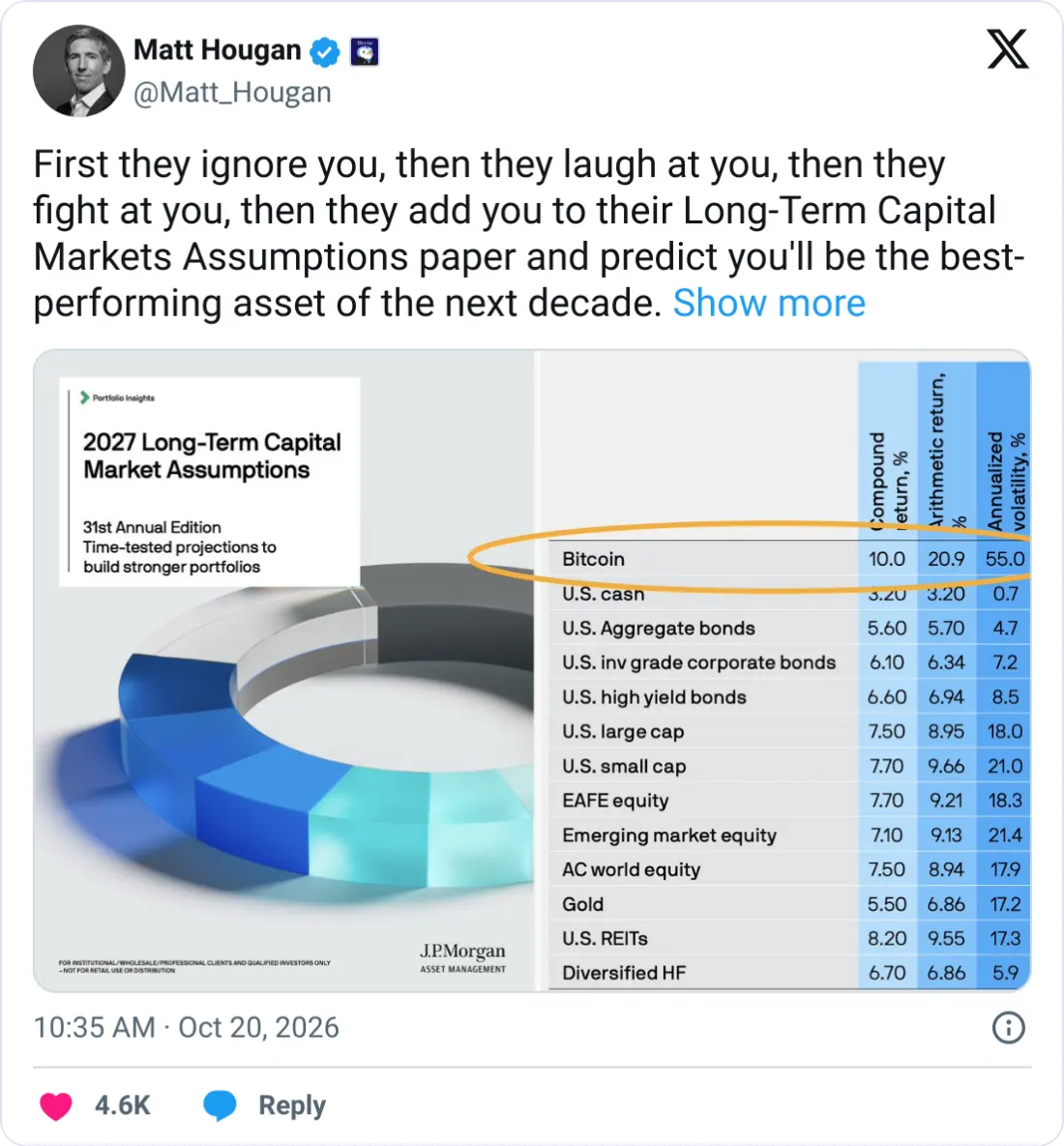
J.P. Morgan Asset Management has issued its first 10-year return forecast for Bitcoin, projecting a 10% compounded annual return while warning that 55% volatility and unstable correlations with other assets remain barriers to widespread portfolio inclusion. The forecast marks the first time JPMorgan has placed a long-term return range on Bitcoin in its research.
The forecast appears in the firm’s 31st annual Long-Term Capital Market Assumptions report, covering its 2027 assumptions. JPMorgan’s base case for Bitcoin exceeds its projected returns for U.S. bonds, large- and small-cap equities and gold, although the range around that forecast remains wide.
The firm has not added Bitcoin to its main models for measuring how asset prices move together. Instead, analysts created a separate, smaller covariance model comparing BTC with a subset of other assets.
“The volatility and unstable correlation of assets like Bitcoin (BTC) remain an obstacle to their widespread inclusion in portfolios,” the analysts wrote. “Nevertheless, we initiate a long-term return forecast for BTC this year [and] provide a separate, smaller covariance matrix with BTC against a subset of assets.”
JPMorgan Keeps Bitcoin Outside Its Main Portfolio Model
J.P. Morgan Asset Management said its treatment of Bitcoin could change if volatility falls and correlations with other assets become more stable. Analysts also pointed to clearer regulation, stronger liquidity and improved price discovery as factors that could affect their approach.
Dr. Sheena Shah and Dennis Cristallo also pointed to the expansion of infrastructure around digital assets.
“Investors are nevertheless increasingly exploring crypto assets, supported by more defined regulation and growing infrastructure (e.g. exchange-traded funds, futures, publicly traded crypto companies, options, bank-grade custody and financing markets),” they wrote.
“With over 60 million coins and tokens, Bitcoin is the anchor of the crypto ecosystem, offering transactional security, longevity, improving regulatory clarity and liquidity.”
The forecast comes alongside continued institutional flows into digital assets. JPMorgan analysts estimated earlier this month that around $50 billion had entered digital assets during 2026. The bank has also researched Bitcoin’s relationship with gold and how investor hedging activity could affect its performance relative to traditional assets.
BlackRock Bitcoin Products Add to Institutional Activity
BlackRock’s iShares Bitcoin Trust ETF, or IBIT, recorded its strongest daily inflow in more than 12 months, adding another data point to the institutional activity surrounding Bitcoin. SoSoValue showed that the fund’s previous larger daily inflow occurred on Oct. 7, 2025.
IBIT tracks Bitcoin’s spot price and provides investors with indirect BTC exposure through an exchange-traded product. BlackRock also issues the iShares Bitcoin Premium Income ETF, or BITA. Launched in June 2026, BITA gains Bitcoin exposure through holdings that include BTC and IBIT shares while selling call options to generate income.
That same day, BlackRock filed with the U.S. Securities and Exchange Commission to launch the iShares Bitcoin Managed Protection ETF, or PBIT. The proposed fund seeks to provide upside exposure through IBIT or other BTC exposure while offering a level of downside protection, with gains also subject to a cap.
Bitcoin Forecast Draws Industry Reactions
Bitwise CIO Matt Hougan welcomed JPMorgan’s move into long-term Bitcoin forecasting but argued that its volatility assumption was too high, pointing to Bitcoin’s declining volatility over the past 15 years.
“First they ignore you, then they laugh at you, then they fight at you, then they add you to their Long-Term Capital Markets Assumptions paper and predict you'll be the best-performing asset of the next decade,” Hougan wrote on X.
The forecast also follows years of public skepticism toward Bitcoin from JPMorgan CEO Jamie Dimon, who described the cryptocurrency as a “fraud” in 2017 and maintained a skeptical position in later years using softer language.
Strategy Chairman Michael Saylor also welcomed the report. “Wall Street is doing the math,” he said on X.
This article has been refined and enhanced by ChatGPT.


