




 USD
USD
Kalshi Brings Tokenized Event Markets to Solana as Derivatives Landscape Shifts

Hybrid Prediction Model Targets On-Chain Liquidity During a Market Restructure
TL;DR
- Kalshi launched tokenized versions of its regulated event-contract markets on Solana on Dec. 1, 2025.
- The rollout connects Kalshi’s off-chain liquidity with Solana DeFi venues like Jupiter and DFlow.
- The move lands as CoinGlass data shows derivatives liquidity tightening around BTC while altcoins face a prolonged drawdown.
Kalshi’s entry into on-chain trading landed on Dec. 1, 2025, with the exchange opening thousands of its regulated event-contract markets as tokenized assets on the Solana blockchain, marking a structural shift from a closed, centrally hosted product suite to an interoperable model built for crypto liquidity. The company, already known as a U.S. CFTC-regulated prediction-market exchange, effectively turned its event contracts—traditionally accessed through Kalshi’s own interface—into transferable Solana-based tokens. Users will now be able to buy, sell, and move these positions directly on-chain.
The rationale, according to the exchange’s Head of Crypto, centers on accessing “billions of dollars of liquidity that crypto has” while enabling developers to build “third-party front ends” that rely on Kalshi’s underlying liquidity. The rollout creates a hybrid system where the exchange’s off-chain book meets Solana’s permissionless rails, effectively offering a gateway for both traders and developers to interact with regulated event markets without relying solely on Kalshi’s own platform.
Solana-native protocols are moving into the picture as core infrastructure partners, with Jupiter and DFlow linking Kalshi’s liquidity to DeFi trading environments. The integration is designed to convert Kalshi’s markets into freely transferable positions that can circulate across Solana’s broader ecosystem, reducing friction for crypto-native users accustomed to on-chain order flow. This architecture echoes the design of decentralized front-end layers common across DeFi, creating scenarios where third-party developers can build optimized interfaces or market aggregators while still clearing trades through Kalshi’s liquidity pools. The expansion also places the exchange in competition with other crypto-based prediction platforms such as Polymarket, but with the distinguishing factor of regulated event-contract settlement backing its markets.
The timing intersects with the strongest month the prediction-market sector has ever recorded. Data from The Block shows Kalshi’s monthly spot volume jumping from $4.4 billion in October to $5.8 billion in November, a 32% month-over-month increase and the single largest absolute monthly gain in the platform’s history. Polymarket followed the same trajectory with its own all-time high: monthly trading volume rose from $3.02 billion in October to more than $3.7 billion in November, a 23.8% jump that extended a months-long run of record activity. Combined, the two platforms approached $10 billion in November volume — a level that cements their status as dominant flows in the global prediction-market ecosystem.
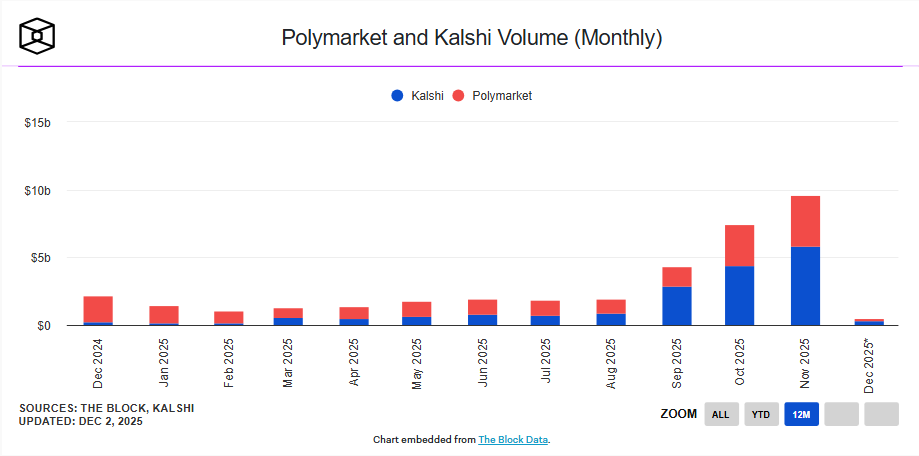
Sector data shows Kalshi and Polymarket have effectively formed an emerging duopoly, capturing the overwhelming majority of monthly global prediction-market activity as their liquidity funnels, integrations, and user bases scale at the same time. Capital formation has accelerated alongside trading volume. Kalshi doubled its valuation last month after securing $1 billion in fresh funding that pushed its market value to $11 billion, reflecting investor confidence in its regulated U.S. footprint. Polymarket, meanwhile, secured a pivotal regulatory green light from the CFTC in mid-November, unlocking its return to the U.S. market after years of enforced limitations.
Distribution partnerships have amplified that momentum, boosting visibility and funneling liquidity into both platforms at a pace previously unseen in the sector. Polymarket secured an exclusive integration with Yahoo Finance, a multi-year partnership with UFC, and newly expanded data embeds via Google Finance, which recently began surfacing Polymarket and Kalshi prediction-market prices directly in search results. Bloomberg reporting also highlighted Galaxy Digital’s early-stage exploration of liquidity-provision deals with both platforms, signaling the rapid institutionalization of a category once dismissed as a retail experiment.
Kalshi’s decision to roll out tokenized markets on Solana fits directly into this broader surge. The exchange is positioning itself for deeper integration with crypto-native liquidity at a moment when prediction markets are experiencing their fastest-ever acceleration in volume, visibility, and institutional adoption. The question now becomes whether on-chain portability amplifies that growth further — or reshapes the competitive balance as both Kalshi and Polymarket navigate their strongest phase in the sector’s history.
This article has been refined and enhanced by ChatGPT.


