




 USD
USD
Kalshi Eyes WTI Perpetual as Prediction-Market Volume Falls

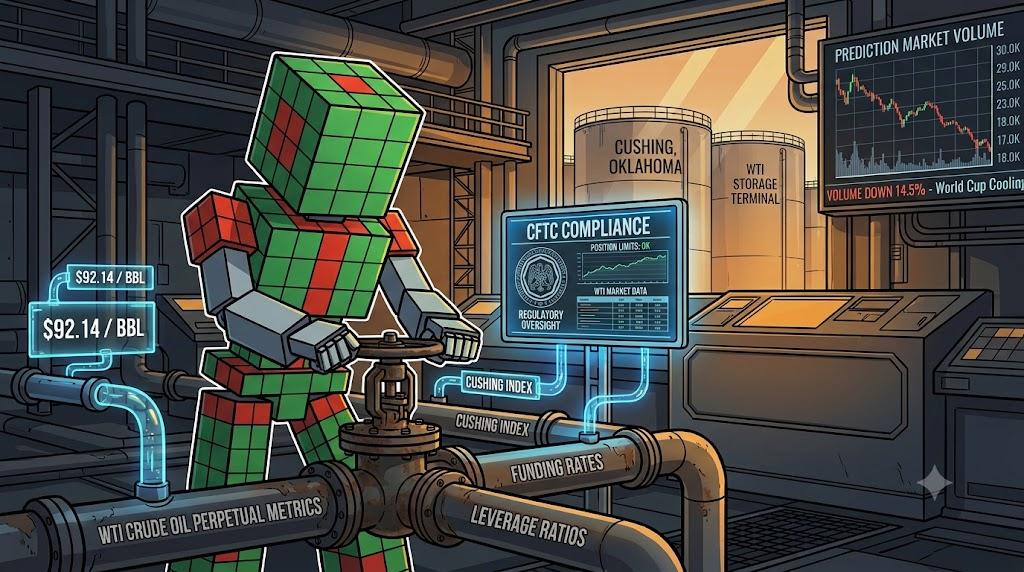
Trading cools after World Cup surge while Kalshi steps up enforcement against politically connected traders
TL;DR
- Kalshi, Polymarket and Polymarket US posted their first combined monthly volume decline in a year as activity eased after the World Cup.
- Kalshi is preparing a proposed WTI crude oil perpetual that could become the first regulated U.S. oil perpetual if approved.
- Kalshi also suspended congressional candidate Laurie Buckhout for betting on her own election as enforcement against conflicted traders intensifies.
Trade smarter on Jupiter, Solana’s leading DEX built for fast execution and deep liquidity.
Swap tokens at competitive rates, route across multiple liquidity sources automatically, and access perpetuals, DCA, and advanced trading tools — all in one place!
Kalshi is moving to expand into regulated oil perpetuals while the broader prediction-market sector cools from a summer trading surge and the exchange increases enforcement against users who trade markets they can directly influence. Combined volume across Kalshi, Polymarket and Polymarket US declined in August 2026 for the first time in a year, while Reuters reported on September 2 that Kalshi was preparing to seek Commodity Futures Trading Commission approval for a perpetual contract tied to West Texas Intermediate crude oil.
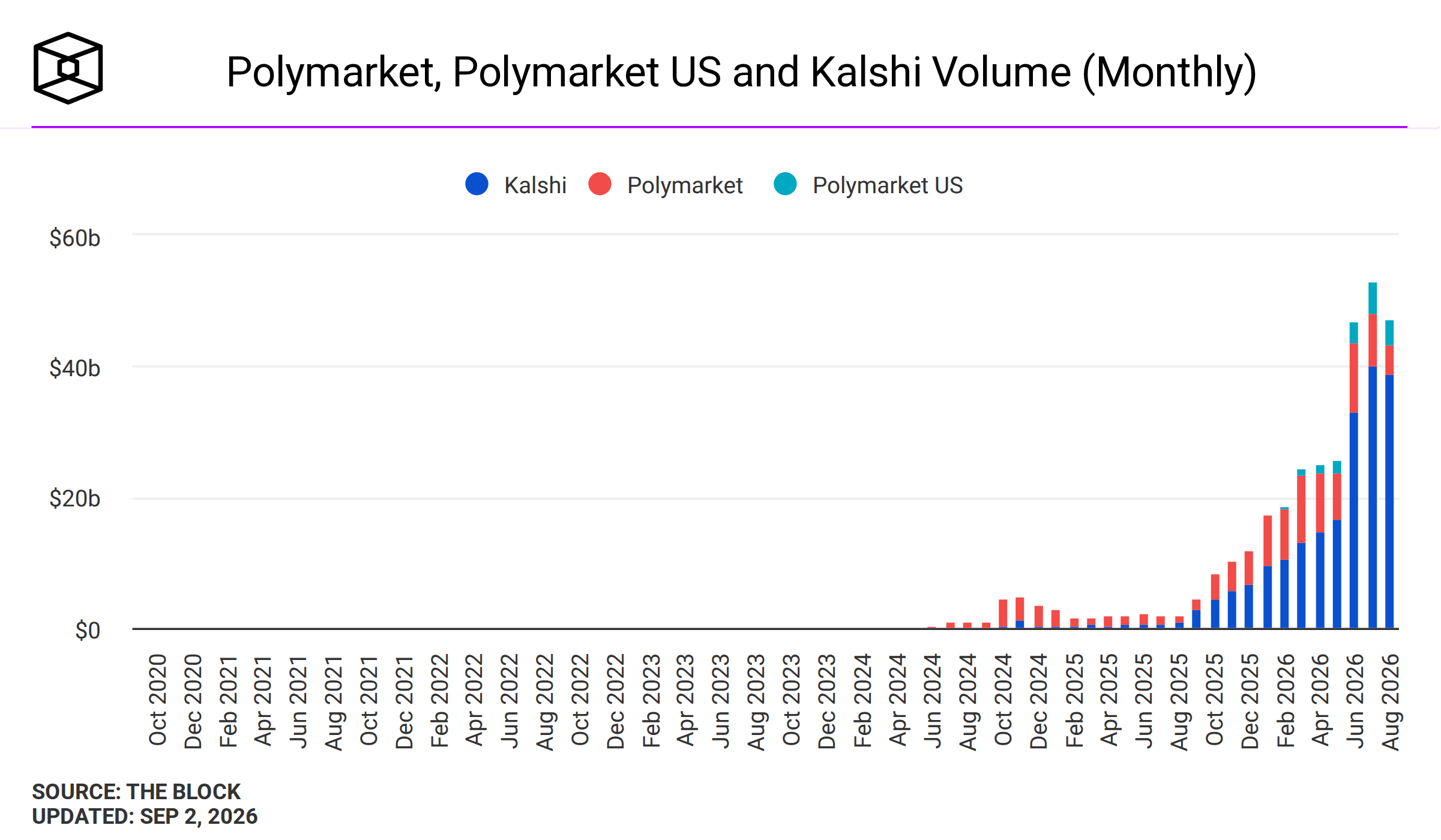
Prediction-market activity had surged during the World Cup, which ran from June 11 through July 19, before falling back the following month. Combined monthly volume across the three platforms dropped 14.5% in August to $45.33 billion, marking the first month-over-month decline since August 2025. August activity still remained above the $25.66 billion recorded in May.
The volume slowdown comes as Kalshi and Polymarket face increased scrutiny from U.S. state regulators, particularly over sports contracts. More than a dozen states have taken enforcement action or filed lawsuits against the platforms. Connecticut recently sued Kalshi to block sports contracts, escalating a months-long legal fight, while Kalshi continued expanding in sports by becoming the U.S. Tennis Association's exclusive prediction-market partner for the U.S. Open, whose main draw began August 30, 2026.
Kalshi prepares proposed WTI perpetual
Reuters reported on September 2, 2026, that Kalshi was preparing to seek CFTC approval for a perpetual contract linked to WTI crude oil. The source cited by Reuters said Kalshi could file the following week and would seek five-day-a-week trading. The proposal remained unconfirmed at publication because Kalshi had not publicly submitted the filing or released its benchmark, funding and trading rules.
Reuters said the contract could become the first oil perpetual on a regulated U.S. platform if the CFTC approves it. Unlike standard WTI futures, which expire and require traders maintaining exposure to close, settle or roll into a later contract, a perpetual would allow a trader to maintain exposure as long as the account continues to meet its margin requirements.
Removing expiration also removes one mechanism that helps conventional futures converge toward the market they represent. Crypto exchanges commonly use funding payments to keep perpetual contracts near a reference price: longs may pay shorts when a contract trades above its benchmark, while payments can move in the opposite direction when the contract trades below that reference.
Kalshi has not said whether its proposed oil product would use funding, how often such payments would occur or which WTI source would govern the calculation. The eventual filing is expected to address whether the contract follows a futures contract, a cash benchmark or another index, as well as how it would handle a delayed or disputed reference price.
WTI also presents a different market structure from crypto assets because the standard NYMEX WTI futures contract uses Cushing, Oklahoma, as its delivery point. A perpetual that regularly diverged from that market could provide leveraged exposure without serving as a dependable oil reference for traders seeking close alignment with the underlying crude market.
The proposed five-day trading schedule also places greater importance on rules governing price updates, margin calls, liquidations and trading interruptions when the reference market is closed, delayed or temporarily less liquid. Those mechanisms would be particularly relevant during geopolitical shocks or sharp supply-driven moves, when crude prices can move rapidly.
Demand for continuous oil exposure already exists outside the U.S. regulatory system. Brent and WTI perpetuals have recently been made available to crypto users, while Hyperliquid's policy arm asked the CFTC on August 7, 2026, to consider whether perpetual futures could provide businesses with an additional commodity-hedging tool.
Kalshi already operates as a CFTC-designated contract market. The agency approved Kalshi's Bitcoin perpetual in May 2026 through its voluntary product-approval process, but the CFTC said perpetual designs may not be suitable for every asset class and encouraged exchanges to seek review for products outside the assets covered by that approval.
Regulatory permission alone would not determine whether a WTI perpetual develops into a durable market. Traders would still require sufficient two-way liquidity to avoid wide spreads, while market makers would need confidence in the benchmark, margin framework and liquidation process. Commercial users such as producers, airlines, refiners and fuel distributors would also need the contract to track their real-world exposure closely enough to function as a practical hedge.
Kalshi steps up enforcement against conflicted traders
Kalshi has also increased enforcement against traders whose positions relate to outcomes they can directly influence. North Carolina Republican House candidate Laurie Buckhout was suspended for three years after the exchange found that she had traded contracts tied to her own congressional election.
Buckhout launched her campaign in North Carolina's 1st Congressional District in December 2025 and purchased less than $1,000 of contracts on her race against Democratic Rep. Don Davis. Kalshi determined that her status as a candidate made her a direct decision maker over the outcome, barring the trade under Rule 5.17(z) of its rulebook.
The settlement took effect on the Friday before the September 2 article and imposed a $2,589.96 penalty, more than twice what Buckhout had wagered. Kalshi's compliance department found that the retired Army colonel cooperated with the inquiry.
Buckhout acknowledged the trade, saying, “I bet on myself. Literally. It was a dumb mistake,” and said she worked to correct the issue once she learned there was a problem. A Kalshi spokesperson declined further comment.
Buckhout was at least the fourth political candidate Kalshi penalized in 2026 for trading on their own contest. Earlier cases involved Minnesota state Senator Matt Klein, former Texas congressional candidate Ezekiel Enriquez and Virginia Senate candidate Mark Moran, each of whom admitted betting on their own races and received five-year suspensions.
Former Rep. George Santos was permanently banned after trading contracts tied to whether he would attend the State of the Union address. The action was Kalshi's first permanent trading ban and relied on the same prohibition against trading markets where the participant can influence the outcome.
Enforcement over informational advantages has extended beyond candidates. The CFTC fined a former White House teleprompter operator $172,000 in the preceding week over trades placed using advance knowledge of presidential speeches. A U.S. soldier was also charged over alleged Polymarket trades tied to the operation that ousted Venezuelan leader Nicolas Maduro, while a MrBeast video editor was fired amid a Kalshi insider-trading probe. Kalshi subsequently introduced additional safeguards.
Buckhout remains a candidate for Congress. She won the Republican primary in March 2026 and is facing Davis again after losing to him in 2024 by less than two percentage points. North Carolina lawmakers redrew the 1st Congressional District in fall 2025, and the Cook Political Report rates the seat as leaning Republican.
This article has been refined and enhanced by ChatGPT.


