




 USD
USD
Kbank Tests Ripple Remittance System in South Korea

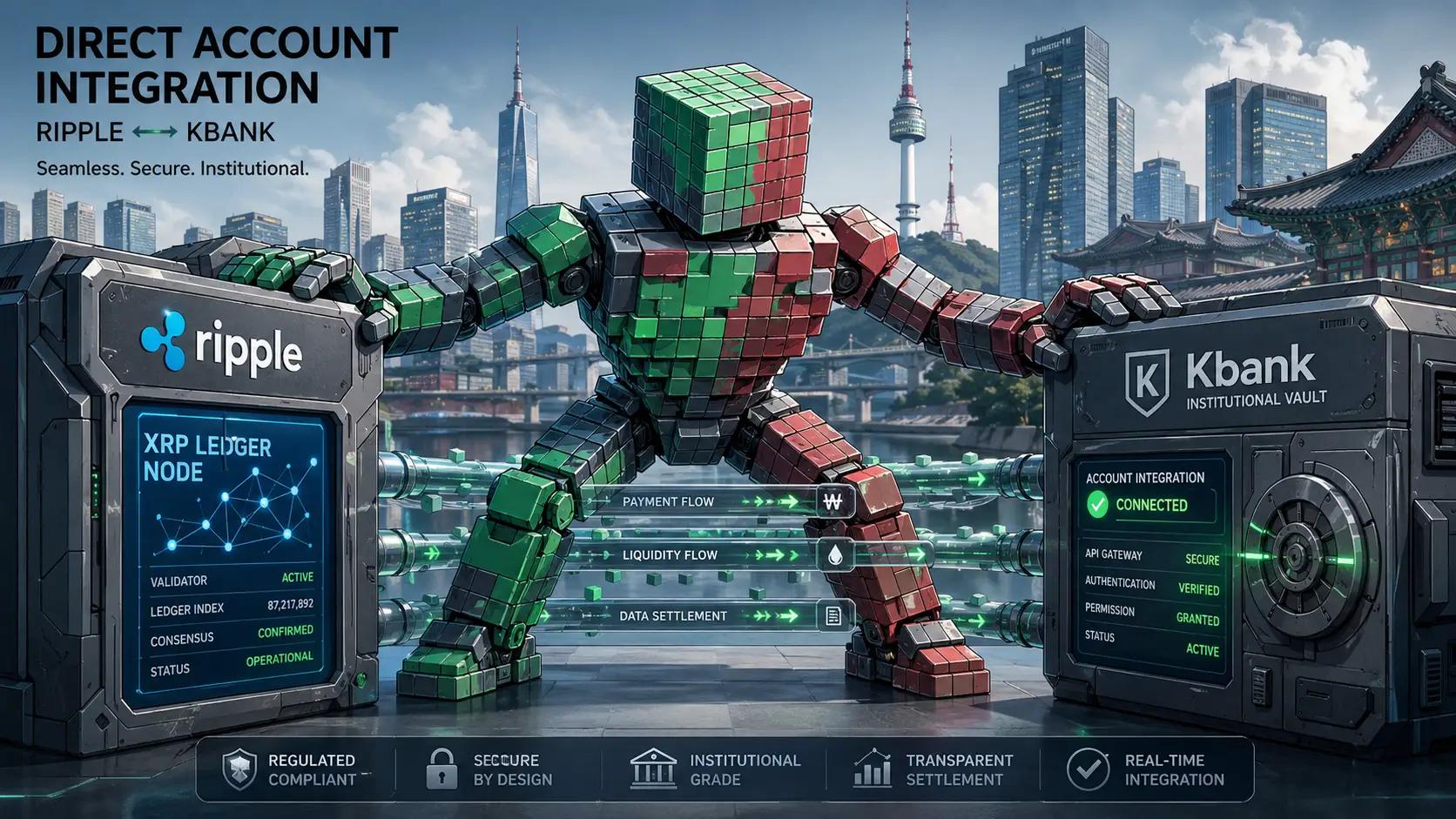
Bank Links Customer Accounts to Blockchain Transfers as Stablecoin Rules Take Shape
TL;DR
- Kbank partnered with Ripple to test blockchain-based overseas remittances.
- The pilot is in a second stage linking customer accounts and internal systems.
- South Korea is preparing rules classifying stablecoins as foreign exchange payment instruments.
We’ve launched the all-new COIN360 Perp DEX, built for traders who move fast!
Trade 130+ assets with up to 100× leverage, enjoy instant order placement and low-slippage swaps, and earn USDC passive yield while climbing the leaderboard. Your trades deserve more than speed — they deserve mastery.
Kbank has partnered with Ripple to test blockchain-based overseas remittances, advancing to a stage where customer accounts and internal systems are directly linked to onchain payment flows.
The agreement was signed at Kbank’s Seoul headquarters by Kbank CEO Choi Woo-hyung and Fiona Murray, Ripple’s Asia-Pacific managing director. The partnership evaluates whether cross-border transfers can become faster, cheaper and more transparent through Ripple’s global network and blockchain infrastructure, positioning the trial as a direct bank-level infrastructure test.
The pilot has progressed beyond an initial phase that used a separate mobile-wallet structure. The current stage integrates customer accounts and internal systems, with testing focused on remittance stability through real-world transaction simulations and blockchain transfers to overseas markets including the United Arab Emirates and Thailand.
Kbank tests Ripple Palisade system for remittances
Kbank is using Palisade, a Ripple software solution delivered as a service and described as adhering to international security standards. The results of the pilot are expected to determine whether the bank integrates the technology into its permanent payment infrastructure.
The bank’s digital asset positioning is tied to its role as the primary or exclusive banking partner for Upbit, where it provides mandatory fiat-linked accounts for users of one of South Korea’s largest crypto exchanges. Its user base expanded from roughly 2 million in 2020 to approximately 15 million by the end of last year, increasing its scale as it explores blockchain-based payment rails.
South Korea regulation drives payment infrastructure race
The pilot is unfolding as South Korean financial companies test blockchain-based cross-border payment systems while stablecoin and digital asset rules remain under discussion. Institutions are moving to establish partnerships and infrastructure before legislation is finalized.
South Korea’s ruling Democratic Party prepared a draft bill on April 8 that would classify stablecoins as foreign exchange payment instruments and require tokenized real-world assets to be backed by assets held in trust. An integrated draft of the Digital Asset Basic Act would treat stablecoins used in cross-border transactions as a “means of payment” under South Korea’s Foreign Exchange Transactions Act.
Hana Financial Group signed a business agreement with Standard Chartered Group on March 16 covering cooperation in foreign exchange and digital assets. It has also partnered with Circle and Crypto.com to promote stablecoin-based payments for foreign visitors.
Danal was reported on March 5 to be preparing a digital asset payments service for foreign visitors through a partnership with Binance Pay.
Ripple’s activity in South Korea also includes a partnership with Kyobo Life Insurance to tokenize government bonds, extending its presence beyond remittances into institutional tokenization and settlement systems.
FAQ
What is Kbank testing with Ripple?
Blockchain-based overseas remittances linked to customer accounts and systems.
Which countries are included in testing?
United Arab Emirates and Thailand.
What software is being used?
Palisade, a Ripple software solution.
What regulation is being discussed?
Stablecoins may be classified as foreign exchange payment instruments.
This article has been refined and enhanced by ChatGPT.


