


 USD

MiCA and the CLARITY Act Are on Different Regulatory Timelines


Europe’s longest MiCA transition period ended on July 1, 2026. In the United States, the CLARITY Act failed to advance in the Senate on September 15 and remains proposed legislation. European providers now face requirements under an adopted framework, while US regulators continue using powers they already hold. Those starting points shape what each new regulatory development can actually change.
MiCA, the Markets in Crypto-Assets Regulation, began applying in stages before July. Its stablecoin provisions applied from June 2024, followed by its wider framework in December 2024. The July 2026 deadline ended transitional permission for qualifying existing providers. CLARITY, the Digital Asset Market Clarity Act, has yet to become law. The dates describe different kinds of progress, rather than consecutive steps in one shared process.
The timing helps explain how MiCA and the Clarity Act split on crypto rules on licensing and oversight. MiCA already governs covered crypto services in the EU. CLARITY would change the US statutory framework. An EU authorization announcement concerns permission to provide services under existing rules, while progress on the US bill concerns requirements that Congress has not yet enacted.
Europe’s Rules Applied Before the Transition Ended
MiCA’s rollout separated the rules for certain tokens from the requirements governing service providers. The provisions for asset-referenced tokens and e-money tokens, its two categories associated with stable-value assets, applied first. The broader framework followed, covering crypto-asset service providers, market conduct, and other crypto-assets. By the time the final transition ended in 2026, these requirements had already been applying for more than a year.
Existing businesses did not all have to switch permissions on the same day. EU member states could allow providers lawfully operating under earlier national arrangements to continue temporarily. The maximum period ran until July 1, 2026, or until authorization was granted or refused, whichever came first. Some countries shortened that period or did not offer the full transition. July was the final backstop, rather than a uniform starting date for every provider.
That explains why an earlier national registration and a MiCA authorization belong to different stages of the rollout. The temporary arrangement let qualifying businesses continue under previous permissions while the common framework took effect. Its expiry removed that transitional basis. A pending application did not automatically extend the permission to carry on ordinary regulated activity beyond the deadline.
The expiry also changed what unauthorized providers could do for existing customers. They had to stop taking on new business and limit transactions and custody to an orderly exit. Customer identity checks, transaction monitoring, and record-keeping continued during that process. Those remaining duties governed the withdrawal of services; they did not extend permission to run the ordinary business.
Authorization also concerns the provider actually serving customers. MiCA authorization attaches to a particular legal entity and the services covered by its approval. One company’s authorization does not automatically cover every business sharing its brand. Authorized providers can use passporting to supply covered services across the European Union, subject to notification procedures. The common framework therefore combines shared rules with permissions that still have a defined scope.
MiCA also provides a different route for certain financial institutions that are already regulated. Eligible institutions can notify the relevant authority before providing covered services, rather than follow the standard authorization application process. That distinction concerns how a business obtains permission under rules already applying. It does not postpone MiCA’s application or extend the expired transition.
CLARITY Remains a Legislative Proposal
In the US, Troutman Pepper Locke’s analysis of CLARITY and agency powers describes the proposed division of responsibility between the Securities and Exchange Commission, or SEC, and the Commodity Futures Trading Commission, or CFTC. The bill would establish registration requirements for digital commodity intermediaries, including exchanges, brokers, and dealers, and broaden statutory anti-money laundering coverage. Its September setback left those proposed changes unadopted.
Existing CFTC authority over fully paid spot digital commodity trading covers fraud and manipulation. It does not provide a general federal registration and supervision regime for the intermediaries operating those markets. Here, spot trading means direct purchases and sales of assets paid in full. CLARITY would have supplied the CFTC with a statutory structure for registering and supervising those businesses.
That gap concerns the CFTC’s powers, rather than an absence of all US regulation. Existing federal and state requirements continue to govern relevant activities, including anti-money laundering obligations for many crypto businesses. Agencies can pursue rules and exemptions within existing statutes, but cannot grant themselves new authority simply because the digital asset bill failed to advance.
Agency measures also have their own status. A proposed rule sets out intended requirements; an adopted rule or exemption has effects governed by its terms. Work by the SEC or CFTC can therefore proceed while CLARITY remains stalled, but it cannot be read as implementation of the unpassed bill. Enactment, rulemaking, and a provider’s registration are separate decisions, even when they address related activity.
The Dates Mark Different Legal Changes
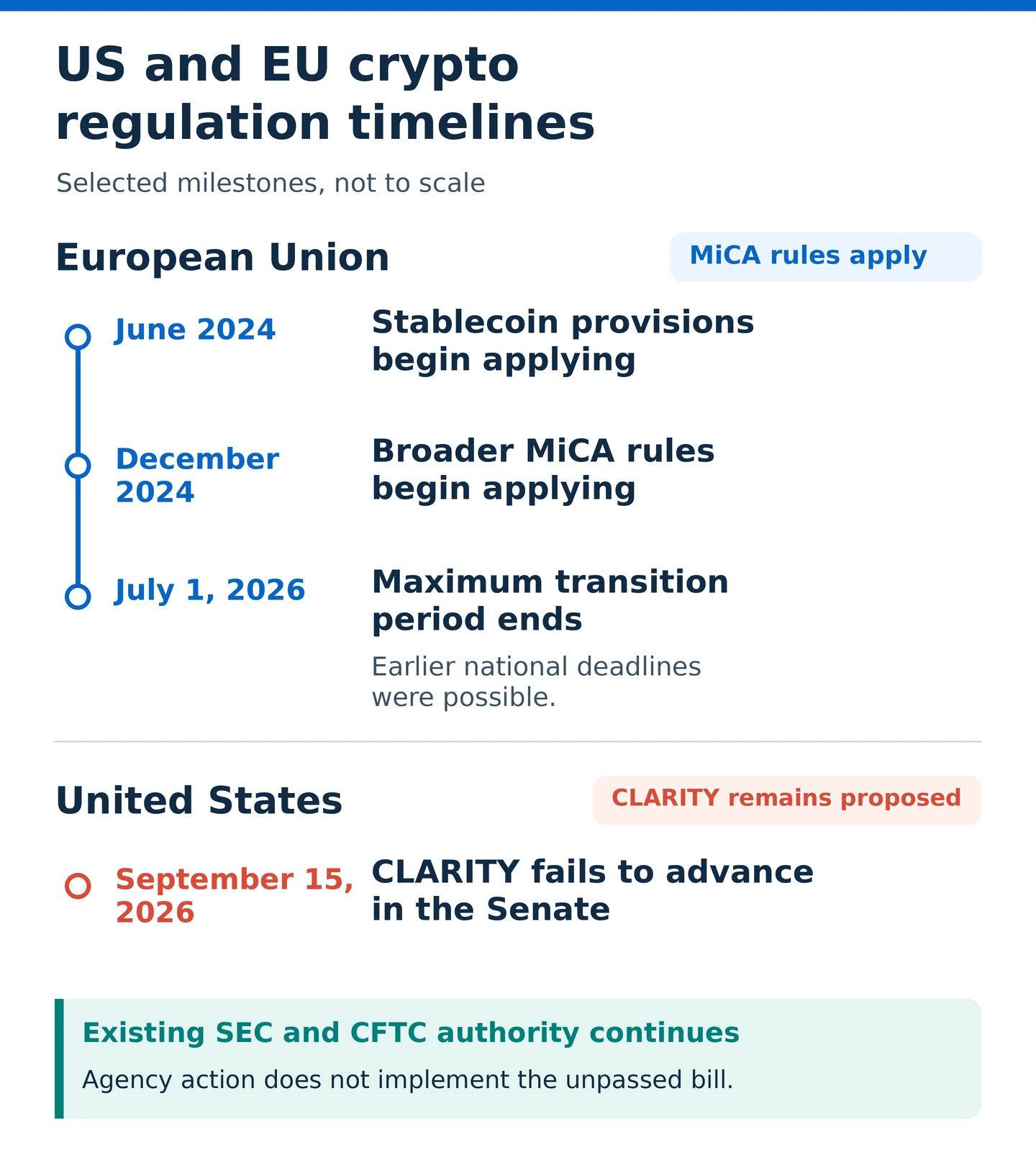
MiCA’s phased rollout shows how a framework can apply before every existing provider has completed its transition. July 1, 2026, ended the last temporary permissions under that process; it did not create MiCA or automatically authorize firms with pending applications. CLARITY’s September setback occurred earlier in the lawmaking process, before its proposed federal framework had been enacted. Europe’s implementation deadline and America’s legislative setback therefore cannot be treated as matching launch dates for new crypto rules.


