


 USD

Microsoft 365 Outage Hits 74 Countries as Email Recovery Continues


Server failures disrupt governments and businesses while Microsoft extends email timeout to clear delayed messages
TL;DR
- Microsoft 365 suffered a widespread outage affecting 74 countries and territories, disrupting Outlook, Teams, Copilot and critical communications.
- Microsoft attributed the disruption to unavailable servers and extended an email timeout by 48 hours to protect delayed messages.
- Microsoft reported improving service availability across major regions, with email queues approaching normal levels, although intermittent problems persisted.
Trade smarter on Jupiter, Solana’s leading DEX built for fast execution and deep liquidity.
Swap tokens at competitive rates, route across multiple liquidity sources automatically, and access perpetuals, DCA, and advanced trading tools — all in one place!
A widespread Microsoft 365 outage that began on November 12, 2026, disrupted Outlook, Teams, Exchange Online and other workplace services across multiple regions, forcing government agencies and businesses to change how they communicated. Microsoft reported partial recovery on Friday, November 13, but intermittent connectivity problems and delayed email deliveries persisted as the company worked to restore infrastructure capacity.
Microsoft 365 Outage Disrupts Governments and Businesses Worldwide
According to Downdetector data, disruptions spread across 74 countries and territories within roughly 60 minutes. Microsoft initially investigated Exchange Online connection problems in the Americas before acknowledging that users worldwide could be affected. The company's admin-center advisory, MO1550821, placed the broader incident's start at 1:26 p.m. Eastern Time and identified problems involving Microsoft Teams, SharePoint Online, Microsoft 365 Copilot and Microsoft Defender XDR.
Roughly 430 million people worldwide use Microsoft 365, although that figure represents the broader user base rather than a verified count of affected users. Downdetector also recorded spikes in complaints involving Azure, OneDrive and the Microsoft Store. The disruption lasted more than 12 hours, interrupting access to tools used for routine workplace communication and collaboration.
Government operations were affected across several countries. Italy reported disruptions at the Presidency, various ministries and the Constitutional Court. New Zealand's foreign minister said email access had been interrupted at all the country's embassies, consulates and offices worldwide. Singapore's government technology agency separately reported that institutional emails were being blocked.
Britain also experienced widespread interruptions. Multiple National Health Service facilities advised patients against relying on web-based communications, while several Westminster lawmakers lost access to Microsoft services through their parliamentary accounts. A Parliament spokesperson acknowledged the problems and said alternative communication arrangements were being established. Japan's finance minister similarly urged citizens to contact authorities by telephone for urgent matters while email services remained disrupted.
Private companies adjusted their operations as well. Air India temporarily moved its email services to maintain customer support, while Workhorse Group postponed its quarterly earnings call. These disruptions affected organizations that depended on Microsoft services for both internal coordination and external communications.
Microsoft Blames Unavailable Servers, Extends Email Timeout
Microsoft attributed the outage to infrastructure overload after unexpectedly unavailable servers increased pressure on systems that remained operational. The company subsequently clarified that the strain resulted from lost server capacity rather than an unexpected increase in traffic. Some servers became unresponsive again as traffic returned during recovery.
Microsoft's early status update stated:
"We’re opening all available pathways to restore service, as our actions taken thus far have not provided the anticipated relief. We found a core process on affected servers is becoming overwhelmed, causing capacity loss."
The company also ruled out an identified cyberattack as the cause of the disruption, stating:
"At the moment we are not aware of any malicious activity that caused this incident."
Recovery efforts included pausing deployments, redistributing connections across Microsoft's global infrastructure, diverting traffic away from affected environments and restarting servers. Earlier measures had failed to deliver the expected improvement, prompting Microsoft to pursue additional ways to restore capacity and stabilize services.
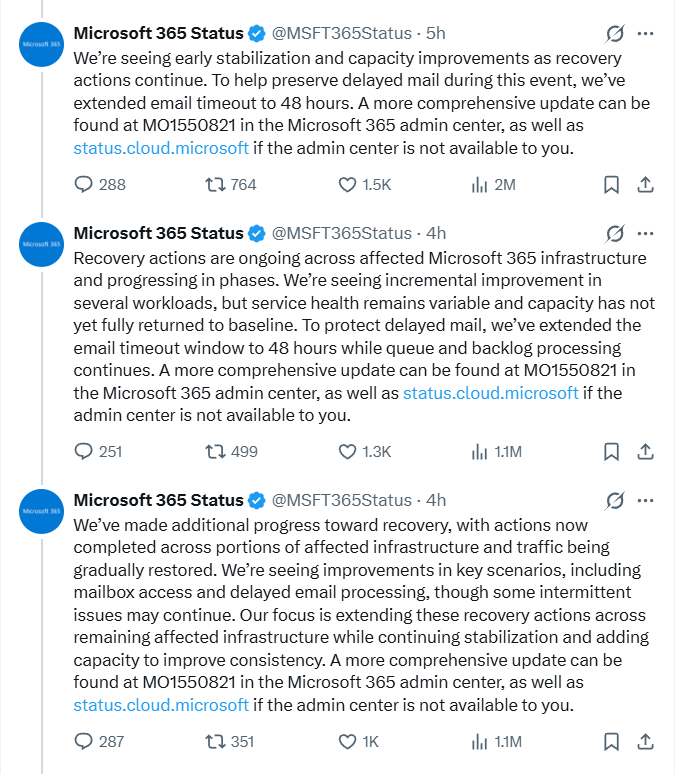
Microsoft reported partial restoration shortly after midnight Central European Time. By Friday morning, the company said additional traffic-optimization changes were improving stability and capacity, with recovery measures being expanded across affected areas.
Microsoft also extended an email timeout by 48 hours to allow delayed messages to move through the system as services recovered. The measure was intended to help reduce the accumulation of undelivered emails while restoration continued.
Microsoft subsequently reported improvements across major regions:
"We’re seeing continued recovery progress across affected regions, with broader improvements in North America, sustained improvements across much of Europe, and encouraging recovery signals in Asia Pacific."
However, the company cautioned that service restoration had not been completed:
"Some users may still experience intermittent issues as recovery actions continue. We’re focused on recovery for the remaining affected environments while prioritizing email queue and backlog reduction."
The $3.88 trillion company committed to publishing a detailed incident report after resolution, covering the underlying cause, its response measures and other relevant findings.
Microsoft Reports Further Recovery as Email Backlogs Shrink
Microsoft reported further recovery progress on November 13, with service availability and email delivery performance improving across a growing portion of its affected infrastructure. The company said email queues had been significantly reduced and were approaching normal levels following additional mitigation measures.
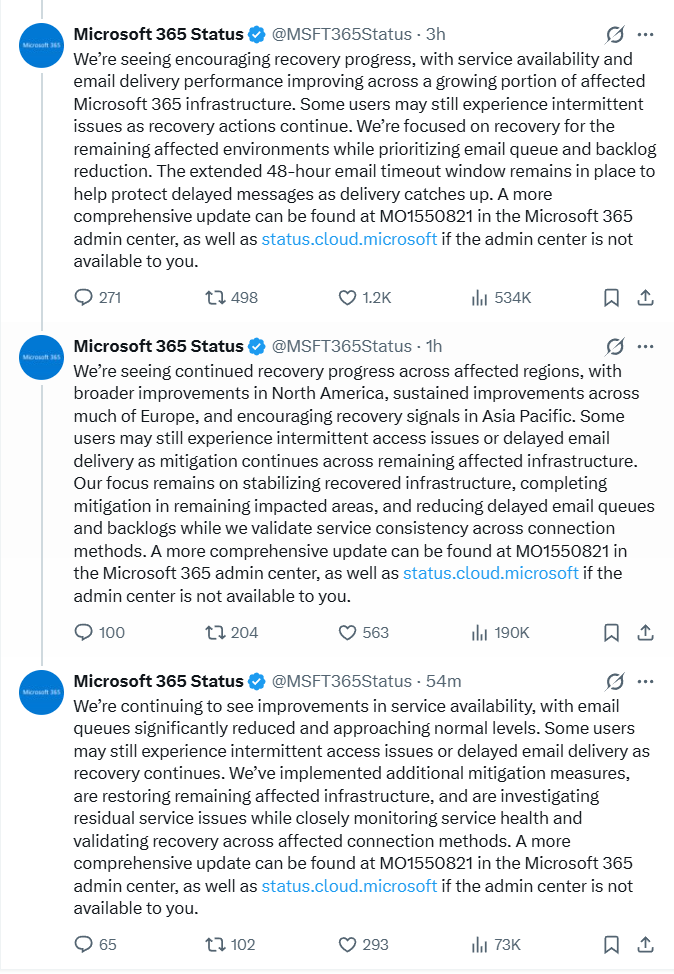
The extended timeout window remained active to protect delayed messages while delivery caught up. Microsoft also reported broader improvements in North America, sustained progress across Europe and encouraging recovery signals in Asia Pacific.
However, intermittent access problems and email delays persisted for some users. Microsoft said it was restoring remaining infrastructure, investigating residual issues and monitoring service health across affected connection methods.
Microsoft Stock Faces Separate Pressure From AI Infrastructure Spending
The service disruption also renewed questions about Microsoft's cloud reliability as the company continues investing heavily in artificial intelligence infrastructure.
The incident followed another Microsoft 365 service disruption earlier in the year. The publication argued that repeated outages could weaken enterprise customer confidence and encourage some organizations to reassess their dependence on a single cloud provider. The immediate financial damage from the latest disruption remained unclear.
Microsoft's investment commitments represent another issue for shareholders. The company has been expanding data-center capacity to support Azure, AI workloads and demand for computing resources. Its reported spending and operating figures show rapid cloud growth alongside substantial capital requirements.
Despite strong cloud demand, Microsoft has acknowledged capacity constraints, including delayed deliveries of third-party GPU resources. Its filings also warn that slower AI adoption, underused infrastructure and rising computing costs could affect future investment returns. Heavy data-center spending may pressure free cash flow and operating margins if new capacity takes time to generate revenue.
The outage has brought operational reliability into focus alongside Microsoft's existing infrastructure commitments. Investors are assessing whether the company can maintain cloud growth, address capacity constraints and turn increasing AI demand into returns without sustained pressure on profitability.
This article has been refined and enhanced by ChatGPT.


