




 USD
USD
Nasdaq Seeks SEC Approval for Binary Outcome Options as Prediction Market Volumes Post First Monthly Decline Since August 2025


Exchange Giant Targets Nasdaq-100 Contracts Priced $0.01–$1 While Industry Open Interest Stays Above $1B
TL;DR
- Nasdaq filed with the SEC on March 2, 2026 to list “Outcome-Related Options” tied to the Nasdaq-100 and Micro Index, priced between $0.01 and $1.
- February 2026 marked the first monthly prediction market volume decline since August 2025, even as Kalshi processed $9.8B and total open interest stayed above $1B.
- Kalshi handled $23.8B in 2025 transactions, while Opinion Labs’ share fell from above 30% to about 3%, and Polymarket’s open interest stood above $400M.
We’ve launched the all-new COIN360 Perp DEX, built for traders who move fast!
Trade 130+ assets with up to 100× leverage, enjoy instant order placement and low-slippage swaps, and earn USDC passive yield while climbing the leaderboard. Your trades deserve more than speed — they deserve mastery.
Nasdaq Inc. filed with the U.S. Securities and Exchange Commission on March 2, 2026 seeking approval to list a new class of binary-style contracts called “Outcome-Related Options,” structured as yes-or-no bets tied to specific market events. The proposed contracts would reference the Nasdaq-100 Index and the Nasdaq-100 Micro Index and would trade within a fixed price range between $0.01 and $1.00, settling at $1 if the defined outcome occurs and expiring worthless if it does not.
The filing positions the contracts under SEC oversight as securities options, distinguishing them from many existing prediction market products that operate under Commodity Futures Trading Commission jurisdiction. A derivatives analyst said, “Nasdaq entering this space represents a structural shift in how institutional exchanges view retail sentiment,” referring to the exchange’s move into event-style trading instruments.
The submission follows similar activity from Cboe, which has explored bringing back all-or-nothing style contracts resembling prediction market wagers within regulated derivatives markets. Reporting around the filing described the contracts as mirroring core prediction market mechanics, where prices function as implied probabilities based on trading activity.
Nasdaq’s move comes as prediction market platforms experience shifting volume dynamics after rapid growth tied to the 2024 U.S. presidential election and major sports events. Kalshi processed $23.8B in total transactions during 2025, reflecting accelerated adoption compared with earlier benchmarks. At peak periods during the previous cycle, daily volumes exceeded $465–$700M+, largely driven by sports-related contracts.
February 2026 marked the first month-on-month volume decline for the broader prediction market sector since August 2025. The pullback followed the conclusion of high-profile sports contracts linked to the Super Bowl, which had previously boosted participation and turnover. Despite the aggregate slowdown, Kalshi recorded $9.8B in volume for February, compared with $8.9B in January.
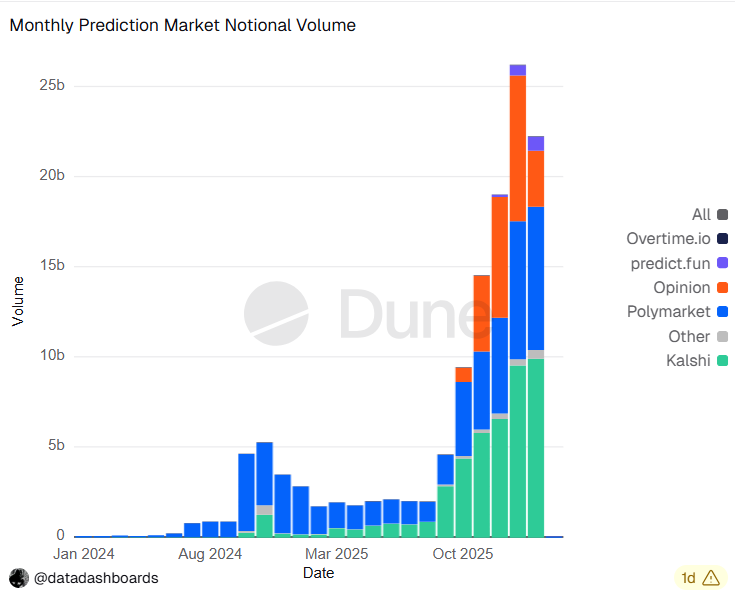
Opinion Labs saw its market share fall sharply from above 30% at its peak to roughly 3% during the same period. Polymarket reported nominally flat growth for the month while maintaining open interest above $400M. Total open interest across prediction markets remained above $1B during the period.
A survey cited in industry reporting found that 43% of market structure experts expressed positive views about the informational value of prediction markets. One observer said the contracts could become “regulated as mainstream securities products,” describing the potential classification under SEC rules.
The regulatory landscape remains split between federal agencies, with outcome-based contracts straddling distinctions between securities and commodities oversight. Nasdaq’s filing formally initiates the SEC review process for its proposed contracts linked to the flagship 100 index and its micro counterpart, with contract prices bounded between $0.01 and $1.00 as specified in the submission dated March 2, 2026.
This article has been refined and enhanced by ChatGPT.


