




 USD
USD
Ondo, Ripple, JPMorgan, Mastercard Complete Treasury Redemption

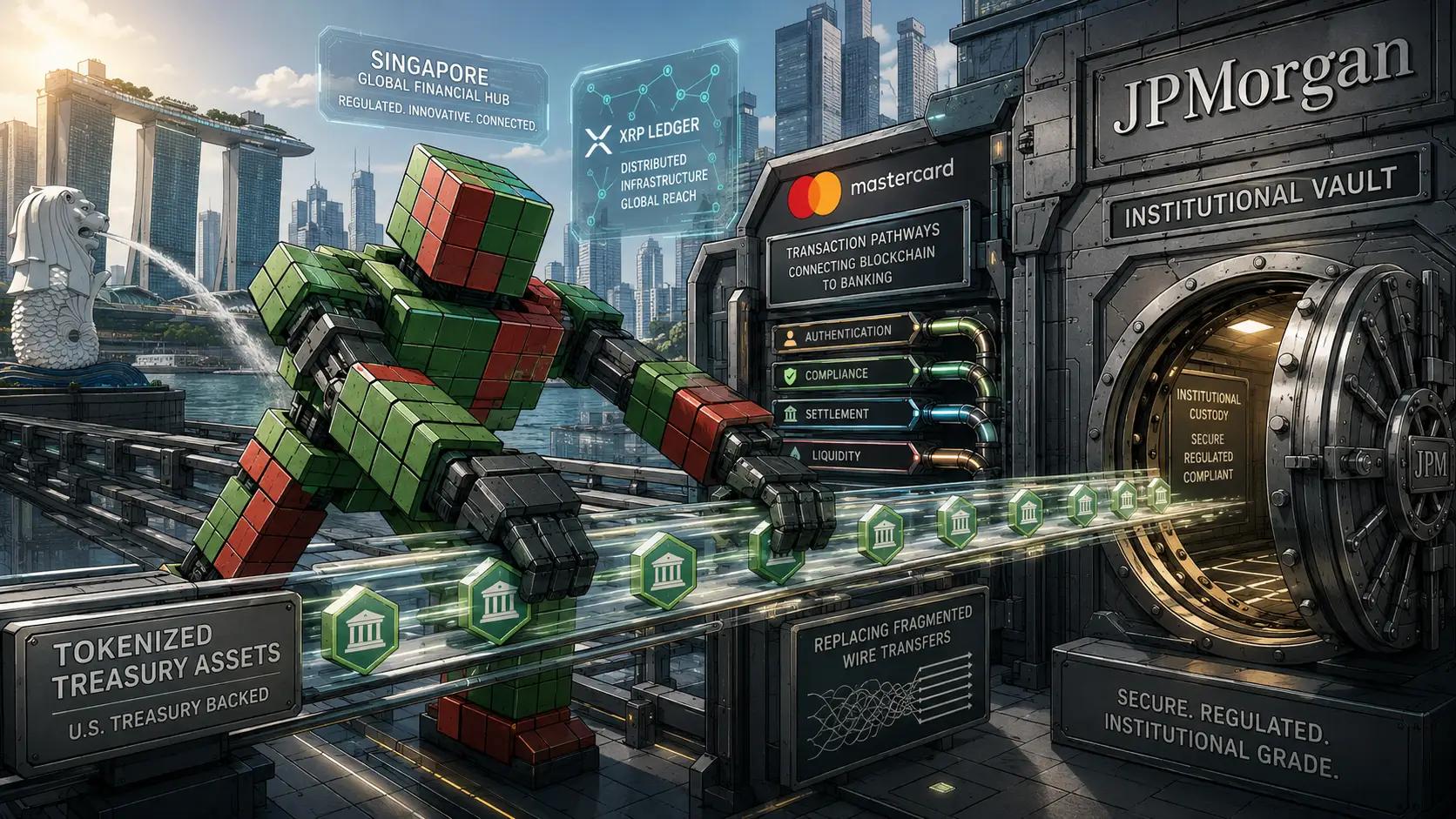
Pilot links tokenized Treasuries to cross-border dollar settlement
TL;DR
- Ondo Finance, Ripple, Mastercard and Kinexys by J.P. Morgan completed a near real-time cross-border redemption of tokenized U.S. Treasuries.
- Ripple redeemed OUSG on the XRP Ledger, while Mastercard and Kinexys by J.P. Morgan handled the fiat settlement path.
- The pilot showed a hybrid model using public blockchain execution and regulated banking infrastructure.
We’ve launched the all-new COIN360 Perp DEX, built for traders who move fast!
Trade 130+ assets with up to 100× leverage, enjoy instant order placement and low-slippage swaps, and earn USDC passive yield while climbing the leaderboard. Your trades deserve more than speed — they deserve mastery.
Ondo Finance, Ripple, Mastercard and Kinexys by J.P. Morgan completed the first near real-time cross-border, cross-bank redemption of a tokenized U.S. Treasury fund, connecting OUSG redemption on the XRP Ledger with U.S. dollar settlement to Ripple’s bank account in Singapore.
Ripple redeemed a portion of its Ondo Short-Term U.S. Government Treasuries holdings on XRPL. Ondo processed the redemption, Mastercard’s Multi-Token Network routed the fiat payout instruction, and Kinexys by J.P. Morgan debited Ondo’s Blockchain Deposit Account before settling U.S. dollars through JPMorgan’s correspondent banking network.
The transaction replaced a redemption process normally tied to wire transfers, manual steps and fixed banking windows. The blockchain leg was processed in under five seconds, while the dollar leg moved through traditional banking infrastructure, creating a hybrid settlement model that paired public blockchain execution with regulated banking rails.
Pilot targets 24/7 tokenized asset redemptions
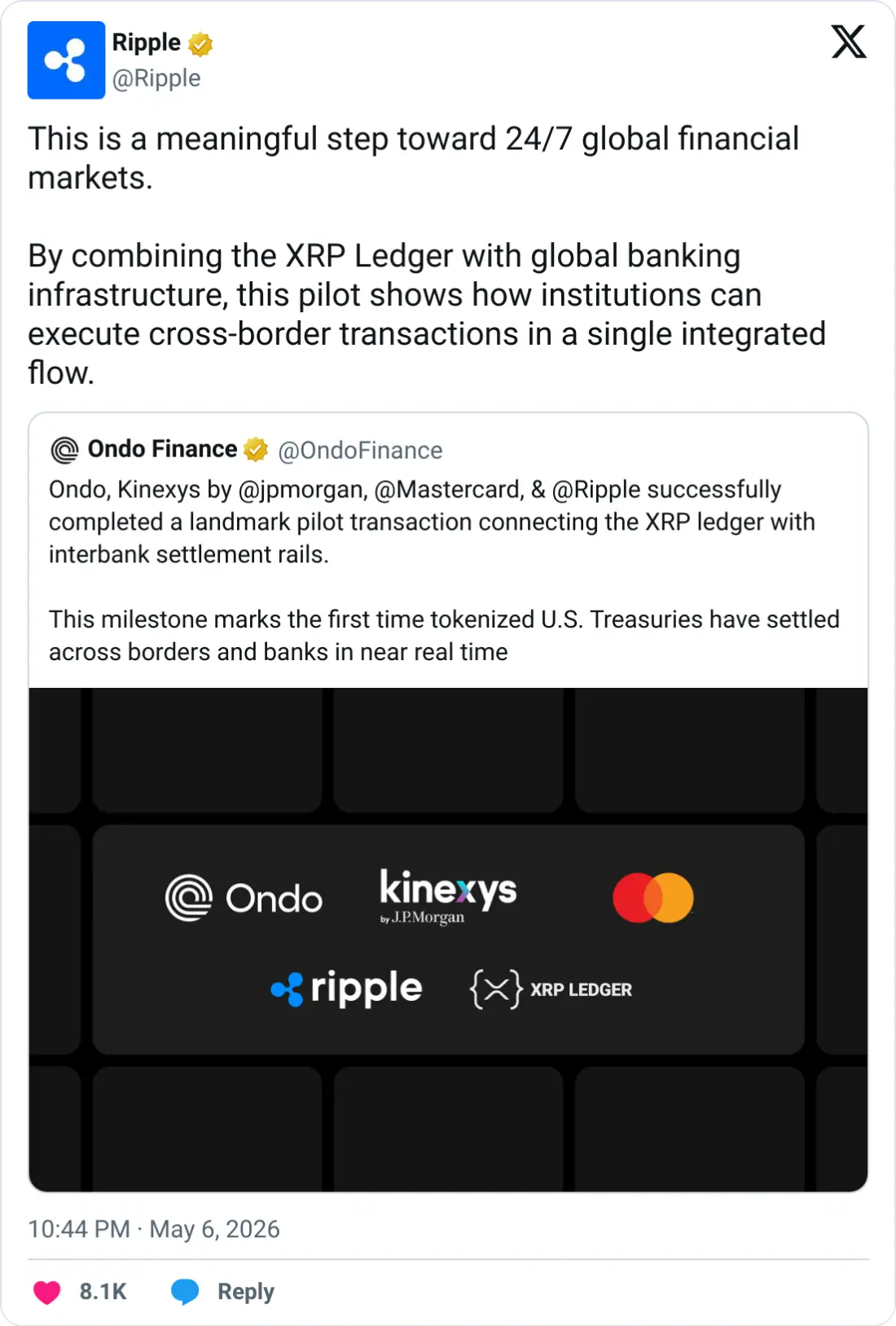
Ripple said, “This is a meaningful step toward 24/7 global financial markets,” adding that “by combining the XRP Ledger with global banking infrastructure, this pilot shows how institutions can execute cross-border transactions in a single integrated flow.”
Ian De Bode, President of Ondo Finance, said, “By connecting public blockchain infrastructure with interbank settlement rails, Ondo, Kinexys by J.P. Morgan, Mastercard, and Ripple are laying the groundwork for 24/7 global markets that never close.”
Markus Infanger, SVP of RippleX, said, “The XRP Ledger enables real-time asset movement, and when paired with global banking infrastructure, this pilot shows how institutions can execute cross-border transactions as a single, integrated flow.”
Zack Chestnut, Global Head of Commercialization at Kinexys by JPMorgan, said, “To see widespread adoption of tokenized financial products, we need wholesale cross-industry collaboration across geographies, global banking infrastructure and public blockchains,” adding that the firms were “excited to continue working with Ondo, Ripple and Mastercard to bring this to life.”
Raj Dhamodharan, executive vice president of Blockchain and Digital Assets at Mastercard, said, “As tokenized assets continue to see strong institutional momentum and engagement, the focus is quickly shifting to how tokenized commerce can operate at scale in real time.”
The framework is designed to support redemptions from any public blockchain where Ondo’s OUSG is issued, including XRPL. That positions the pilot as a reusable cross-chain redemption architecture rather than a single-chain transaction test.
Ondo’s total value locked crossed $3 billion in April 2026. OUSG, the tokenized Treasury product used in the pilot, held approximately $770 million in TVL across Ethereum, Solana, XRPL and Polygon.
Institutional tokenization push broadens
JPMorgan’s role extends a broader Kinexys push that already includes foreign-exchange settlement, deposit tokens and corporate-dollar transfers. The redemption followed earlier public-chain settlement work involving Kinexys, Chainlink and Ondo on the Ondo Chain testnet in May 2025.
The latest pilot went beyond that earlier public blockchain interaction by adding cross-border fiat settlement through a correspondent banking network. The structure turned public-chain execution into a banking-system payout rather than stopping at blockchain-side delivery-versus-payment testing.
The Depository Trust and Clearing Corporation plans to launch a tokenization service in October with Treasury bills and bonds among eligible assets. Nasdaq is preparing for tokenized stock and ETF trading, while Ripple and J.P. Morgan were reported among 50 companies selected by the Depository Trust & Clearing Corporation for a tokenization pilot.
State Street Investment Management and Galaxy Asset Management launched SWEEP, a tokenized cash management fund on Solana, Ethereum and Stellar. Ripple says its treasury platform links 13,000 banks and handles $12.5 trillion in payment volume across its wider system.
Ripple has built the XRP Ledger with permissioned domains and zero-knowledge tooling for regulated users. The pilot positioned XRPL as the public blockchain layer for real-time asset movement inside an institutional redemption workflow.
FAQ
What asset was redeemed?
Ondo Short-Term U.S. Government Treasuries tokens, known as OUSG.
Which blockchain handled the redemption?
Ripple redeemed OUSG on the XRP Ledger.
Who handled the fiat instruction?
Mastercard’s Multi-Token Network routed the fiat payout instruction.
Where did the U.S. dollars settle?
The dollars settled to Ripple’s bank account in Singapore.
This article has been refined and enhanced by ChatGPT.


