




 USD
USD
Open USD Challenges Circle’s Stablecoin Model, But Then Faces Partner Backlash

OUSD launch plan pressures CRCL as partners weigh reserve-revenue sharing
TL;DR
- Open Standard announced Open USD, or OUSD, on June 30, 2026, as a planned stablecoin for global payments and enterprise digital money movement.
- OUSD is expected to launch later in 2026 with more than 140 companies backing or joining the initiative.
- Circle shares fell more than 16% after the reveal as analysts debated whether the selloff was justified or overblown.
Trade smarter on Jupiter, Solana’s leading DEX built for fast execution and deep liquidity.
Swap tokens at competitive rates, route across multiple liquidity sources automatically, and access perpetuals, DCA, and advanced trading tools — all in one place!
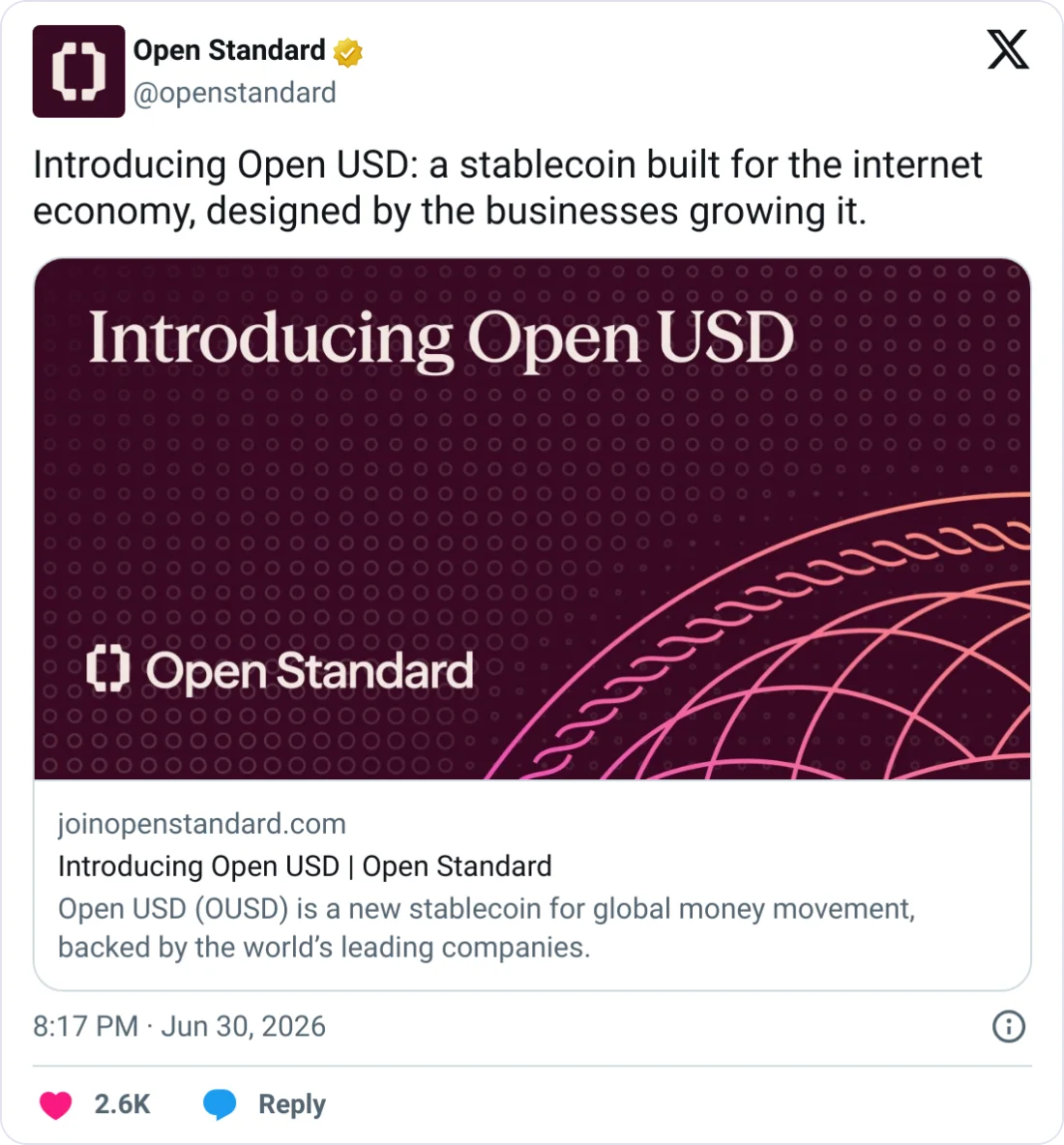
Open Standard announced Open USD, or OUSD, on June 30, 2026, presenting it as a new stablecoin for global payments, internet-native commerce and enterprise digital money movement that will share most reserve earnings with participating businesses, a model that immediately pressured Circle shares and raised questions about USDC’s reserve-income economics.
OUSD is expected to launch later in 2026 with support from payments, banking, technology, crypto and institutional finance companies. More than 140 companies are backing or joining the Open Standard initiative, with named participants including Visa, Stripe, Coinbase, Mastercard, BlackRock, American Express, Discover, BNY, Standard Chartered, Google, Shopify, IBM, Bybit, OKX, MetaMask, Ripple, Galaxy, U.S. Bank and BBVA.
Open Standard’s core pitch is that businesses should be able to mint and redeem OUSD without fees or volume limits while earning revenue tied to the stablecoin’s adoption. Open Standard said most income generated by OUSD reserves will be distributed to participating businesses after a small management or operational fee is deducted.
The model is designed to challenge stablecoin economics in which issuers typically retain significant income from reserves backing circulating tokens. Open Standard said companies joining the network will use OUSD as a core payment asset inside their products and services, receive technical and integration support, and earn revenue based on OUSD adoption.
Open Standard Pitches OUSD as Partner-Owned Payment Infrastructure
OUSD will be managed by an independent organization rather than a single issuer, with governance shared among partner companies. Open Standard’s governance pitch is that major decisions should reflect collective business interests instead of the priorities of one centralized issuer. Open Standard described OUSD as “a stablecoin built for the internet economy, designed by the businesses growing it.”
Open Standard said businesses often face high minting and redemption costs when using existing stablecoins at enterprise transaction volumes. Open Standard also said many firms cannot benefit from stablecoin reserve earnings because those revenues generally remain with centralized issuers. Open Standard said OUSD removes minting and redemption fees while allowing businesses to process transactions without artificial volume limitations across supported networks.
Founding CEO Zach Abrams said businesses require an open, scalable and accessible stablecoin aligned with long-term commercial interests. Abrams also positioned Open USD as a product built specifically for internet-native commerce and enterprise payment infrastructure.
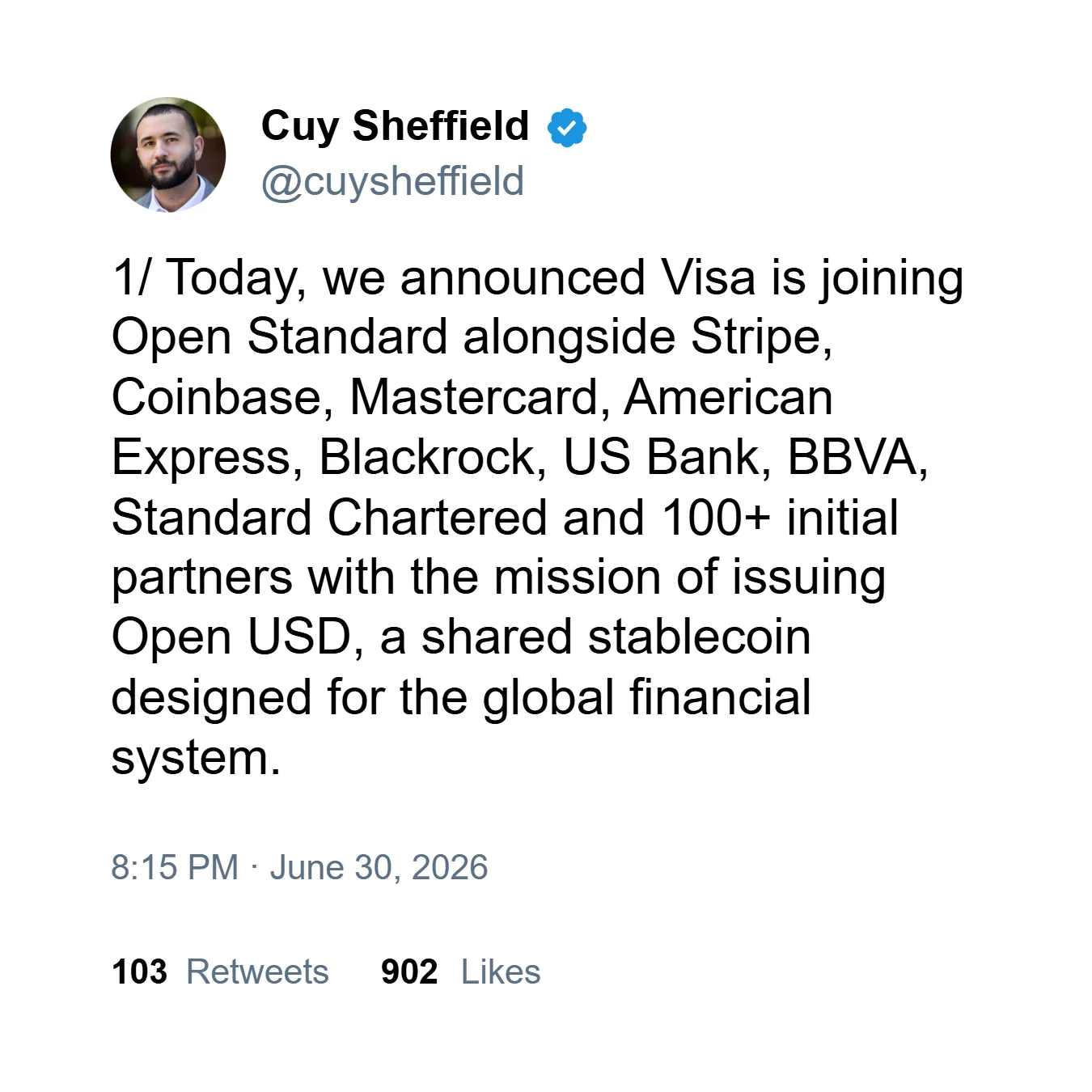
OUSD is expected to launch with native support on Solana. Tempo CEO Matt Huang said Open USD will be “natively issued” on Tempo from day one, with support for payments, liquidity, exchanges and decentralized finance. Open Standard has not clarified whether Tempo will be the exclusive network for native issuance at launch.
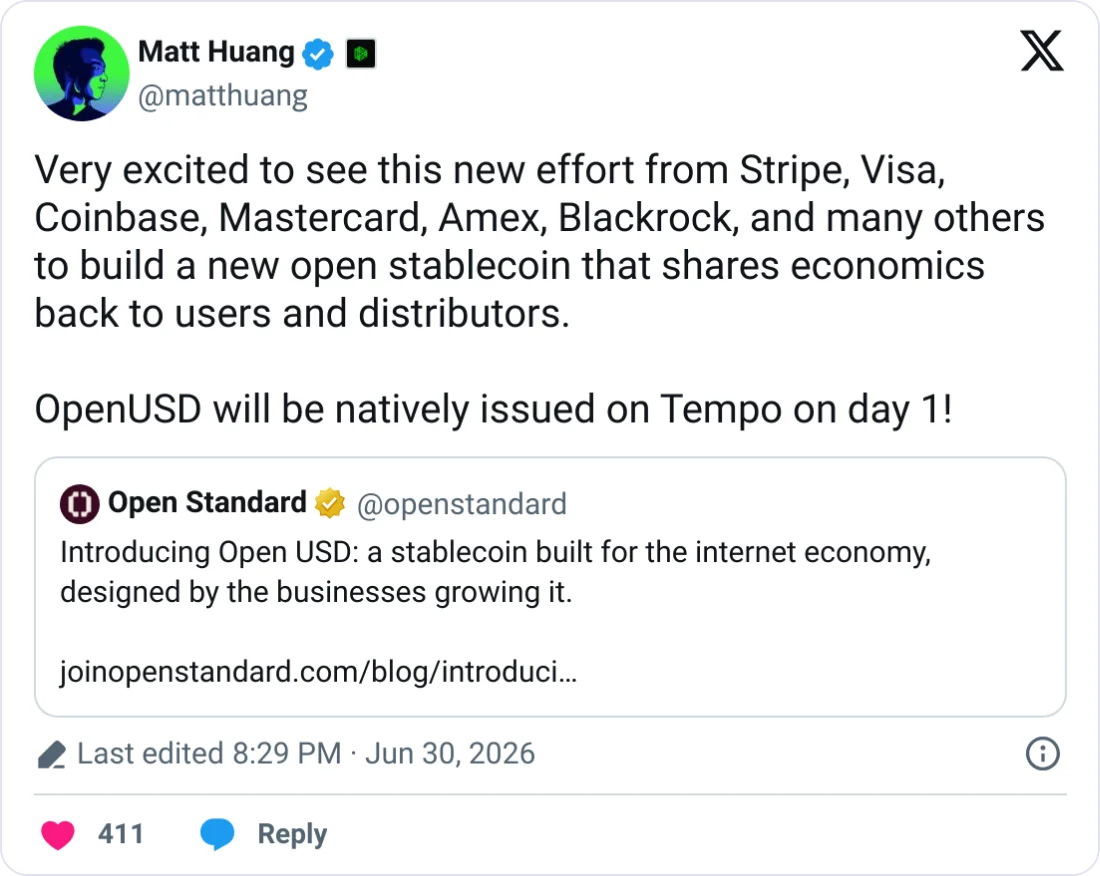
Visa head of crypto Cuy Sheffield wrote on X that Visa was joining Open Standard alongside Stripe, Coinbase, Mastercard, American Express, BlackRock, U.S. Bank, BBVA, Standard Chartered and more than 100 initial partners “with the mission of issuing Open USD, a shared stablecoin designed for the global financial system.”
BlackRock Global Head of Market Development Samara Cohen said trusted infrastructure and practical utility remain essential for stablecoin adoption across digital markets. Cohen said Open USD gives businesses more options for accessing tokenized value through internet-based financial infrastructure.
Coinbase Chief Business Officer Shan Aggarwal described stablecoins as one of the most important developments in modern payments and financial services. Aggarwal said broader industry collaboration could speed up the transition toward faster and more efficient payment networks for businesses and consumers.
Visa Chief Product and Strategy Officer Jack Forestell said reliable governance and operational standards remain critical as stablecoins gain wider adoption. Forestell said Visa plans to contribute its payments infrastructure expertise to strengthen confidence across the Open USD ecosystem.
Mastercard Chief Product Officer Jorn Lambert said shared and interoperable infrastructure is key to bringing stablecoins into the broader financial system. Stripe President of Technology and Business Will Gaybrick said Open USD is intended to become the default stablecoin for businesses using Stripe.
Circle shares sold off sharply after the Open USD reveal, with CRCL falling more than 17.5% on Tuesday, June 30, 2026, as investors reacted to the perceived competitive threat to USDC.
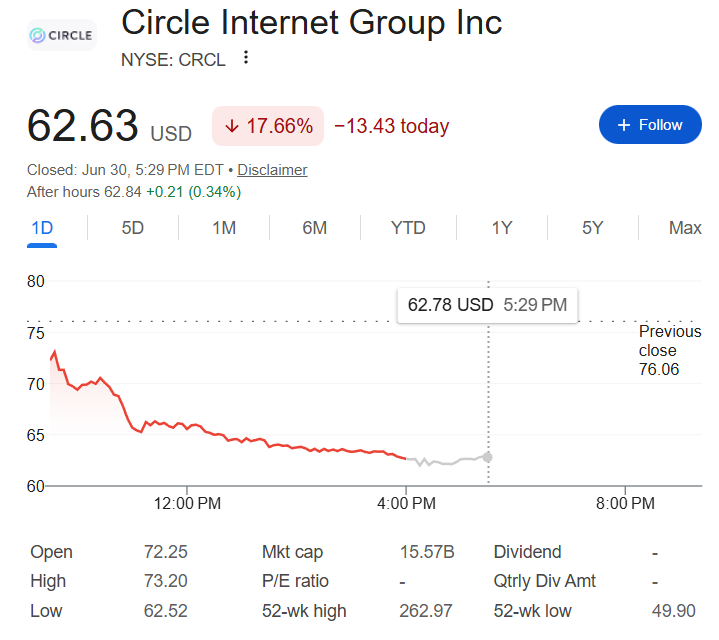
The market reaction centered on one pressure point: OUSD’s partner-revenue model challenges one of Circle’s biggest strengths, its institutional distribution network and reserve-income economics. Circle’s business model relies heavily on retaining interest earned on assets backing USDC, while OUSD proposes to distribute that yield to partners.
The Open Standard launch intensified scrutiny of Circle’s economics and its relationship with Coinbase. Circle and Coinbase jointly founded the Centre Consortium, which originally started USDC issuance. Circle and Coinbase continue to share economics tied to USDC reserve income under a commercial agreement that is reportedly up for renewal in August 2026.
Dragonfly general partner Omar Kanji suggested the announcement makes a potential breakup between Circle and Coinbase look more possible. Kanji still expects the companies to renew their agreement with revised economics while competing in some areas.
Rob Hadick, general partner at venture capital firm Dragonfly, said, “The marquee partner names clearly suggest a real threat to Circle’s business.” Hadick added that Stripe’s broad suite of financial products could give the consortium an edge by allowing it to “uniquely undercut Circle’s economics.”
Hadick warned that execution could be difficult for Open Standard. “Consortiums are hard and they break easily,” Hadick said. “Incentives are broad and often misaligned.” Hadick said Circle’s stock selloff looked “clearly reasonable,” but he does not expect Open Standard to have an easy path to scale and expects the road to be “harder to get to scale than expected.”
We’ve launched the all-new COIN360 Perp DEX, built for traders who move fast!
Trade 130+ assets with up to 100× leverage, enjoy instant order placement and low-slippage swaps, and earn USDC passive yield while climbing the leaderboard. Your trades deserve more than speed — they deserve mastery.
Clear Street managing director Owen Lau said OUSD has “a strong line-up on paper,” which will likely pressure near-term sentiment around CRCL until OUSD launches later this year. Lau said Circle’s 16% Tuesday selloff went too far. “I think it is an overreaction,” Lau said.
Lau pointed to Paxos’ Global Dollar Network, or USDG, as a warning that consortium-backed stablecoins can look strong on paper but still struggle to gain meaningful market share. USDG has grown to a $3 billion supply since launching in late 2024, while USDC has roughly $73 billion in supply and USDT has roughly $145 billion in supply, based on reported market data.
“The bigger question is how OUSD can convince consumers and end users to adopt them,” Lau said. “We don’t really know the answer until it is fully launched so that we can gauge the market cap and usage.”
William Blair said the Circle selloff was an overreaction and reiterated its Outperform rating on Circle. William Blair described the CRCL rout as a buying opportunity and argued that competition in stablecoins is “inevitable” and ultimately validates the sector’s potential.
William Blair analysts Andrew Jeffrey and Adib Choudhury wrote, “We see competitive concerns as overblown.” Jeffrey and Choudhury pointed to USDC’s roughly $74 billion market capitalization, deep liquidity and Circle Payments Network as reasons Circle remains well positioned.
Jeffrey and Choudhury argued that new entrants will struggle to replicate Circle’s model. They were skeptical of Open Standard’s pitch, arguing that Circle already offers similar incentives to partners, and described OUSD as “a solution searching for a problem.”
Jeffrey and Choudhury compared Open USD to past payments consortiums such as MCX and Paze, saying those efforts struggled “to gain traction against established networks.”
Circle, Tether and Market Participants Respond
Circle CEO Jeremy Allaire said shortly after the announcement that USDC remains “the most trusted, widely adopted, institutional-ready stablecoin in the world.” Allaire said Circle will continue investing in its ecosystem across banks, payment companies, capital markets firms and enterprises.
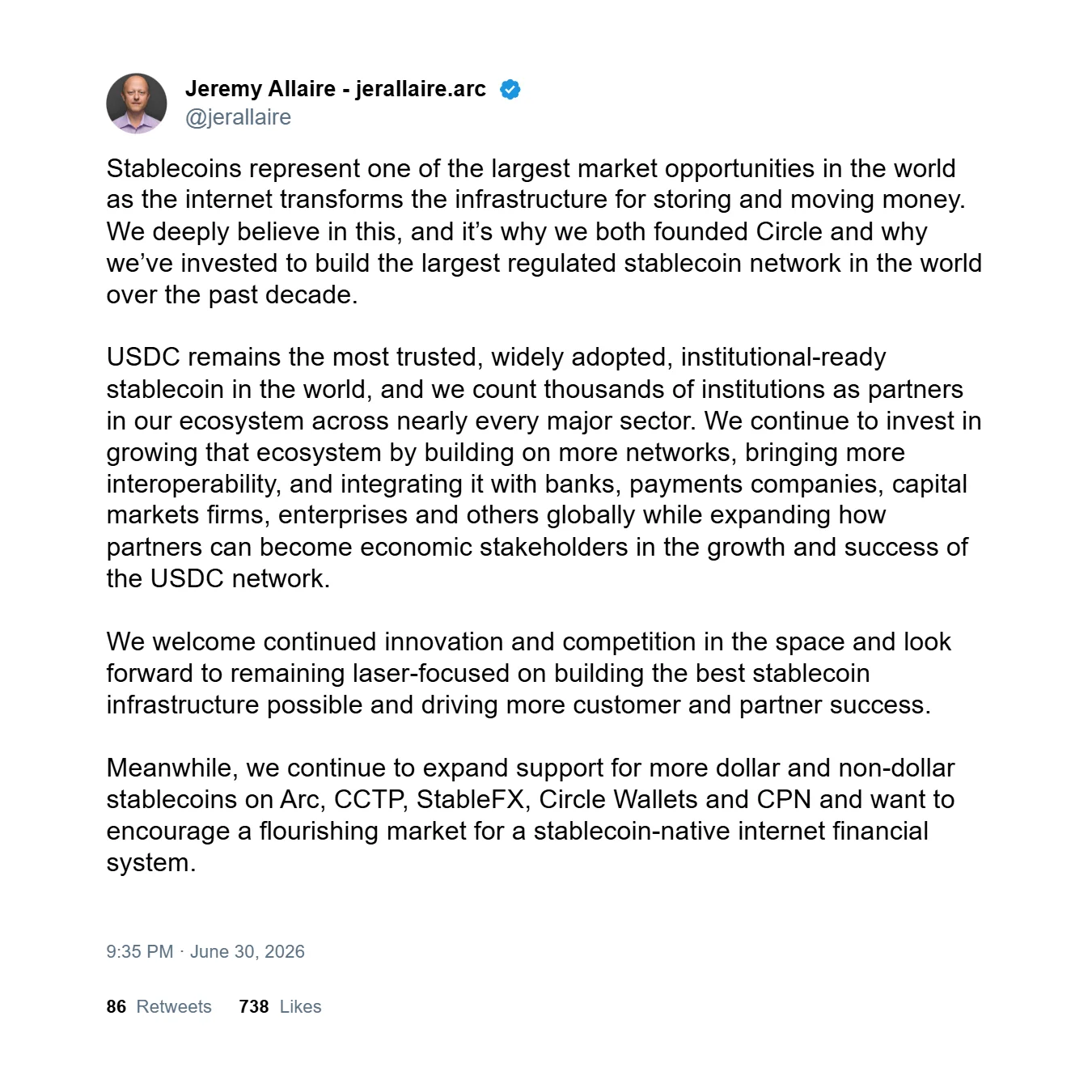
Allaire said Circle will keep giving partners more ways to become “economic stakeholders” in the growth of the USDC network. Allaire welcomed continued innovation and competition and said Circle will keep building infrastructure for a “stablecoin-native internet financial system.”
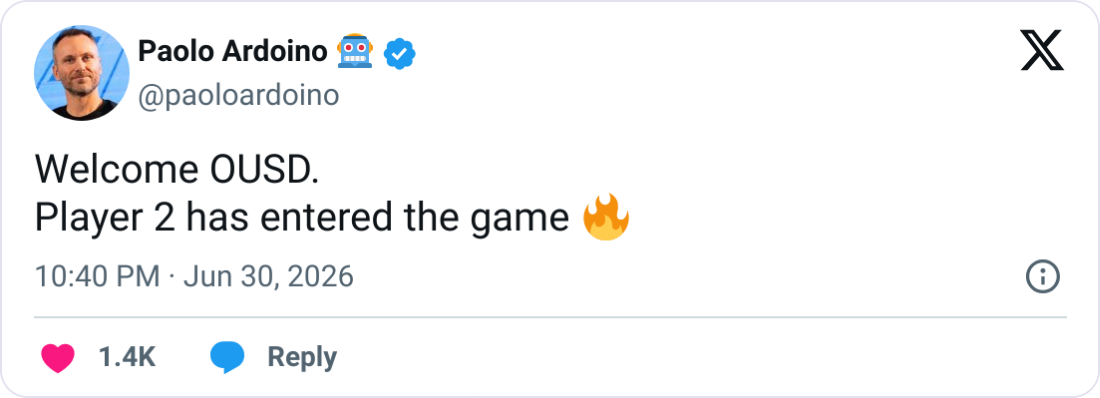
Paolo Ardoino, CEO of Tether, reacted with a short competitive jab: “Welcome OUSD. Player 2 has entered the game.”
Noelle Acheson, author of the Crypto Is Macro Now newsletter, said Open Standard has assembled an impressive list of partners and is led by Bridge co-founder Zach Abrams, “who knows what he’s doing.” Acheson warned that the release is vague on several key issues.
Acheson said unanswered questions remain around Open Standard’s ownership structure, the licensing framework for the issuer, which blockchains Open USD will launch on, and how reserve income will be distributed among partners.
Omid Malekan, an adjunct professor at Columbia Business School, described the announcement as part of the “logo spray and pray” phase of stablecoin adoption. “Putting your name on a list is easy,” Malekan wrote on X. “Actually changing corporate behavior (and business models) is hard.”
Malekan argued that the key question is whether stablecoins can actually improve participants’ bottom lines.
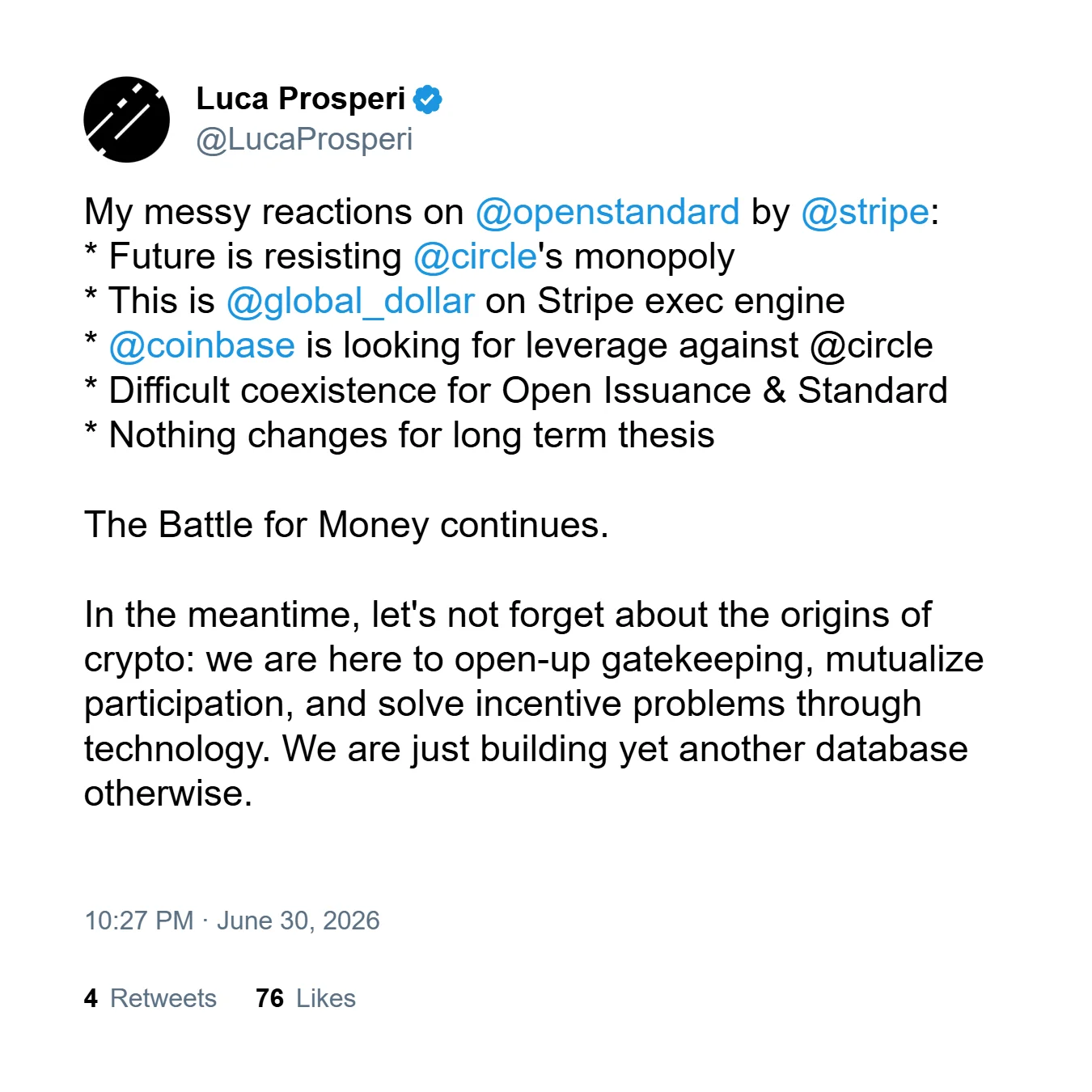
Luca Prosperi, CEO of M0 Foundation, viewed Open USD as another sign that the stablecoin market is moving away from winner-take-all dynamics. Prosperi wrote, “The future is resisting Circle’s monopoly.” Prosperi described the consortium as “Global Dollar on Stripe’s execution engine” and argued that “nothing changes for the long-term thesis.”
Jeff Dorman, CIO of investment firm Arca, said the stablecoin opportunity extends beyond issuers such as Circle and Tether. “The stablecoin opportunity extends far beyond Circle, Tether, or any single issuer,” Dorman said.
Dorman said exchanges, payment firms, wallets, custodians and blockchain networks that distribute and settle digital dollars may also be major winners. Dorman said investors often ask what the next trillion-dollar blockchain use case will be and argued that the answer increasingly appears to be money itself, while it remains difficult to identify the best pure-play investment vehicle.
The core market debate is not whether OUSD has strong partners. The unresolved question is whether those partners will actively route payment volume, liquidity, users and integrations through OUSD rather than merely participating in a consortium.
The launch shows stablecoin competition shifting from pure issuance toward distribution control. Exchanges, wallets, payment processors, fintech platforms, custodians, banks and chain infrastructure providers are strategically important because they control where users hold, spend, swap, settle and redeem digital dollars.
OUSD’s model looks attractive to enterprises because it turns stablecoin adoption into a potential revenue line instead of only a payments utility. The model also creates a direct incentive for distribution partners to push OUSD inside their own products, because adoption could translate into reserve-revenue sharing.
The risk is that broad partner lists can create governance friction, slow decisions and misaligned incentives. The major strategic tension is that Open Standard wants to decentralize governance and economics among partners, while stablecoin users still need simple, trusted, liquid and reliable money rails.
Circle’s defensive case rests on USDC’s liquidity, market depth, institutional readiness, existing payment infrastructure and long-running network effects. OUSD’s offensive case rests on better partner economics, heavyweight distribution partners, fee-free minting and redemption, and a governance model that promises shared control.
The biggest adoption test for OUSD will be whether its launch partners actively make it a default payment, liquidity, exchange, decentralized finance or checkout asset inside their platforms. A second adoption test will be whether end users care, because partner economics matter only if users find the stablecoin liquid, accepted, cheap, trusted and frictionless.
A third adoption test will be regulatory and structural clarity, because the announcement leaves questions around issuer licensing, ownership, chain deployment and reserve-income allocation. A fourth test will be whether OUSD can avoid the fate of past payment consortiums that looked powerful at launch but failed to displace entrenched networks.
Open USD is not just another stablecoin launch. It is an attempt to turn stablecoin reserve income into a shared distribution incentive for the companies that move digital dollars. The market story extends beyond Circle’s one-day stock drop, because OUSD signals that stablecoin power may be moving from issuers alone toward platforms that control users, payments, wallets, checkout, exchange liquidity and settlement flow.
Circle is not shown to have lost its stablecoin position, but the announcement challenges the idea that issuers can rely on easy reserve-margin capture without sharing more economics with major distribution partners. OUSD may not win quickly, but it pressures every issuer to explain why partners should help grow a stablecoin network without directly sharing more of the upside.
Open USD Faces Questions Over Partner Consent
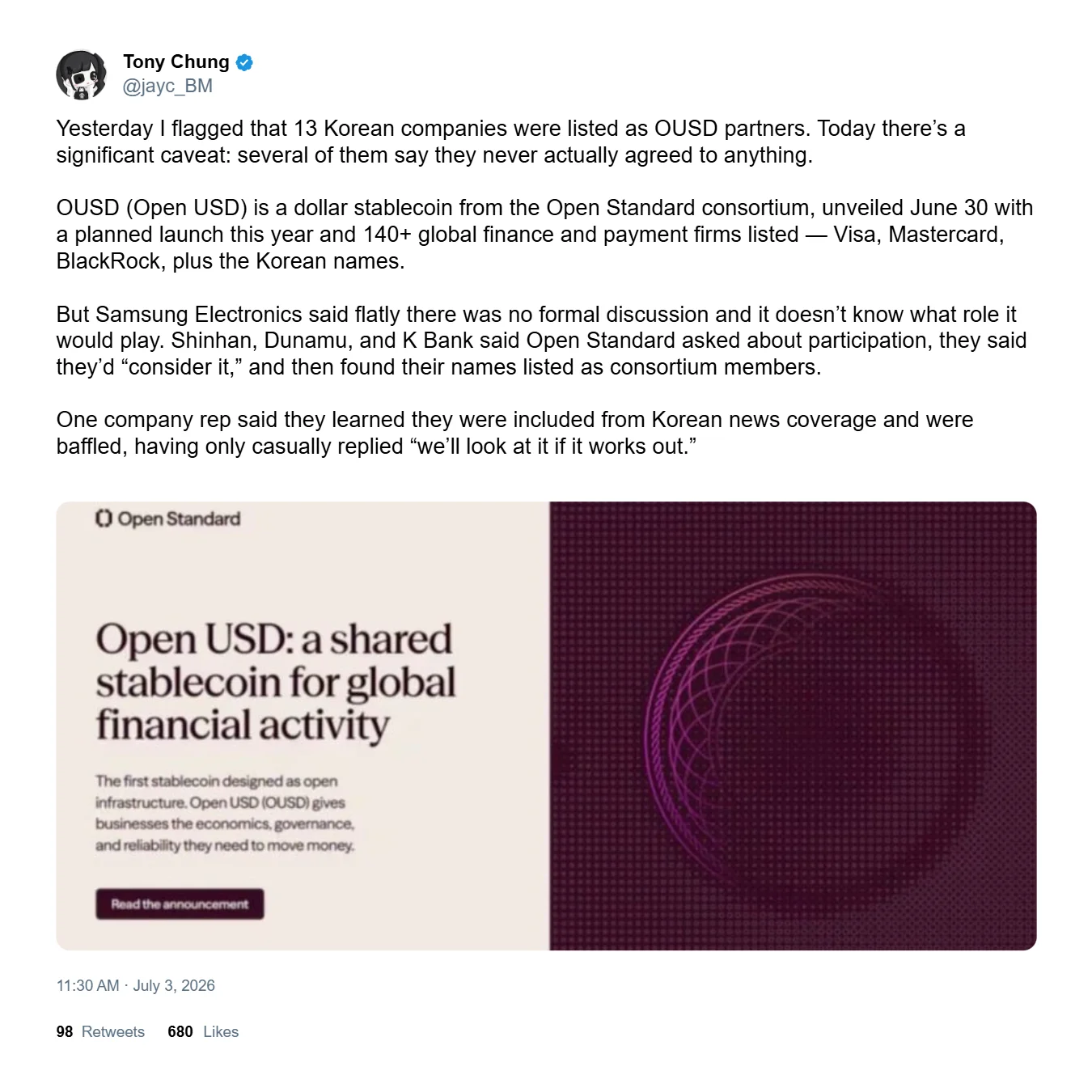
Open Standard’s partner list is now facing new scrutiny after allegations that some companies were included in the OUSD consortium announcement without formally approving their participation. Blockmedia’s Tony Chung said 13 Korean firms were identified as Open USD partners, but some did not understand why their names appeared in the announcement. “Samsung Electronics said flatly there was no formal discussion and it doesn’t know what role it would play. Shinhan, Dunamu, and K Bank said Open Standard asked about participation, they said they’d ‘consider it,’ and then found their names listed as consortium members,” Chung said. He added that some companies learned about their supposed involvement through Korean media and were “baffled.”
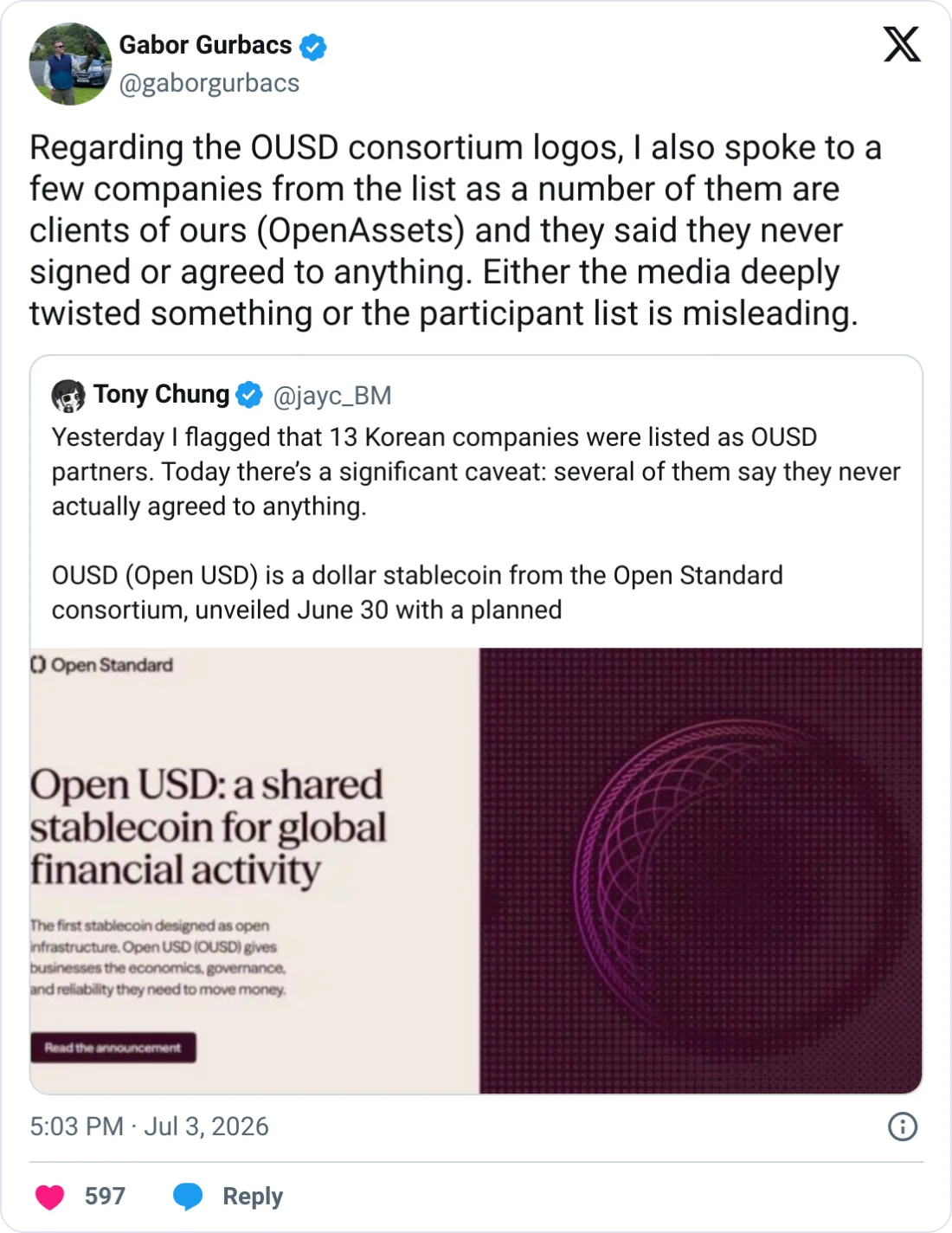
Tether advisor Gabor Gurbacs said some listed partners told him they never signed or agreed to anything. “Either the media deeply twisted something or the participant list is misleading,” Gurbacs said. He added that one company described only preliminary discussions about possible future interaction if Stripe and Visa changed their terms.
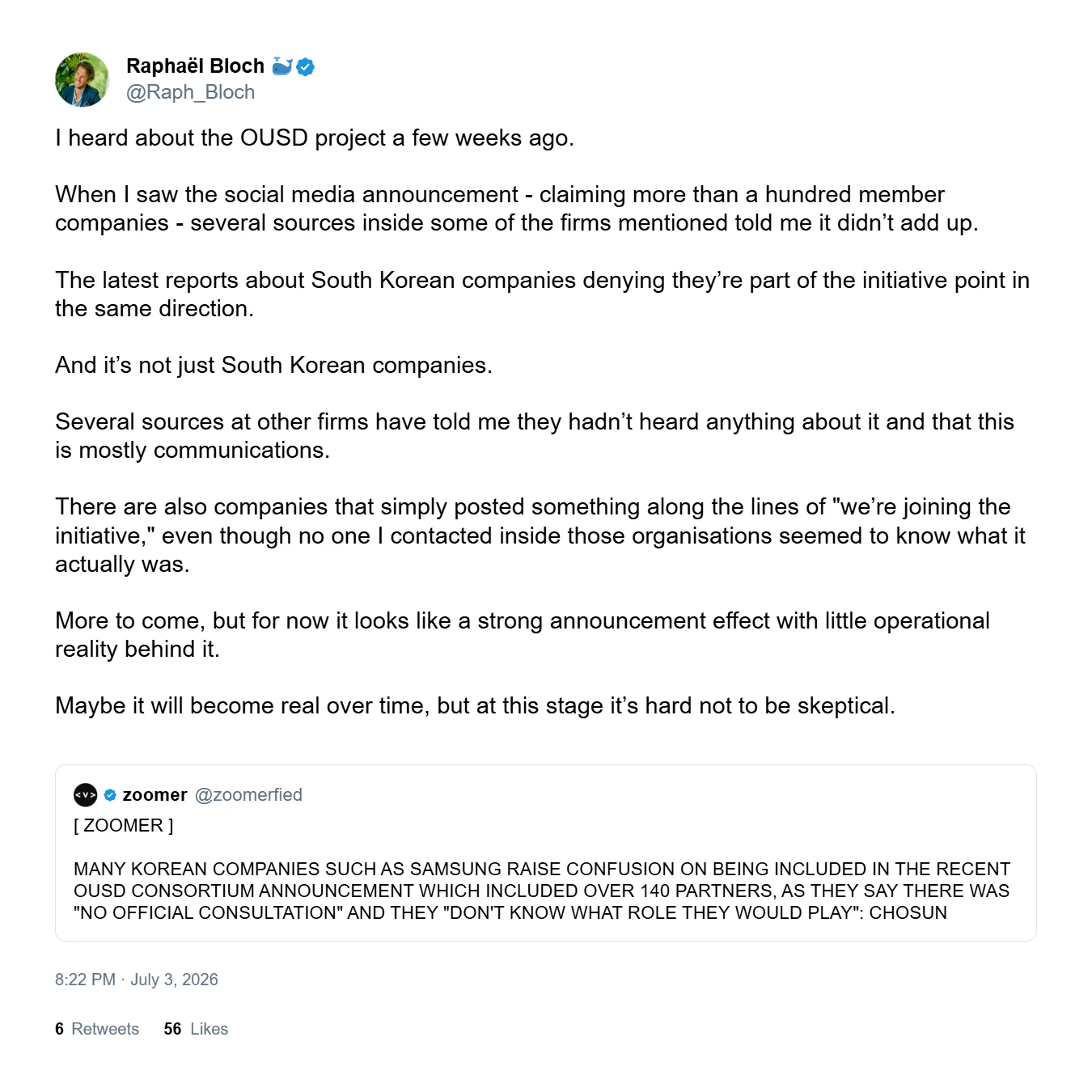
The Big Whale CEO Raphaël Bloch said “no one inside the institutions knew what the initiative really was,” calling it “a strong announcement effect with little operational reality behind it.”
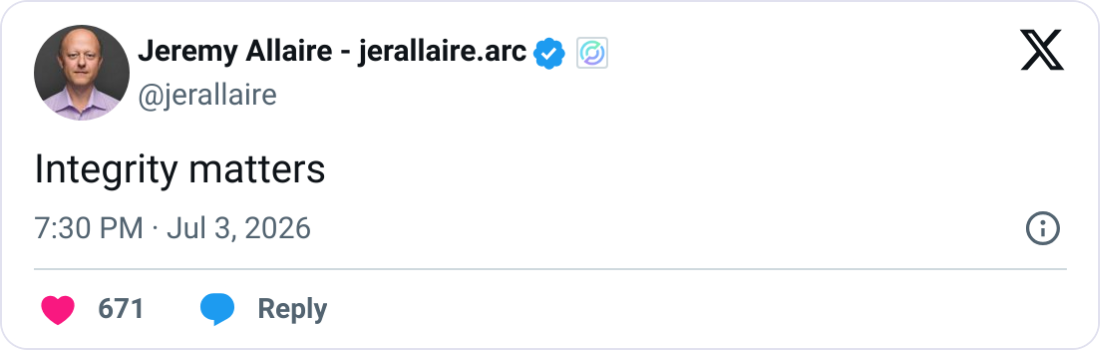
Circle CEO and co-founder Jeremy Allaire responded, “Integrity matters.”
FAQ
What is Open USD?
Open USD, or OUSD, is a planned stablecoin announced by Open Standard.
When is OUSD expected to launch?
OUSD is expected to launch later in 2026.
Why did Circle shares fall?
Investors reacted to OUSD’s potential challenge to Circle’s USDC reserve-income economics.
What remains unresolved about OUSD?
Ownership, issuer licensing, supported blockchains and reserve-income distribution remain unclear.
This article has been refined and enhanced by ChatGPT.


