




 USD
USD
Pakistan Ends 2018 Crypto Banking Ban With Licensed VASP Rules

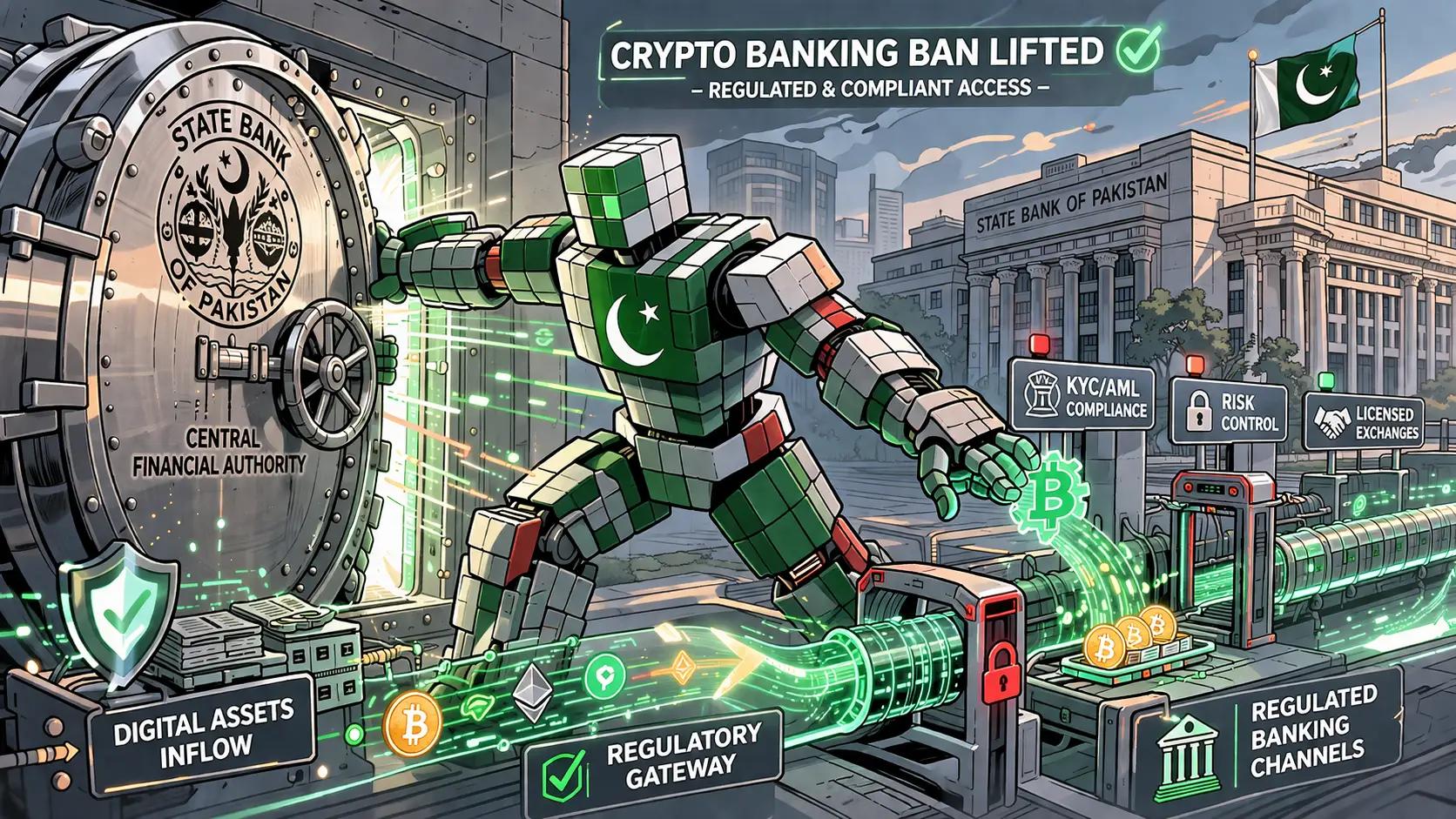
New framework opens bank access while barring direct crypto exposure for lenders
TL;DR
- Pakistan ended its 2018 crypto banking ban on April 14, 2026, and replaced it with a regulated framework for licensed Virtual Asset Service Providers.
- Banks can open accounts for licensed VASPs, but client funds must stay in segregated, non-interest-bearing Pakistani rupee accounts.
- The framework pairs bank access with strict licensing, AML controls, Sharia compliance requirements, and criminal penalties for unlicensed activity.
We’ve launched the all-new COIN360 Perp DEX, built for traders who move fast!
Trade 130+ assets with up to 100× leverage, enjoy instant order placement and low-slippage swaps, and earn USDC passive yield while climbing the leaderboard. Your trades deserve more than speed — they deserve mastery.
Pakistan ended its eight-year crypto banking ban on April 14, 2026, replacing the 2018 prohibition with a regulated structure that allows banks to serve licensed Virtual Asset Service Providers under the Virtual Assets Act 2026 and the Pakistan Virtual Assets Regulatory Authority.
The new system allows banks to open accounts for licensed VASPs, but it does not permit banks to take direct crypto risk. Client Money Accounts must be segregated, held in Pakistani rupees, and kept as non-interest-bearing accounts. VASP funds cannot be mixed with other client money, while cash deposits and withdrawals are prohibited.
Banks also remain barred from trading, investing in, or holding crypto either on their own balance sheets or with customer deposits. Their role under the framework is limited to servicing licensed crypto firms and monitoring those relationships for compliance with Pakistan’s anti-money-laundering and risk-control requirements.
The regulatory change moves a large existing market into a formal structure. The domestic crypto market was estimated at between $21 billion and $25 billion, with the framework aimed at shifting peer-to-peer trading, exchange activity, and remittance flows into licensed and traceable financial channels.
Licensing, compliance, and enforcement
The licensing system is structured in two stages. Stage one provides a No-Objection Certificate within 60 days of a complete application. Stage two requires full incorporation in Pakistan under the Companies Act 2017, along with IT and cybersecurity documentation and a full AML/CFT framework.
Licensed VASPs are classified as Financial Institutions under the AML Act 2010, placing them inside the same oversight perimeter as banks. Each licensed VASP must also maintain a Sharia compliance board, while the Travel Rule applies to every transaction above Rs. 1 million and requires full originator and beneficiary information.
The framework also requires records to be retained for 10 years. Operating without a license carries criminal penalties of up to five years in prison and fines of PKR 50 million.
Pakistan’s broader digital-asset push extends beyond the banking change. The Ministry of Finance signed a memorandum of understanding with Binance to explore tokenizing up to $2 billion in government-backed real-world assets, and Binance and HTX have already been involved in licensing discussions.
Another part of that effort involves SC Financial Technologies, which was described as affiliated with World Liberty Financial and in discussions around USD-linked stablecoins for international remittances. Reports suggested that Pakistan’s government had previously met with World Liberty Financial leadership, later signed an MOU with the firm, and positioned its dollar-pegged stablecoin USD1 for an initial focus on cross-border payments.
The policy shift is also tied to wider state-backed digital finance plans, including exploration of a central bank digital currency pilot and potential strategic Bitcoin reserves. Cited tax treatment set capital gains tax at 15%, rising to 20% under IMF-backed fiscal reforms.
The final confirmed change is narrow but clear: Pakistan did not authorize unrestricted crypto activity for banks, but replaced the earlier ban with a controlled regime that gives licensed VASPs access to banking services under strict segregation, licensing, monitoring, and enforcement rules.
FAQ
What changed on April 14, 2026?
Pakistan replaced its crypto banking ban with a regulated framework for licensed VASPs.
Can Pakistani banks now hold or trade crypto?
No. Banks remain barred from trading, investing in, or holding crypto.
What accounts can licensed VASPs use?
Segregated, non-interest-bearing Client Money Accounts denominated in Pakistani rupees.
What is the penalty for operating without a license?
Up to five years in prison and fines of PKR 50 million.
This article has been refined and enhanced by ChatGPT.


