




 USD
USD
Polymarket Resolves Strategy Bitcoin Sale Dispute

UMA Vote Splits May and June Market Outcomes
TL;DR
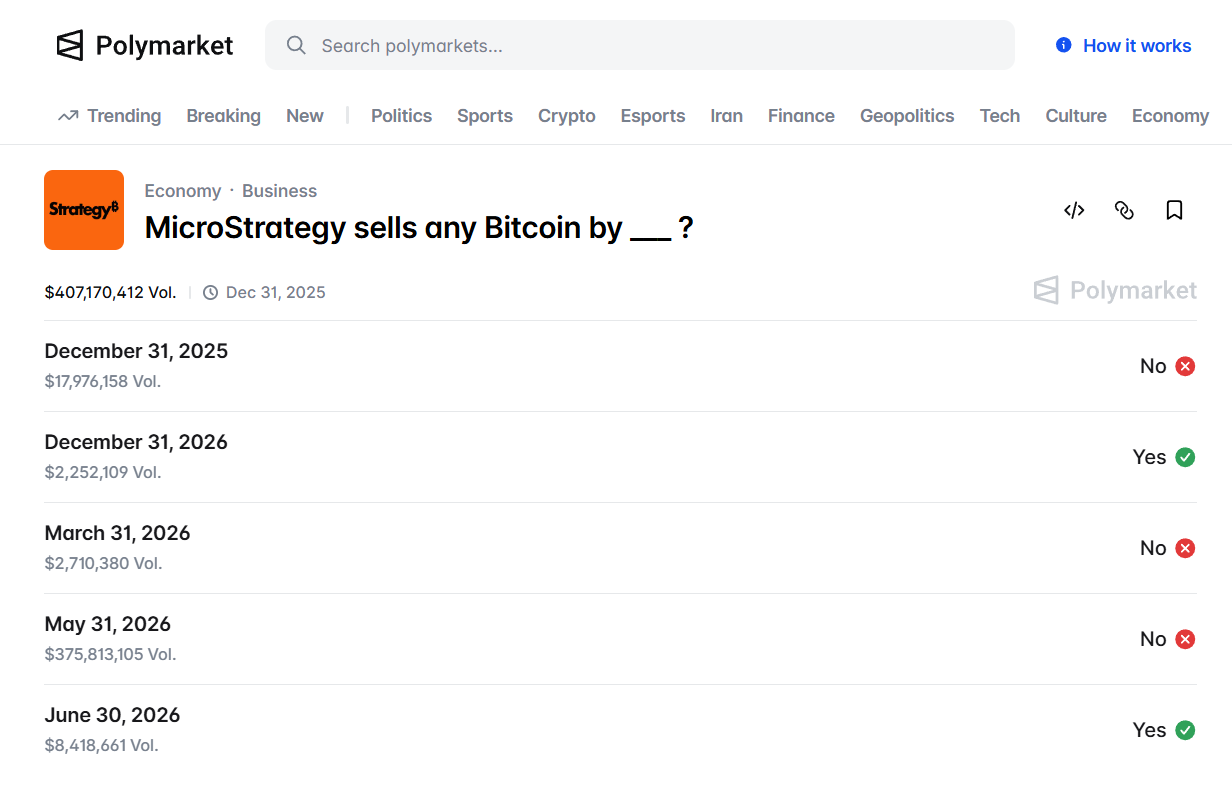
- Polymarket resolved the May Strategy Bitcoin sale market as “No” and the June market as “Yes.”
- Strategy disclosed on June 1 that it sold Bitcoin during the final week of May.
- Galaxy Research argued the May market should have resolved to “Yes” based on Strategy’s SEC filing.
Trade smarter on Jupiter, Solana’s leading DEX built for fast execution and deep liquidity.
Swap tokens at competitive rates, route across multiple liquidity sources automatically, and access perpetuals, DCA, and advanced trading tools — all in one place!
Polymarket’s disputed Strategy Bitcoin sale markets ended with a split outcome after UMA voters treated Strategy’s public disclosure date as decisive, resolving the May contract as “No” and the June contract as “Yes” despite Strategy saying the Bitcoin sale occurred before the May cutoff.
Strategy disclosed in a June 1 SEC filing that it sold 32 Bitcoin between May 26 and May 31. The sale was described as Strategy’s first Bitcoin sale in more than three years, making the event notable because the company is widely associated with Bitcoin accumulation rather than selling.
The dispute centered on a Polymarket question asking whether Strategy, formerly MicroStrategy, would sell any of its Bitcoin holdings by May 31. Traders who backed “Yes” argued the sale clearly happened before the deadline because Strategy’s filing placed the transaction window in the final week of May.
The other side argued that the sale did not become publicly known until June 1. Under that reading, the transaction should not count toward the May contract, even if Strategy later said the sale itself happened before the deadline.
Disclosure Timing Decided the Market
Polymarket ultimately resolved the May 31 contract as “No” and the June 30 contract as “Yes.” The outcome meant May “Yes” bettors lost, while the June market counted Strategy’s June 1 disclosure as the relevant event.
The practical dispute was not whether Strategy sold Bitcoin. The question was whether the market should resolve based on the actual transaction date or the date when the transaction became publicly verifiable through the company’s disclosure.
UMA token holders served as the dispute-resolution layer for Polymarket’s oracle system. The final resolution came after UMA network validators heavily supported the “No” outcome for the May contract.
The decision intensified criticism because the May market had attracted substantial trading activity. The result redistributed payouts across a large prediction pool and turned what looked like a timing question into a dispute over oracle rules.
We’ve launched the all-new COIN360 Perp DEX, built for traders who move fast!
Trade 130+ assets with up to 100× leverage, enjoy instant order placement and low-slippage swaps, and earn USDC passive yield while climbing the leaderboard. Your trades deserve more than speed — they deserve mastery.
Large UMA Voters Drew Scrutiny
The voting outcome also drew attention because several large UMA holders had significant influence over the final result. The biggest “No” vote came from borntoolate.eth, while UMA contributor Kevin Chan also backed the “No” side.
Several wallets identified as affiliated with Risk Labs, the company behind UMA, also voted “No,” along with other prominent UMA ecosystem participants. That detail added to concerns about whether the final resolution reflected broad decentralized agreement or the voting power of a concentrated group of holders.
One account of the dispute said this concentration “undercuts the core promise of decentralized finance,” because governance is supposed to be democratized rather than led by a few large holders.
Galaxy Research, which had significant exposure to the May contract, challenged the result on X. Galaxy Research argued that Strategy’s filing showed the sale happened inside the May window and that the resolution criteria should focus on when the sale occurred.
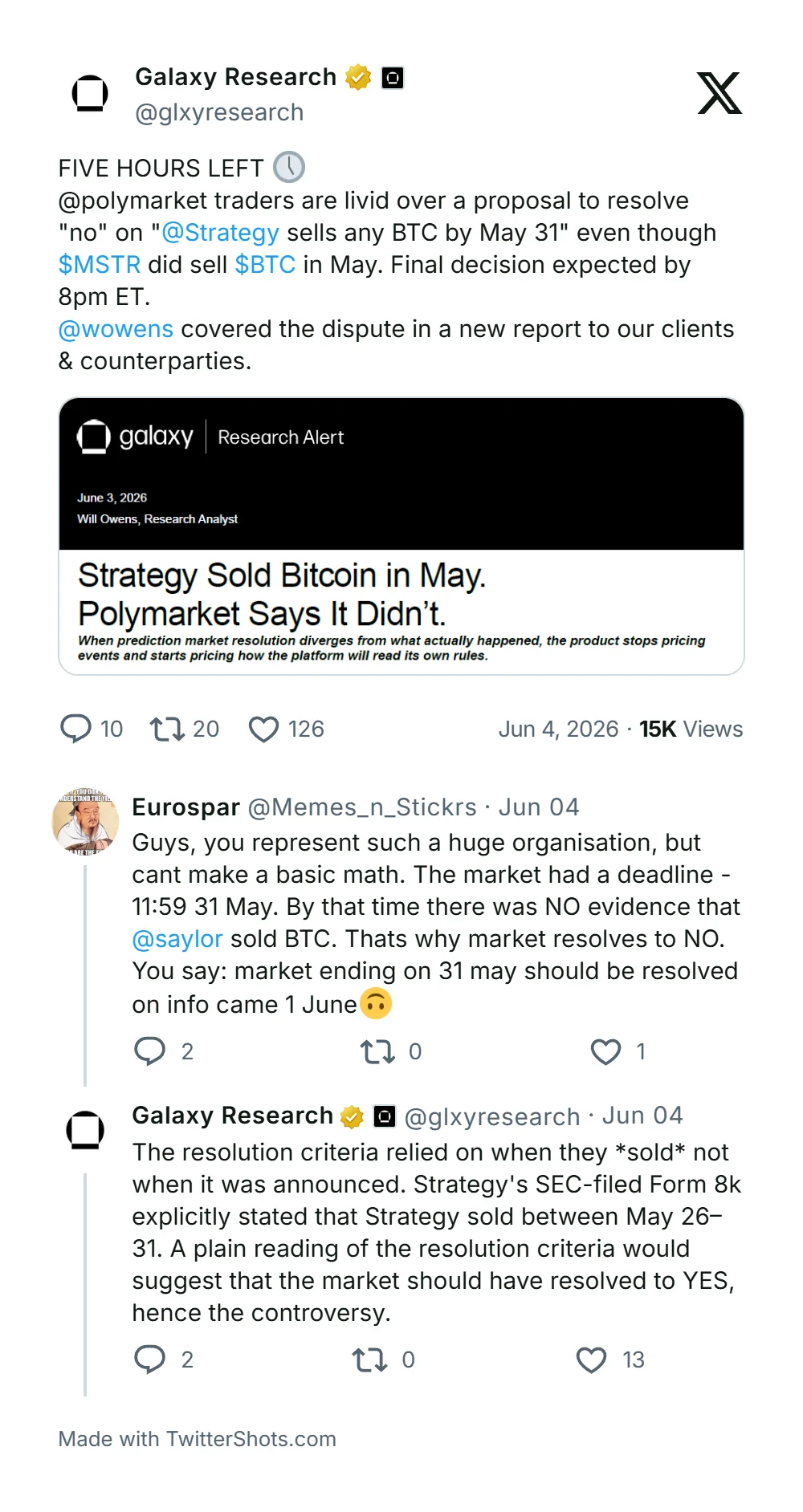
“Strategy's SEC-filed Form 8k explicitly stated that Strategy sold between May 26–31. A plain reading of the resolution criteria would suggest that the market should have resolved to YES, hence the controversy,” Galaxy Research said.
The quote sharpened the central dispute. Galaxy Research did not dispute the existence of the filing or the sale. Instead, it argued that the plain reading of the market should have followed the transaction period stated in Strategy’s SEC-filed Form 8-K.
Rule Wording Became the Flashpoint
The controversy exposed a gap between event timing and settlement timing. Traders backing the May “Yes” side focused on when Strategy sold Bitcoin, while the final market resolution treated publicly available proof and disclosure timing as decisive.
The dispute also showed how prediction markets can settle based on oracle interpretation rather than a simple reading of a real-world event. When market wording does not clearly define whether a deadline refers to transaction timing, filing timing or public disclosure timing, the final answer can turn on governance rather than chronology.
Polymarket defended the final choice by saying results after the strict deadline did not meet the criteria. The platform’s interpretation leaned toward information that could be publicly verified during the agreed timeframe.
The market’s resolution ended the payout dispute but left unresolved questions about how future contracts should be written. A more precise market could specify whether the deadline refers to the actual transaction date, the official filing date, the public announcement date, or the first verifiable source available before expiry.
The Strategy Bitcoin sale dispute therefore became a test of prediction-market infrastructure. It showed that the financial result of a market can be settled while trust in the interpretation remains contested.
FAQ
Why did the May market resolve “No”?
UMA voters treated the June 1 disclosure timing as decisive.
Why did the June market resolve “Yes”?
The sale became publicly disclosed on June 1.
What did Galaxy Research argue?
Galaxy Research said Strategy’s filing showed the sale occurred between May 26–31.
What remains unresolved?
Whether future markets should prioritize transaction dates or public disclosure dates.
This article has been refined and enhanced by ChatGPT.


