




 USD
USD
Polymarket’s Winner-Take-Most Reality Emerges as 70% of Traders Lose Money While 2026 Bets Gain Momentum


On-chain data exposes extreme profit concentration as prediction markets expand beyond crypto-native users
TL;DR
- Roughly 70% of Polymarket traders ended up losing money, while less than 0.04% captured over 70% of total profits.
- Only about 5% of users made more than $1,000, underscoring how rare consistent profitability is on prediction markets.
- Despite skewed outcomes, prediction markets are gaining mainstream traction, with 2026 bets spanning politics, sports, and global events.
We’ve just launched the all-new COIN360 Perp DEX, built for traders who move fast!
Trade 130+ assets with up to 100× leverage, enjoy instant order placement and low-slippage swaps, and earn USDC passive yield while climbing the leaderboard. Your trades deserve more than speed — they deserve mastery.
Fresh on-chain analysis of Polymarket reveals a stark imbalance between participation and profitability, even as prediction markets continue their push into the financial mainstream. Research published in late December 2025 shows that approximately 70% of all Polymarket trading addresses realized net losses once positions were settled, while profits were overwhelmingly concentrated among a tiny cohort of top performers. Out of roughly 1.7 million addresses analyzed, fewer than 30% ended in profit, and the bulk of those gains flowed to an elite fraction of users with outsized positions, superior timing, or systematic trading strategies.
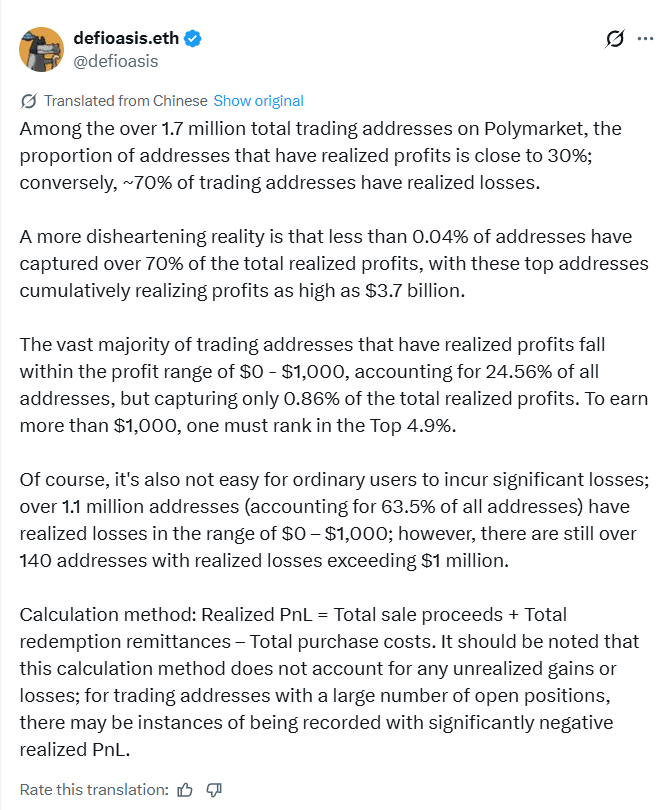
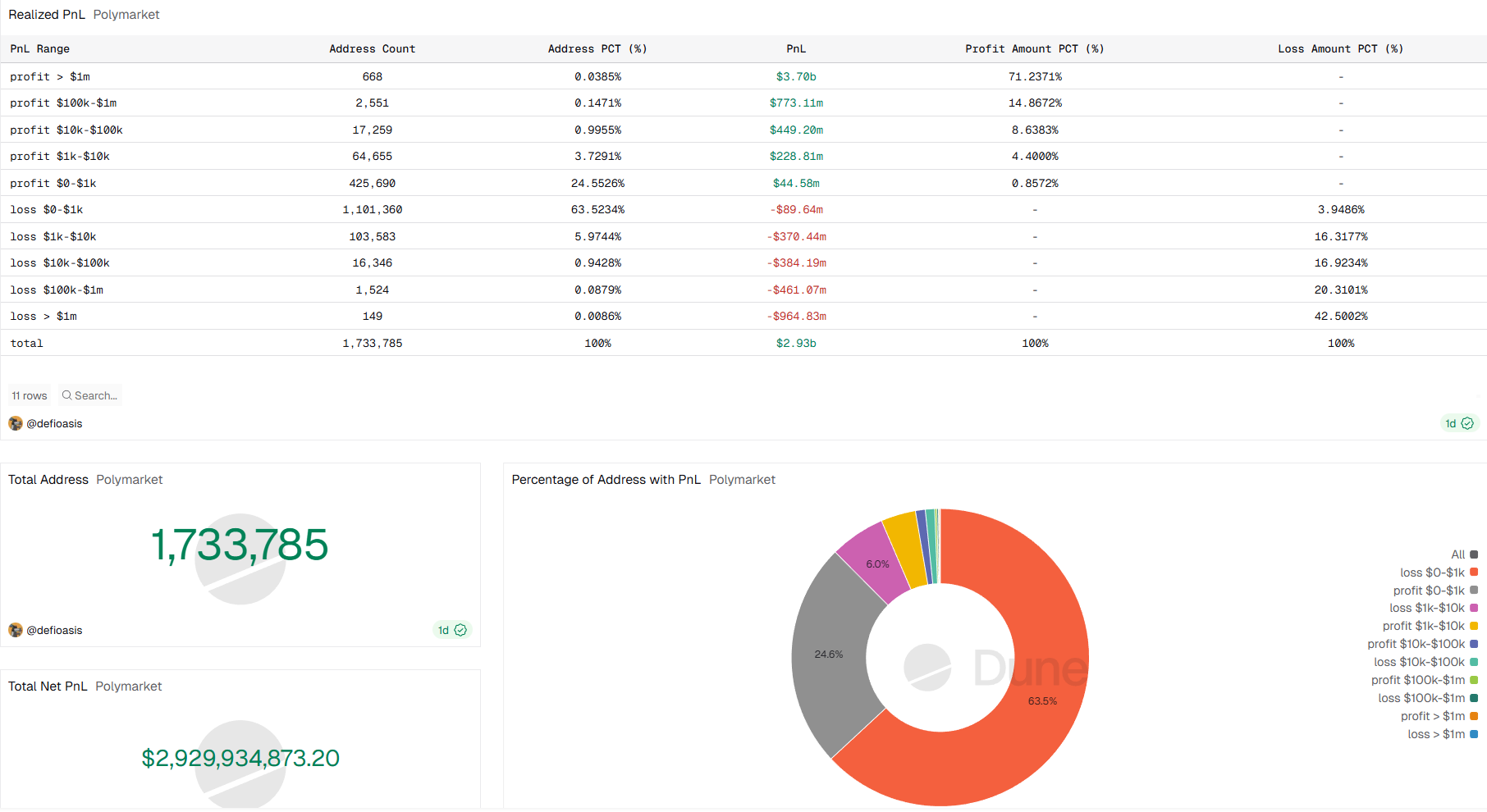
Profit concentration proved especially severe at the top of the distribution. Fewer than 0.04% of all addresses—about 0.0385%—captured more than 70% of total realized profits, equivalent to roughly $3.7 billion. Only 668 addresses recorded gains exceeding $1 million each, while meaningful profitability remained elusive for the vast majority of participants. Nearly a quarter of all addresses managed to eke out small gains between $0 and $1,000, yet this group accounted for less than 1% of total profits, highlighting how marginal most “winning” outcomes were in aggregate terms. Analysts noted that traders typically needed to rank within the top 4.9% of all participants to clear even $1,000 in realized profit.
Losses, by contrast, were widespread but generally modest. More than 63% of losing addresses dropped less than $1,000, suggesting that many users treated prediction markets as low-stakes speculation rather than a primary trading strategy. At the extreme end, however, risk cut both ways. Roughly 149 addresses lost more than $1 million each, underscoring that large capital deployments can amplify downside just as easily as upside. The analysis focused strictly on realized gains and losses, meaning open positions with unrealized profits or losses were excluded, a nuance that may slightly understate outcomes for traders still holding unsettled bets.
These findings land at a moment when prediction markets are growing rapidly in both visibility and volume. Polymarket has seen surging user activity, with monthly active traders nearing 463,000 and volumes hitting record highs following its return to U.S. availability after regulatory settlements. Investor interest has followed suit, pushing Polymarket’s post-money valuation toward an estimated $9 billion and drawing backing commitments tied to traditional market infrastructure players. Public debate around the platform has also intensified, with figures such as Ethereum co-founder Vitalik Buterin defending prediction markets as tools for accountability and information aggregation, even as critics question the ethics of betting on sensitive global events.
At the same time, user behavior points to expanding ambitions for prediction markets in 2026. Data summarized by Bankless shows active markets covering everything from the FIFA World Cup and the Super Bowl to U.S. political outcomes. Spain currently leads World Cup winner odds among traders, while the probability of a U.S. presidential impeachment before the end of 2026 sits in the mid-teens. Industry forecasts suggest weekly volumes across major prediction platforms could stabilize above $1 billion next year, driven by broader participation, improved liquidity, and deeper institutional involvement.
This article has been refined and enhanced by ChatGPT.


