




 USD
USD
Prediction Markets Emerge as Crypto’s World Cup Onboarding Layer

Bitget Wallet Says New Bettors Are Entering Onchain Markets Through Polymarket
TL;DR
- Bitget Wallet found that about 60% of Polymarket users placing their first World Cup bets had no prior onchain trading history.
- Prediction-market activity surged during the World Cup, with sports contracts becoming the leading trading category on major platforms.
- U.S. regulators and states are challenging whether sports-focused prediction markets should be treated as event contracts or unlicensed betting products.
Trade smarter on Jupiter, Solana’s leading DEX built for fast execution and deep liquidity.
Swap tokens at competitive rates, route across multiple liquidity sources automatically, and access perpetuals, DCA, and advanced trading tools — all in one place!
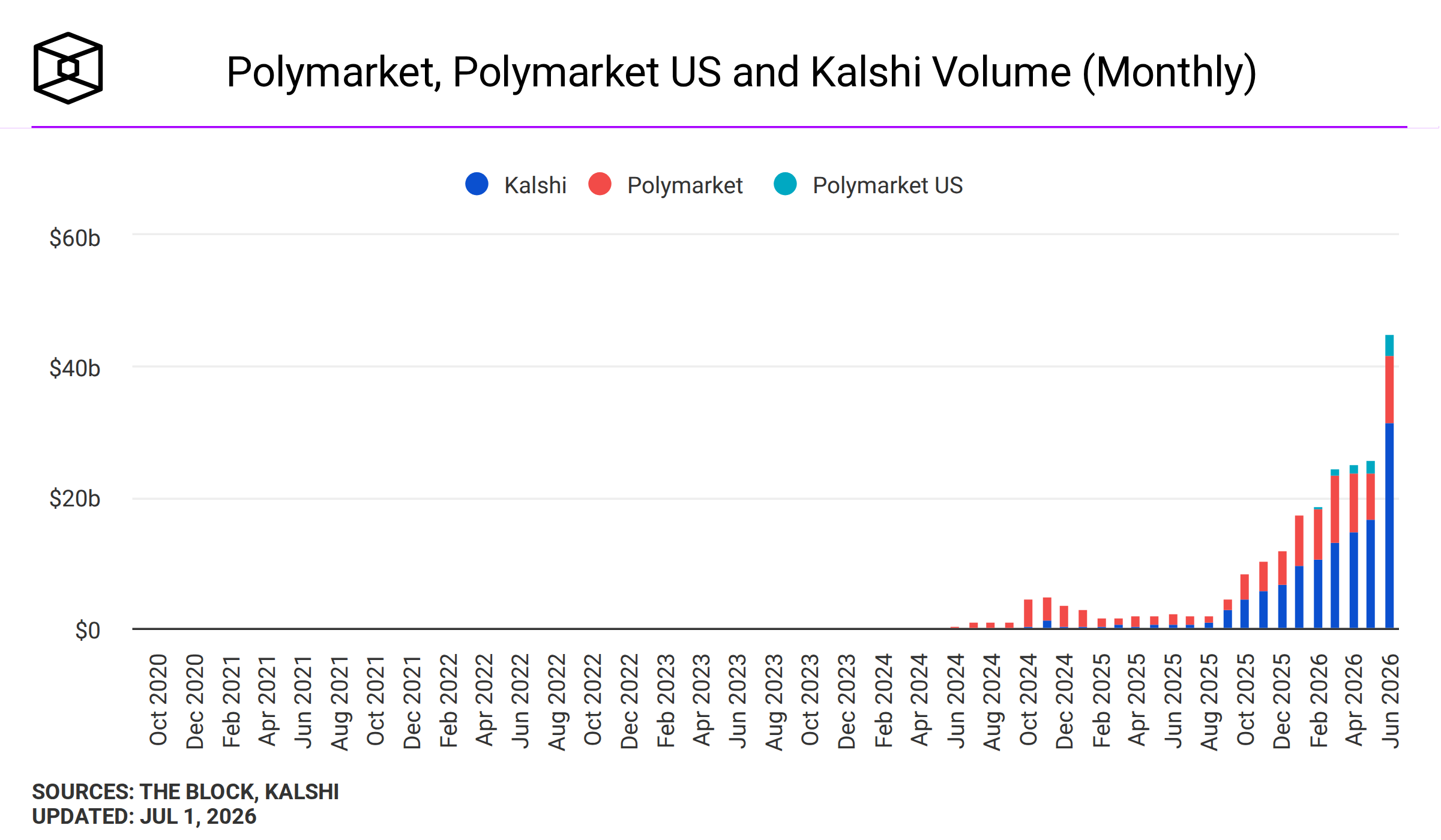
According to The Block, Kalshi, Polymarket, and Polymarket US combined for $44.8 billion in monthly trading volume in June, up 75% from May’s $25.66 billion, driven largely by FIFA World Cup 2026 betting activity. Kalshi led the growth, increasing 87.4% month over month to $31.5 billion from $16.81 billion. Polymarket’s main (non-U.S.) platform generated $10.26 billion in volume, a 45% rise from $7.08 billion in May. Polymarket US climbed to $3.04 billion, up from $1.77 billion, after Polymarket’s overall volume had declined from March through May while the U.S.-regulated segment trended upward.
The World Cup Winner market on Kalshi attracted more than $832 million, with roughly 35% of bets backing France. On Polymarket, event contracts for individual matches drew $500,000 to $2 million each, with the tournament set to end July 19.
Prediction markets are becoming a major crypto onboarding channel, with Bitget Wallet finding that about 60% of users who placed their first World Cup bets on Polymarket had no prior blockchain or onchain trading history before using the platform.
Bitget Wallet said the data showed that prediction markets are drawing users directly into crypto through consumer-facing applications rather than through token trading, decentralized exchanges or DeFi protocols.
Bitget Wallet based the findings on a 90-day study of 857,000 active Polymarket users. The company said the results suggest prediction markets are becoming an application-level onboarding layer, where users arrive because they want to express a view on sports, politics or macroeconomic events while blockchain infrastructure remains mostly behind the interface.
Alvin Kan, chief operating officer at Bitget Wallet, said earlier crypto onboarding efforts focused on making blockchain easier to understand through simpler wallets and better interfaces, while still requiring users to learn how crypto worked before participating. “Prediction markets shifted that dynamic. Users show up because they have a view on something happening in the world,” Kan said.
Kan also said prediction markets are changing where crypto adoption begins. “Prediction markets are increasingly acting as the first meaningful entry point into crypto for users who may never interact with traditional DeFi,” he said. “What we are seeing is a shift from protocol-led onboarding to application-led onboarding, where users engage with outcomes and interfaces, not blockchain mechanics.”
User Activity Stays Concentrated Inside Prediction Markets
Bitget Wallet said users onboarded through prediction markets tend to remain concentrated inside those applications instead of spreading broadly across DeFi. Polymarket-heavy users averaged 1,194 prediction-market interactions over 90 days, compared with 11.9 DEX trades over the same period, showing a sharp gap between event-market engagement and broader decentralized trading activity.
Bitget Wallet said downstream DeFi behavior among prediction-market users remained conservative when they did interact with decentralized trading infrastructure. Stablecoin swaps and major crypto assets accounted for most downstream DEX volume, while meme coin activity represented only a small share. The company said liquidity remained concentrated on Ethereum-based venues such as Uniswap, even though Polymarket operates on Polygon.
The findings point to a different adoption path from earlier crypto cycles. Instead of starting with wallets, exchanges, tokens or liquidity pools, users appear to be starting with real-world outcomes and moving into onchain accounts through prediction-market applications. Bitget Wallet did not say that all Polymarket users were new to crypto, only that the finding applied to users who placed their first World Cup bets in the studied cohort.
We’ve launched the all-new COIN360 Perp DEX, built for traders who move fast!
Trade 130+ assets with up to 100× leverage, enjoy instant order placement and low-slippage swaps, and earn USDC passive yield while climbing the leaderboard. Your trades deserve more than speed — they deserve mastery.
World Cup Trading Pushes Prediction-Market Volume Higher
Prediction markets reached all-time-high daily trading volume in June, driven by World Cup momentum. The 2026 FIFA World Cup kicked off on June 11, 2026, and a June 11 Bernstein report predicted the tournament would generate more than $3 billion in incremental sports betting handle and between $5 billion and $10 billion in additional consumer prediction-market volume.
Daily prediction-market taker volume hit a record $713 million on Saturday, according to Dune data. Taker volume refers to contracts bought or sold by traders filling existing orders. Platform data showed that the World Cup winner contract alone generated more than $3.1 billion in trading volume on Polymarket.
Sports contracts were among the biggest drivers of prediction-market trading over the previous 30 days. Kalshi recorded $8.5 billion in sports contract trading volume during that period, making sports its largest category. Polymarket recorded more than $4.9 billion in sports trading volume over the same period, with sports ranking first on the platform, according to Defirate data.
The World Cup data places sports at the center of the current prediction-market surge. For crypto adoption, Bitget Wallet’s findings suggest users may be entering onchain markets because they understand the event, not because they first understand DeFi infrastructure. For market structure, the same sports-driven growth has intensified legal and regulatory scrutiny in the United States.
Regulatory Pressure Builds Around Sports Prediction Markets
Kentucky sued five prediction-market platforms, including Kalshi and Polymarket, on June 17, 2026. Kentucky accused the platforms of operating unlicensed sports betting platforms. At least 17 other states have taken prediction-market operators to court, according to the provided information.
The legal fights have drawn involvement from the Commodity Futures Trading Commission and the White House. The CFTC later sued eight states, arguing that they interfered with the federal regulator’s exclusive authority over federally regulated event contracts. The disputes reflect the core tension surrounding prediction markets: sports contracts are driving consumer use, but those same contracts sit near the boundary between event markets, derivatives and betting.
Bitget Wallet’s findings do not present prediction-market users as broad DeFi power users. Instead, the data shows an application-native pattern: users engage with prediction-market interfaces around real-world events, stay heavily concentrated inside those applications and interact with broader DeFi infrastructure in a limited way.
Bitget Limited said prediction-market services may be restricted or unavailable in certain jurisdictions and are subject to local laws and regulations. The company warned that participation involves uncertainty and financial risk, including the potential loss of capital, and said users should assess their risk tolerance, exercise caution and comply with relevant regulatory requirements before engaging in prediction markets.
FAQ
What did Bitget Wallet find about World Cup bettors?
About 60% had no prior onchain trading history before placing first World Cup bets on Polymarket.
What drove the prediction-market volume surge?
World Cup momentum drove record June activity, with sports contracts leading major platform volumes.
How did these users behave after onboarding?
They stayed mostly inside prediction markets and showed limited DEX activity.
Why are regulators involved?
States challenged sports contracts as unlicensed betting, while the CFTC asserted federal event-contract authority.
This article has been refined and enhanced by ChatGPT.


